Early Redemption Features Table of Contents Introduction What Is an...
Read MoreEarly Redemption Features
Table of Contents
- Introduction
- What Is an Autocallable Structured Product?
- What Does Early Redemption Mean in Structured Products?
- How Does the Autocall Mechanism Actually Work?
- What Is an Autocall Barrier and Why Does It Matter?
- What Happens If the Product Is NOT Called Early?
- What Are the Benefits of Early Redemption for Investors?
- What Are the Risks Investors Should Understand?
- Are There Different Types of Early Redemption Features?
- Conclusion & Key Takeaways

Introduction
When investors explore structured products, few features generate as much curiosity — or confusion — as early redemption. In the world of autocallable products, early redemption is not a penalty or a problem. It is actually a designed outcome that can work in an investor’s favour when market conditions align with the product’s structure.
Understanding how early redemption works is essential before committing capital to any autocallable note. This guide breaks down every key aspect of this feature in plain language, helping both retail and professional investors make well-informed decisions.
What Is an Autocallable Structured Product?
An autocallable structured product is a fixed-term investment instrument — typically linked to a stock, index, or basket of assets — that has the potential to be redeemed before its scheduled maturity date. The “auto” in autocallable refers to the fact that this early exit is triggered automatically by predefined conditions written into the product’s term sheet, with no action required from the investor.
These products are popular across global wealth management platforms because they offer a defined return profile and conditional capital protection. They are commonly referred to as autocall notes, knock-out notes, or in some formats, snowball notes.
If you want to understand the broader category these products belong to, the types of structured products page offers a clear overview of how they compare to other investment structures available in the market.
What Does Early Redemption Mean in Structured Products?
Early redemption in structured products means the product terminates before its scheduled end date, and the investor receives their capital back — along with any agreed coupon or return — ahead of the original maturity timeline.
This happens automatically when the price of the underlying asset (such as an equity index) meets or exceeds a specified threshold on a scheduled observation date. Once that condition is met, the product is said to be “called,” and the issuer returns the investor’s principal together with the predefined return for that period.
Think of it as a built-in exit clause that activates when things go well. The investor does not need to monitor markets daily or initiate a sell order. The product’s own rules handle the exit.
How Does the Autocall Mechanism Actually Work?
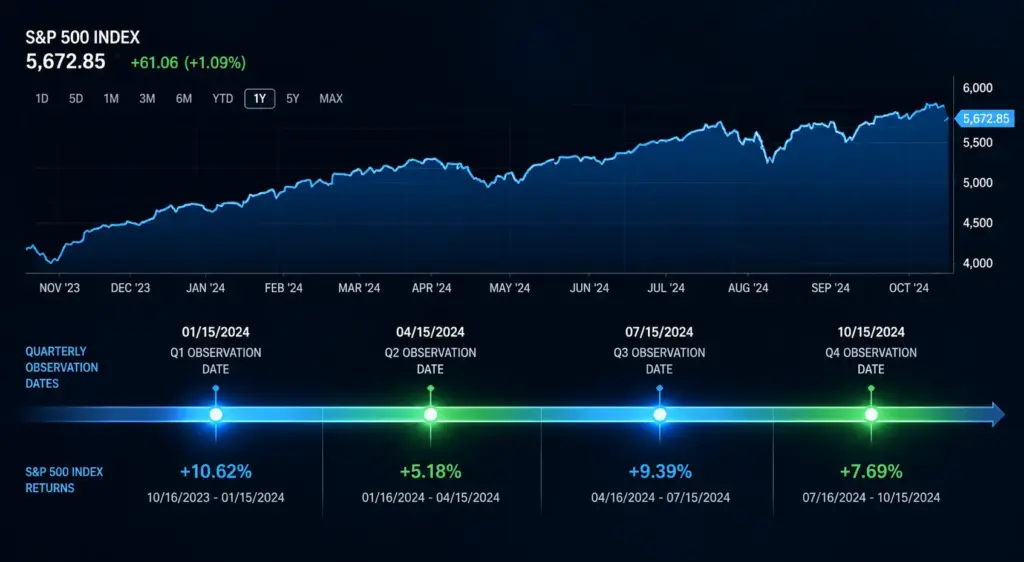
The autocall mechanism operates on a series of observation dates — often quarterly, semi-annually, or annually — over the life of the product. On each observation date, the performance of the underlying asset is measured against a pre-set level called the autocall barrier.
Here is a simplified example:
- An autocall note is linked to a major equity index.
- The product has a 3-year maturity with quarterly observation dates.

- The autocall barrier is set at 100% of the initial level (i.e., the index must be at or above where it started).
- If on the first observation date (say, month 3) the index is at or above the autocall barrier, the product is immediately redeemed.
- The investor receives 100% of their original capital plus a quarterly coupon — for example, 3%.
- If the index is below the barrier on that date, the product continues to the next observation date, and the process repeats.
This structure means an investor could receive their money back in as little as three months, or the product could run its full term if the underlying asset underperforms throughout.
What Is an Autocall Barrier and Why Does It Matter?
The autocall barrier is the price level that the underlying asset must reach or exceed on an observation date for early redemption to be triggered. It is one of the most critical terms to understand before investing.
Barriers are typically expressed as a percentage of the initial fixing price — the price of the underlying asset recorded at the product’s start date.
Common barrier structures include:
- 100% barrier: The asset must return to its starting level for the product to be called. This is the most common structure.
- Sub-100% barrier (e.g., 90% or 95%): The product can be called even if the underlying asset has declined slightly from its starting point. This makes early redemption easier to trigger and is generally more favourable to investors.
- Step-down barriers: The barrier level decreases on each observation date. For example, it might start at 100% and drop to 95% by year two and 90% by year three. This progressively increases the chance of early redemption as time passes.
Investors considering structured notes as part of a broader wealth management and structured notes strategy should pay close attention to barrier levels when comparing products, as they significantly affect the probability of a positive early exit.
What Happens If the Product Is NOT Called Early?
If the underlying asset never crosses the autocall barrier on any observation date, the product runs to its full maturity. At maturity, the outcome depends on whether a capital protection feature or a knock-in barrier has been included:
- With full capital protection: The investor receives 100% of their original capital back at maturity, regardless of how the underlying performed.
- With a knock-in (or capital-at-risk) barrier: If the underlying asset has fallen below a certain level (e.g., 60% of its starting price) at any point during the product’s life, the investor may receive back only the reduced value of the underlying — meaning they can lose a portion of their principal.
This is why it is important for investors to read the full product term sheet and understand both the upside features (the autocall trigger) and the downside risks (the knock-in barrier). These are two separate mechanisms within the same product, and both matter.
What Are the Benefits of Early Redemption for Investors?
Early redemption is not just a mechanical feature — it delivers several practical advantages for investors who understand how to use it:
- Capital returned sooner than expected If markets perform well early in the product’s life, investors can have their capital returned — with a positive return — well before the scheduled maturity. This frees up capital to redeploy into other opportunities.
- Certainty of outcome Unlike holding equities directly, autocallable products offer defined returns. The investor knows exactly what they will receive if the product is called — there is no guesswork about dividends or market valuation.
- Regular income potential Many autocall products accumulate coupons during the holding period. If the product is called after two quarters, the investor receives two quarters’ worth of coupon payments along with their principal — a clean and predictable income.
- Lower effective holding period risk The earlier a product is called, the shorter the period during which the investor’s capital is exposed to market movements. A product called in month six carries significantly less time-based risk than one that runs to full three-year maturity.
Ready to Explore Structured Products?
Discover how structured notes can work for your portfolio PhillipCapital DIFC offers tailored structured note solutions for both retail and institutional investors in the UAE.
What Are the Risks Investors Should Understand?
While early redemption features add an attractive dimension to autocallable products, investors must be equally clear on the risks:
Reinvestment risk When a product is called early, the investor must find a new home for their returned capital. If market conditions have changed, they may not find a product with comparable terms or return potential.
The product may never be called If the underlying asset underperforms across all observation dates, the investor holds the product to maturity. Depending on the knock-in structure, this could result in a loss of principal if the underlying has dropped significantly.
Liquidity constraints Most autocallable structured products are not easily traded on a secondary market. Once capital is committed, investors should treat it as locked in until either the autocall is triggered or the product matures.
Issuer credit risk The product’s performance guarantees are backed by the issuer. If the issuer faces financial difficulties, the investor’s returns — and potentially their capital — could be at risk. This is why assessing the creditworthiness of the issuing institution matters.
Investors exploring fixed-income alternatives should also understand how bonds and debentures compare in terms of credit risk and income certainty, as they sit within a similar yield-seeking segment of the investment universe.
Are There Different Types of Early Redemption Features?
Yes. Not all autocallable products use the same early redemption structure. Here are the most common variations investors will encounter:
Standard Autocall The product is called as soon as the underlying crosses the barrier on any observation date. The return is fixed and does not accumulate across missed observation dates.
Memory Autocall (Snowball) If the coupon is not paid on a missed observation date (because the barrier was not breached), the unpaid coupon is remembered and added to the next successful call payment. This means investors can receive a larger accumulated coupon if the product is called later in its life.
Phoenix Autocall This version separates the coupon payment from the autocall trigger. The coupon can be paid independently of whether the product is called — as long as the underlying is above a separate (often lower) coupon barrier. This provides more regular income even when the autocall is not triggered.
Step-Down Autocall As described earlier, the autocall barrier decreases over time, giving the product progressively higher chances of being called as maturity approaches.
Each structure suits different investor profiles and market outlooks. Understanding the structured products basics is a useful starting point before comparing these variants in detail.
Speak to a Structured Products Specialist
Get guidance tailored to your investment goals Our team at PhillipCapital DIFC is available to walk you through autocallable product options and help you find the right fit.
Conclusion & Key Takeaways
Early redemption is one of the defining features of autocallable structured products — and one of the most investor-friendly when markets cooperate. Rather than being a complex technicality, it is essentially a built-in reward mechanism: if the underlying performs, investors get their capital back early with a defined gain.
However, like every financial instrument, autocallable products come with conditions that must be fully understood before investing. The relationship between the autocall barrier, the knock-in barrier, and the coupon structure determines both the upside potential and the downside risk.
Key Takeaways:
- An autocall is triggered automatically when the underlying asset meets or exceeds a set barrier on an observation date.
- Early redemption means the investor receives capital plus a defined return before the scheduled maturity.
- Autocall barriers can be set at, above, or below the initial price level — and step-down structures increase call probability over time.
- If never called, the product runs to maturity, where capital protection or knock-in features determine the final return.
- Memory, Phoenix, and Step-Down autocalls offer different trade-offs between call probability, income frequency, and return accumulation.
- Always consider issuer credit risk, liquidity constraints, and reinvestment risk alongside the potential upside.
For investors in the UAE seeking income-generating, capital-aware investment structures, autocallable products represent a compelling option — provided the terms are clearly understood and the product is selected to match individual risk tolerance and investment horizon.
Frequently Asked Questions (FAQs)
No — early redemption is a positive event. When the autocall triggers, you receive your full principal back plus the agreed coupon. Capital loss only becomes a risk if the product runs to maturity and the underlying asset has breached the knock-in (downside) barrier. Early redemption and capital loss are two separate outcomes governed by completely different conditions within the same product.
The product continues until its scheduled maturity date. At that point, if the underlying asset stayed above the knock-in barrier throughout the term, you get your capital back in full — though without any coupon in some structures. If the underlying fell below the knock-in barrier at any point, your repayment is reduced in line with the asset’s decline. This is the key risk of holding an autocallable product to maturity.
Yes — and this is the main trade-off. Once the product is called, your participation ends. If the underlying asset continues to rise significantly after the call, you don’t benefit from those further gains. However, you do receive a defined, pre-agreed return that was clear from day one. For investors who prioritise certainty over maximum upside, this is an acceptable trade-off.
Neither. The autocall is triggered automatically by the product’s built-in rules. On each observation date, the underlying asset’s price is checked against the autocall barrier. If the condition is met, the product redeems — no decision required from you or the issuer. This is what makes it an autocall. The only discretionary early exit alternative is an issuer call, which is far less common and works differently.
Disclaimer:
Trading foreign exchange and/or contracts for difference on margin carries a high level of risk, and may not be suitable for all investors as you could sustain losses in excess of deposits. The products are intended for retail, professional and eligible counterparty clients. Before deciding to trade any products offered by PhillipCapital (DIFC) Private Limited you should carefully consider your objectives, financial situation, needs and level of experience. You should be aware of all the risks associated with trading on margin. The content of the Website must not be construed as personal advice. For retail, professional and eligible counterparty clients. Before deciding to trade any products offered by PhillipCapital (DIFC) Private Limited you should carefully consider your objectives, financial situation, needs and level of experience. You should be aware of all the risks associated with trading on margin.
Rolling Spot Contracts and CFDs are complex instruments and come with a high risk of losing money rapidly due to leverage. 78% of our retail client accounts lose money while trading with us. You should consider whether you understand how Rolling Spot Contracts and CFDs work, and whether you can afford to take the high risk of losing your money.
Coupon Payments in Autocalls
Coupon Payments in Autocalls Table of Contents Introduction What Is...
Read MoreObservation Dates
Observation Dates Introduction If you have ever explored structured products...
Read MoreAutocall Mechanics
Autocall Mechanics Introduction If you’ve come across the term “autocallable...
Read MoreAutocallable Structures
Autocallable Structure Table of Contents Introduction What Is an Autocallable...
Read MoreKnock-In and Knock-Out Features
Knock-In and Knock-Out Features Table of Contents Introduction What Are...
Read MoreParticipation Structures in Structured Products

Participation Structures Maximizing Market Opportunities: A Guide to Participation Structures...
Read MoreZero Capital Protection
Zero Capital Protection Understanding Zero Capital Protection: Risks, Rewards, and...
Read MoreFull Capital Protection

Full Capital Protection Understanding Full Capital Protection in Structured Products:...
Read MorePartial Capital Protection

Partial Capital Protection Partial Capital Protection: The Strategic Bridge Between...
Read MoreCapital Protection Structures

Capital Protection Structures Strategic Wealth Preservation: A Comprehensive Guide to...
Read MoreHow Structured Products Work

How Structured Products Work A Complete Guide for Investors Table...
Read MoreComponents of Structured Products

Components of Structured Products A Detailed Guide for UAE Investors...
Read MoreIntroduction to Structured Products

Introduction to Structured Products In today’s dynamic financial landscape, traditional...
Read More