Contingent Conversion Features

Financial analyst reviewing structured product documents on dual monitors inside a glass-walled Dubai DIFC office during golden hour, with market charts and barrier levels displayed on screens.

Introduction

Structured products have evolved considerably over the years, and autocallable notes are now among the most widely used instruments in wealth management portfolios globally — including across the UAE and wider Gulf region. But within these products lies a feature that often goes underexplained: the contingent conversion feature.

If you’ve been exploring structured notes and wealth management solutions, understanding contingent conversion is essential. It directly affects how your investment behaves, what return you can expect, and — critically — what risk you actually carry.

What Is a Contingent Conversion Feature?

A contingent conversion feature is a built-in mechanism inside certain structured products — particularly autocallable notes — that converts the product’s payout from cash (or a fixed return) into shares of the underlying asset if a specific negative event occurs.

The word “contingent” is key here. The conversion does not happen automatically or on a set date. It is triggered only if certain conditions are met — most commonly, if the price of the underlying asset (a stock, an index, or a basket of equities) falls below a pre-defined threshold known as the barrier level.

Think of it as a conditional outcome. Under normal market conditions, the investor simply receives the agreed coupon payment and their capital back. But if the market turns sharply negative, the “contingency” kicks in — and the investor ends up receiving shares instead of cash.

This feature is common in products sometimes called Reverse Convertibles or Barrier Reverse Convertibles, which sit within the broader autocallable structured product family. If you’re new to this space, it’s worth first reviewing the types of structured products to understand where autocallables fit in the broader landscape.

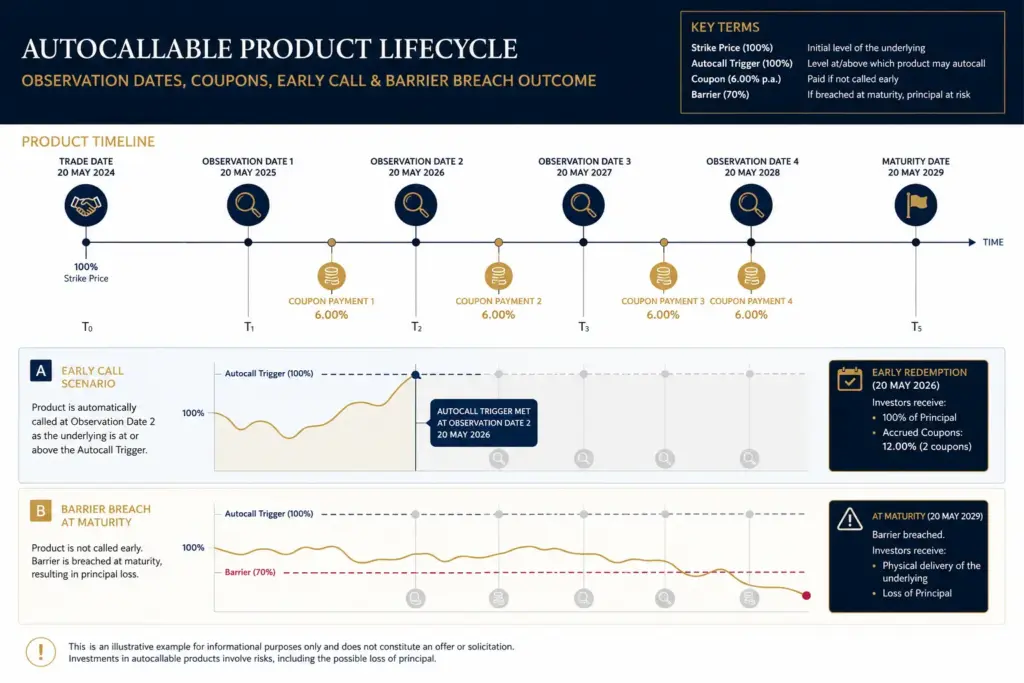
Ultrarealistic financial infographic illustrating an autocallable product lifecycle with observation dates, coupon payments, early redemption scenario, and barrier breach outcome at maturity in a dark navy and gold professional investment design.

How Does It Work Inside an Autocallable Product?

Autocallable products are designed to be redeemed early — automatically — if the underlying asset performs well enough on a scheduled observation date. Investors receive an attractive coupon in exchange for accepting certain downside conditions. The contingent conversion feature is one of those downside conditions.

Here’s a simplified flow:

  • At launch: The investor puts in capital. A barrier level is set (e.g., 60% of the initial asset price). A coupon is agreed (e.g., 10% per annum).
  • Observation dates: If the underlying asset is above the autocall trigger (e.g., 100% of initial price), the product is called early and the investor is paid capital plus coupon.
  • At maturity (if not called early): If the asset stayed above the barrier throughout, capital is returned with final coupon.
  • Barrier breach scenario: If the asset closes below the barrier at maturity, the contingent conversion activates — the investor receives shares of the underlying asset (or cash equivalent at a depressed price) rather than their original capital.

This structure is closely tied to how derivatives basics work, particularly the use of put options embedded within the note that transfer downside risk from the issuer to the investor.

What Is a Conversion Barrier and Why Does It Matter?

The conversion barrier is the price level of the underlying asset that, if breached, triggers the contingent conversion. It is usually expressed as a percentage of the asset’s initial price at the time the product is issued.

Common barrier levels include:

  • 50% barrier — conversion is triggered only if the asset loses more than half its value
  • 60% barrier — triggered if the asset drops more than 40%
  • 70% barrier — triggered on a drop of more than 30%

A lower barrier offers more protection because the asset has to fall further before conversion is triggered. A higher barrier increases risk since less of a market decline is needed to activate it.

The barrier type also matters. There are two main variations:

  • European barrier: Only the asset’s closing price on maturity date matters. The asset can briefly fall below the barrier during the product’s life without triggering conversion, as long as it recovers by maturity.
  • American (or continuous) barrier: If the asset touches or falls below the barrier at any point during the product’s life, conversion is triggered — even if the asset later recovers.

This distinction is critically important and should be understood before investing. Products linked to global equities or indices — including those accessible through global equity trading in Dubai — can experience significant intra-period volatility that affects American barrier products differently.

What Happens When the Barrier Is Breached?

When a contingent conversion is activated (i.e., the barrier has been breached and the product reaches maturity without the asset recovering), the investor no longer receives their original cash investment back. Instead, one of two things typically happens:

  1. Physical delivery of shares: The investor receives a predetermined number of shares in the underlying stock, calculated at the initial (higher) price. Since the stock is now worth less, the investor holds shares at a mark-to-market loss.
  2. Cash settlement at current market value: Some products settle in cash but at the current (lower) price of the underlying, meaning the investor absorbs the loss in value directly.

In both cases, the investor has effectively borne the full downside of the underlying asset’s decline beyond the barrier — offset only by the coupon income received during the product’s life.

For example: If you invested $100,000 and the underlying stock falls 50% below the barrier by maturity, you may receive shares worth $50,000 (or equivalent cash). The coupon received (say 8–10% annually) partially offsets this, but the capital loss can still be significant.

Understanding this outcome is why reviewing bond duration and risk principles — even though bonds are different instruments — helps investors think clearly about how duration and capital risk interact in structured products too.

Ready to explore structured notes designed for your risk profile?

PhillipCapital DIFC offers tailored structured product solutions for both retail and institutional investors.

How Is the Conversion Price Determined?

The conversion price is the reference price at which your cash investment is converted into shares. It is fixed at the time the product is issued — typically set at or near the underlying asset’s price on the launch date.

This is what makes the conversion painful during a downturn: you’re receiving shares at a valuation that was set when markets were higher. The number of shares you receive is fixed, but their market value has fallen.

Formula (simplified): Number of shares received = Principal invested ÷ Conversion price

If the conversion price is $50 per share and you invested $10,000, you’d receive 200 shares. If those shares are now worth $25 each, your holding is only worth $5,000 — a 50% loss on principal.

Some products offer a strike discount, where the conversion price is set at a modest discount to the initial price (e.g., 95% of initial price), providing a small additional buffer. This pricing mechanism is deeply connected to how bond pricing and valuation principles apply to hybrid instruments — the coupon rate, embedded option premium, and conversion terms all interact to determine fair value.

What Are the Key Risks Investors Must Understand?

Contingent conversion features carry several distinct risks that investors must evaluate carefully:

  1. Significant capital loss risk If the barrier is breached, capital loss can be substantial — potentially equal to the full decline of the underlying asset beyond the barrier level, minus coupon income received.
  2. Equity-like downside with capped upside Investors accept full downside exposure to the underlying equity while forgoing the unlimited upside potential that direct equity ownership would provide.
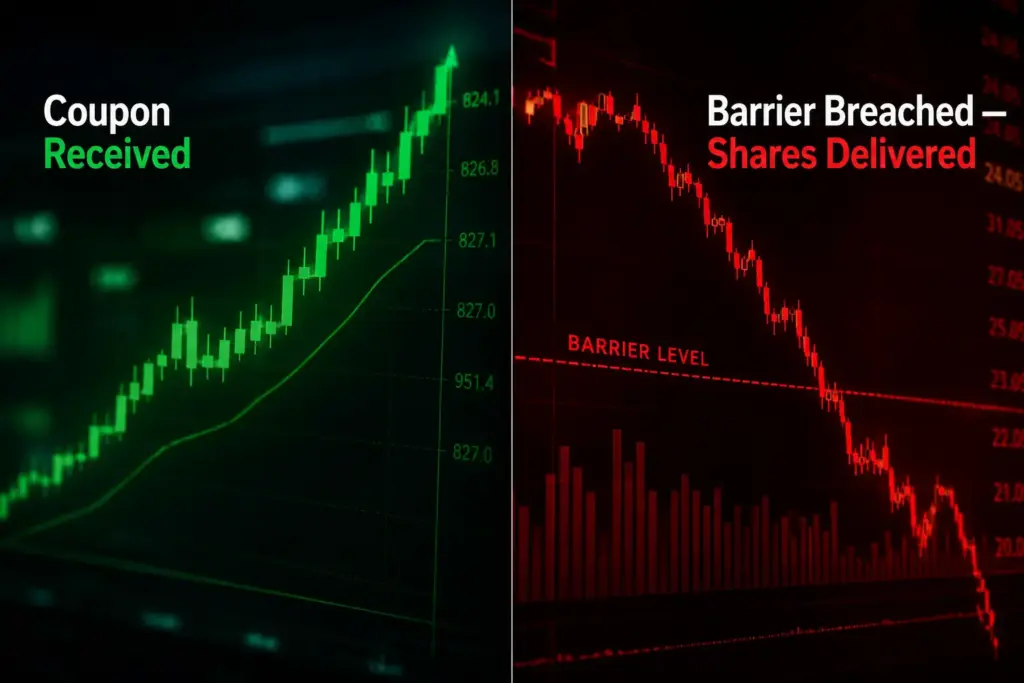
Split-screen financial concept image showing green upward candlestick charts with coupon received on the left side and a red market crash barrier breach with shares delivered on the right side in a dramatic professional investment style.
  1. Concentration risk Products linked to a single stock carry far more risk than those linked to a diversified index. A single company’s poor earnings or sector downturn can be catastrophic for a single-stock reverse convertible.
  2. Liquidity risk Most structured notes are not freely tradeable on exchanges. Exiting early often means selling back to the issuer at a discount, particularly in adverse market conditions.
  3. Credit risk The investor is exposed not only to the underlying asset but also to the creditworthiness of the product issuer. If the issuer defaults, the investor may lose their principal regardless of the underlying performance.

Investors with experience in futures and options trading in UAE will recognize that the embedded put option inside these products is what transfers downside risk — the investor effectively sells a put option to receive the coupon income premium.

Who Should Consider Products With This Feature?

Contingent conversion products are not suitable for every investor. They are generally appropriate for:

  • Investors with a neutral-to-moderately bullish market view who believe the underlying asset will not fall dramatically over the product’s life
  • Income-seeking investors willing to accept some equity-like downside risk in exchange for above-market coupon payments
  • Investors who are comfortable holding shares in the underlying company or index if conversion occurs — meaning they’d be content owning those shares at that price
  • Experienced investors who understand derivatives, barrier mechanics, and the risks of capital loss

They are generally not appropriate for investors who require capital preservation, have short investment time horizons, or who have limited experience with derivative-linked instruments.

For investors building a diversified portfolio, these products work best as a tactical allocation alongside core holdings in global equities, bonds, and other asset classes — not as a standalone strategy.

Speak With Our Structured Products Team

Our specialists can walk you through autocall coupon structures that fit your investment objectives.

Conclusion & Key Takeaways

Contingent conversion features add a layer of sophistication — and risk — to autocallable structured products. When markets perform as expected, investors benefit from attractive coupon income and capital protection. When markets fall sharply and the barrier is breached, these products convert from cash-paying instruments into equity exposures, often at a significant capital loss.

Understanding every term in the product documentation — the barrier level, barrier type, conversion price, observation dates, and issuer credit risk — is not optional. It is the foundation of responsible investing in this product category.

Key Takeaways:

  • A contingent conversion is triggered only if the underlying asset falls below a predetermined barrier level
  • European barriers are less risky than American (continuous) barriers, as only the final maturity price matters
  • The conversion price is fixed at issuance; shares are delivered at a higher-than-market reference price when conversion occurs
  • These products suit income-seeking investors with a neutral-to-bullish outlook who are comfortable holding the underlying equity
  • Always assess issuer credit risk, liquidity terms, and underlying asset concentration before investing
  • Structured products should be one component of a diversified, professionally managed portfolio

For investors in the UAE and DIFC region, working with a regulated, experienced broker is essential. PhillipCapital DIFC brings decades of global market expertise and a full suite of investment solutions to help you make informed, confident decisions.

Frequently Asked Questions (FAQs)

Can I lose all my money in an autocallable product with a contingent conversion feature?

Not all of it in most cases — but you can lose a significant portion of your capital. If the underlying asset crashes well below the barrier and never recovers by maturity, you receive shares worth far less than what you invested. The coupon income you earned along the way softens the blow, but it rarely covers a steep capital loss. Treating these products as “safe” because they pay a coupon is one of the most common investor mistakes.

What's the difference between a barrier and a strike in these products?

The barrier is the safety threshold — if the asset stays above it, your capital is protected. The strike (or conversion price) is the reference price used to calculate how many shares you receive if conversion happens. Both are set at launch. You can breach the barrier (bad) while the strike stays fixed — meaning you receive a set number of shares that are now worth less than your original investment.

Is a 60% barrier safer than a 70% barrier?

Yes. A 60% barrier means the underlying asset must fall more than 40% before your capital is at risk — compared to just 30% for a 70% barrier. The tradeoff is that products with lower (safer) barriers typically offer lower coupon rates, since the issuer carries more of the risk. More protection = less income. It’s a deliberate balance, not a flaw.

Does the coupon get paid even if the barrier is breached?

In most structures, yes — the coupon continues to be paid (or is paid at maturity as a lump sum depending on the product terms) regardless of barrier status. However, some products use a conditional coupon structure, where the coupon is only paid on observation dates when the underlying is above a separate coupon barrier. Always read the term sheet carefully, since coupon payment rules vary between products and issuers.

Disclaimer:

Trading foreign exchange and/or contracts for difference on margin carries a high level of risk, and may not be suitable for all investors as you could sustain losses in excess of deposits. The products are intended for retail, professional and eligible counterparty clients. Before deciding to trade any products offered by PhillipCapital (DIFC) Private Limited you should carefully consider your objectives, financial situation, needs and level of experience. You should be aware of all the risks associated with trading on margin. The content of the Website must not be construed as personal advice. For retail, professional and eligible counterparty clients. Before deciding to trade any products offered by PhillipCapital (DIFC) Private Limited you should carefully consider your objectives, financial situation, needs and level of experience. You should be aware of all the risks associated with trading on margin.

Rolling Spot Contracts and CFDs are complex instruments and come with a high risk of losing money rapidly due to leverage. 78% of our retail client accounts lose money while trading with us. You should consider whether you understand how Rolling Spot Contracts and CFDs work, and whether you can afford to take the high risk of losing your money.