
Observation Dates Introduction If you have ever explored structured products...
Read MoreObservation Dates
Introduction
If you have ever explored structured products or autocallable notes, you may have come across the term “observation date” in the product term sheet. It sounds straightforward, but it plays a decisive role in determining when — and how much — you get paid. Whether you are investing for yield enhancement or capital efficiency, understanding observation dates is key to knowing exactly how your product behaves throughout its life.
This guide breaks down everything you need to know about observation dates in autocallable structured products — clearly, simply, and without unnecessary complexity.
Table of Contents
- What Is an Observation Date in a Structured Product?
- How Do Observation Dates Work in Autocallable Products?
- What Happens on an Observation Date?
- How Frequently Do Observation Dates Occur?
- What Is the Difference Between an Observation Date and a Coupon Payment Date?
- What Happens If the Autocall Condition Is Not Met?
- Why Do Observation Dates Matter for Your Investment Decision?
- Conclusion & Key Takeaways

What Is an Observation Date in a Structured Product?
An observation date is a pre-agreed point in time during the life of a structured product when the performance of the underlying asset — typically a stock, index, or basket of assets — is officially checked against a set condition.
Think of it as a scheduled review. On this date, the issuer looks at where the underlying asset is trading relative to its starting level (known as the strike or initial fixing level). Based on that comparison, a specific outcome is triggered — most commonly, an early redemption of the product or continuation to the next observation date.
In the context of autocallable structured notes, observation dates are the engine that drives the autocall mechanism. Without them, there would be no way to determine when the product can be called early and the investor’s capital returned, often with a coupon.
How Do Observation Dates Work in Autocallable Products?
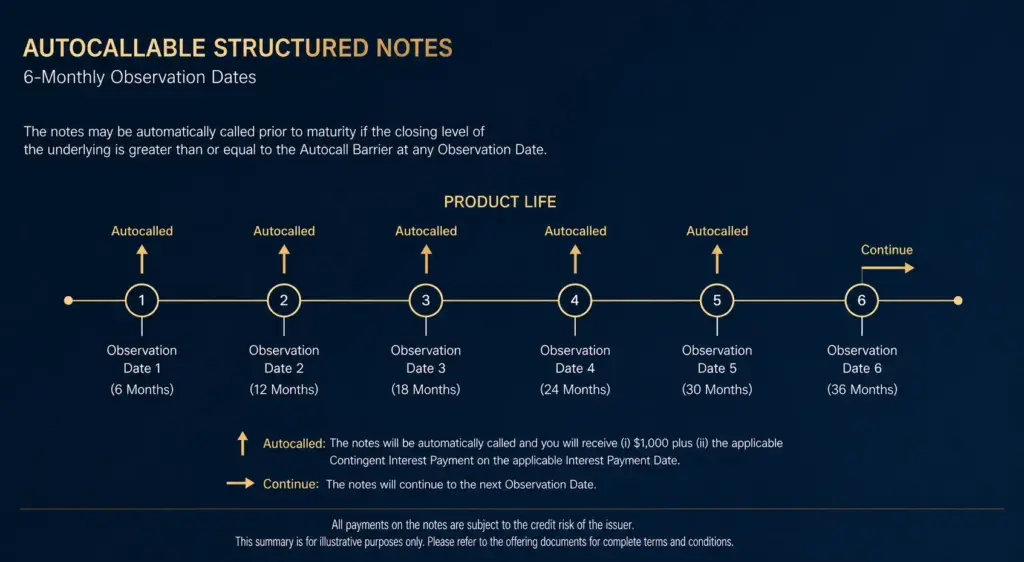
When you invest in an autocallable note, the product term sheet will clearly specify a schedule of observation dates — sometimes monthly, quarterly, semi-annually, or annually. On each date, the closing price of the underlying asset is compared to a pre-set autocall barrier level (for example, 100% of the initial price).
If the underlying asset closes at or above that autocall barrier on the observation date, the product is automatically “called” — meaning it is redeemed early. The investor receives their principal back, plus any accumulated coupon.
If the underlying asset closes below the autocall barrier, the product simply continues to the next observation date, where the same check is repeated.
This structure makes autocallable products quite different from a standard bond or deposit. The investment does not have a guaranteed fixed maturity — instead, its actual maturity depends on market performance, which is assessed at each observation date. Investors who want to explore the broader universe of these products can visit the Types of Structured Products page to understand how autocallables compare to other structures like capital-protected or participation notes.
What Happens on an Observation Date?
On each observation date, one of three scenarios typically plays out:
Scenario 1 — Autocall Is Triggered
The underlying asset is at or above the autocall barrier. The product terminates early. The investor receives 100% of their invested capital plus the agreed coupon (which is usually multiplied by the number of periods elapsed). This is generally the best-case outcome for an autocallable investor.
Scenario 2 — Coupon Is Paid, Product Continues
In products with a “memory coupon” or conditional coupon feature, if the asset is above a coupon barrier (which can be lower than the autocall barrier) but below the autocall barrier, the coupon may still be paid or stored as a memory coupon for future payment. The product continues.
Scenario 3 — No Autocall, No Coupon
If the asset falls below the coupon barrier, no coupon is paid for that period (though memory coupon products may store it for future recovery). The product continues to the next observation date.
How Frequently Do Observation Dates Occur?
The frequency of observation dates varies by product design. Common structures include:
- Monthly observation dates — more frequent opportunities for early redemption; typically seen in shorter-duration products
- Quarterly observation dates — a common balance between frequency and product complexity
- Semi-annual or annual observation dates — longer-dated products with fewer checkpoints; often offer higher potential coupons due to the increased uncertainty
More frequent observation dates generally mean a higher probability of early redemption (if markets are stable or positive), which can reduce the effective duration of your investment. Investors focused on yield management should pay close attention to this feature when comparing products.
If you are new to this space, the Structured Products Basics page offers a clear foundation before diving into product-specific features.
Ready to Explore Structured Notes?
Discover how autocallable products can fit into your portfolio strategy.
What Is the Difference Between an Observation Date and a Coupon Payment Date?
This is one of the most common points of confusion among investors.
An observation date is the date on which the underlying asset’s performance is measured. It is a reference point — the snapshot taken of the market.
A coupon payment date (also called a settlement date) is the date on which the actual cash payment is made to the investor, if a coupon has been earned. This typically falls a few business days after the observation date to allow for settlement processing.

In practice, these two dates are closely linked but are not the same. For example, an observation date might fall on the 15th of the month, while the actual coupon arrives in your account on the 20th, allowing for standard financial settlement procedures.
Understanding this distinction helps investors manage their cash flow expectations accurately.
What Happens If the Autocall Condition Is Never Met?
If the autocall barrier is never breached across all observation dates, the product reaches its final maturity date. At that point, one of the following happens depending on the product’s structure:
Capital Is Fully Returned
If the underlying asset finishes above the capital protection barrier (which in many products is set at a level like 60–70% of the initial price), the investor receives 100% of their principal back, even if no early redemption occurred.
Capital Is At Risk
If the underlying asset has fallen below the capital-at-risk barrier (sometimes called the knock-in barrier) at maturity, the investor may receive a reduced payout — often in the form of the underlying shares or a cash amount equivalent to the actual performance of the asset. This is the primary risk of autocallable products and should be clearly understood before investing.
This is why reading the product’s term sheet carefully — especially the barrier levels tied to each observation date — is so important. PhillipCapital DIFC’s wealth management team provides full transparency on these terms for all structured note products.
Why Do Observation Dates Matter for Your Investment Decision?
Observation dates are not just administrative details — they directly shape your investment experience and potential outcomes. Here is why they deserve careful attention:
They Determine How Long Your Capital Is Locked In
The more observation dates a product has, the more chances exist for early redemption. A product that autocalls on its first observation date effectively becomes a very short-term investment. One that runs to full maturity could keep your capital invested for three to five years.
They Affect Coupon Accumulation
In memory coupon structures, missed coupons are not lost — they are stored and paid out in full the next time the coupon condition is met. This means observation dates create cumulative earning opportunities that reward investors who stay patient through short-term market dips.
They Interact With Volatility
High market volatility can delay autocalls as assets struggle to stay above the autocall barrier. Understanding how many observation dates remain — and the probability of the barrier being breached — is central to evaluating whether an autocallable product suits your market outlook.
For investors also considering other yield-generating instruments alongside structured notes, the Bond & Debentures page offers a useful comparison point.
Speak With a Structured Products Specialist
Get personalized guidance on autocallable notes suited to your financial goals.
Conclusion & Key Takeaways
Observation dates are one of the most important — and most overlooked — features of autocallable structured products. They set the rhythm of the product, determine when early redemption can happen, and define how coupons are earned, stored, or missed. A clear understanding of how they work gives you greater confidence when evaluating any autocallable note.
Key Takeaways:
- An observation date is a scheduled checkpoint when the underlying asset’s performance is compared to the autocall barrier
- If the asset is at or above the barrier on an observation date, the product is redeemed early and the investor receives capital plus coupon
- Observation dates can be monthly, quarterly, semi-annual, or annual — frequency affects both redemption probability and coupon potential
- Observation dates and coupon payment dates are related but distinct — settlement happens a few days after the observation date
- If the product never autocalls, capital protection or loss at maturity depends on the final barrier levels specified in the term sheet
- Memory coupon features allow missed coupons to accumulate and be paid in full at the next qualifying observation date
Before investing in any structured product, always review the full schedule of observation dates, the associated barrier levels, and how they align with your investment timeline and risk tolerance. PhillipCapital DIFC’s team is available to walk you through every feature of our Wealth Management and Structured Notes offerings in detail.
Frequently Asked Questions (FAQs)
Yes — that is actually the whole point of the autocall feature. If the underlying asset closes at or above the autocall barrier on any scheduled observation date, the product is redeemed early and you receive your principal plus the coupon earned. You do not have to wait until final maturity. The earlier the autocall is triggered, the sooner your capital is freed up for reinvestment.
If the underlying asset closes below the autocall barrier on that observation date, no early redemption happens. The product simply moves on to the next observation date. Your capital is not immediately at risk from a single missed observation — the capital protection barrier only becomes relevant at final maturity if the product was never called. This is why observation dates and final maturity barriers are two separate things investors must understand.
It depends on the product structure. Some autocallables pay a conditional coupon as long as the underlying stays above a lower coupon barrier — even if the autocall barrier is not reached. Others use a “memory coupon” feature, where missed coupons are stored and paid out in full the next time the coupon condition is met. Always check whether the product has a coupon barrier separate from the autocall barrier.
Yes, indirectly. More observation dates mean more chances for the product to autocall early, which can reduce the time your capital is exposed to market risk. Fewer observation dates — say, once a year — mean fewer opportunities for early exit, so your investment could run longer if markets stay flat or negative. Products with monthly observations tend to have a higher probability of early redemption in stable markets compared to those with only annual checkpoints.
Disclaimer:
Trading foreign exchange and/or contracts for difference on margin carries a high level of risk, and may not be suitable for all investors as you could sustain losses in excess of deposits. The products are intended for retail, professional and eligible counterparty clients. Before deciding to trade any products offered by PhillipCapital (DIFC) Private Limited you should carefully consider your objectives, financial situation, needs and level of experience. You should be aware of all the risks associated with trading on margin. The content of the Website must not be construed as personal advice. For retail, professional and eligible counterparty clients. Before deciding to trade any products offered by PhillipCapital (DIFC) Private Limited you should carefully consider your objectives, financial situation, needs and level of experience. You should be aware of all the risks associated with trading on margin.
Rolling Spot Contracts and CFDs are complex instruments and come with a high risk of losing money rapidly due to leverage. 78% of our retail client accounts lose money while trading with us. You should consider whether you understand how Rolling Spot Contracts and CFDs work, and whether you can afford to take the high risk of losing your money.
Autocall Mechanics
Autocall Mechanics Introduction If you’ve come across the term “autocallable...
Read MoreAutocallable Structures
Autocallable Structure Table of Contents Introduction What Is an Autocallable...
Read MoreKnock-In and Knock-Out Features
Knock-In and Knock-Out Features Table of Contents Introduction What Are...
Read MoreParticipation Structures in Structured Products
Participation Structures Maximizing Market Opportunities: A Guide to Participation Structures...
Read MoreZero Capital Protection
Zero Capital Protection Understanding Zero Capital Protection: Risks, Rewards, and...
Read MoreFull Capital Protection

Full Capital Protection Understanding Full Capital Protection in Structured Products:...
Read MorePartial Capital Protection

Partial Capital Protection Partial Capital Protection: The Strategic Bridge Between...
Read MoreCapital Protection Structures

Capital Protection Structures Strategic Wealth Preservation: A Comprehensive Guide to...
Read MoreHow Structured Products Work

How Structured Products Work A Complete Guide for Investors Table...
Read MoreComponents of Structured Products

Components of Structured Products A Detailed Guide for UAE Investors...
Read MoreIntroduction to Structured Products

Introduction to Structured Products In today’s dynamic financial landscape, traditional...
Read More