Trading Strategies

Support Resistance Bounce thumbnail

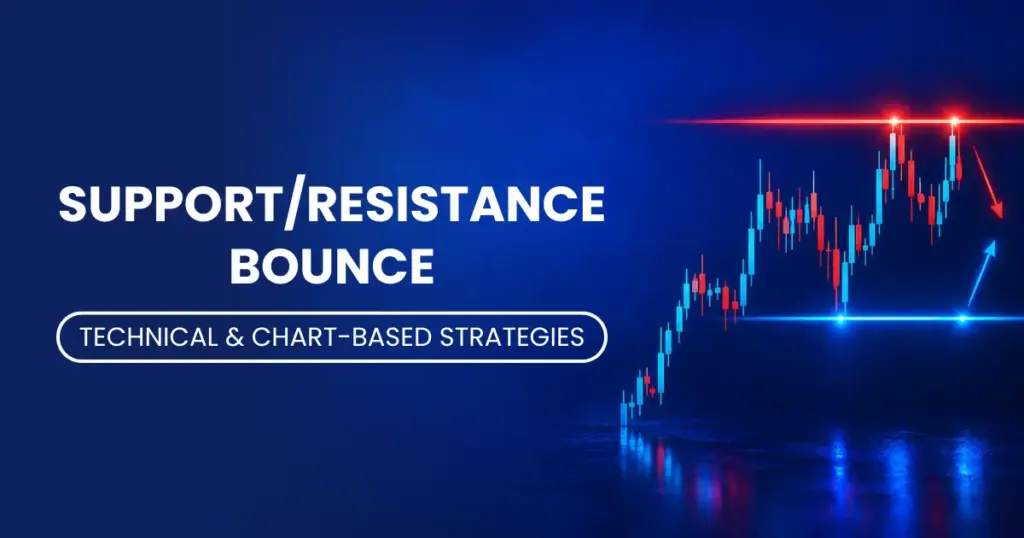
Support-Resistance Bounce

Support/Resistance Bounce Table of Contents Introduction What Is Support and Resistance in Trading? What Is a Support/Resistance Bounce? Why Do Prices Bounce at These Levels? How to Identify a Valid Bounce Setup on a Chart How Do You Enter and Exit a Bounce Trade? What Are the Risks and How Do You Manage Them? Conclusion & Key Takeaways Introduction Every price chart tells a story — and at the heart of that story are price levels where the market repeatedly pauses, reverses, or accelerates. These are support and resistance levels, and the strategy of trading a bounce off these levels is one of the most widely used approaches in technical analysis. Whether you trade global equities, forex pairs, or commodities, understanding how prices behave at these key zones can sharpen your timing, improve your entries, and reduce costly guesswork. This guide breaks down the support/resistance bounce strategy in plain language — explaining what it is, why it works, and how to apply it with discipline. What Is Support and Resistance in Trading? Support is a price level where a falling asset tends to pause or reverse upward. Think of it as a floor — buyers step in at this price, creating enough demand to stop further decline. Resistance is the opposite: a price ceiling where a rising asset tends to stall or pull back. At resistance, sellers become more active, outweighing buying pressure and capping the advance. These levels are not random. They form because of market memory — traders remember where prices reversed in the past and expect similar behavior in the future. Over time, this collective expectation becomes self-reinforcing. The more times a level holds, the more significant and reliable it becomes. Support and resistance levels appear across all asset classes and all timeframes — from a 5-minute forex chart to a monthly equities chart. They are the foundational building blocks of technical chart analysis and are used by retail traders, institutional desks, and algorithmic systems alike What Is a Support/Resistance Bounce? A support/resistance bounce is a trading strategy that seeks to profit from predictable price reversals at established support or resistance levels. In a support bounce, the price falls toward a known support zone, shows signs of slowing down (often with a reversal candlestick pattern), and then moves back upward. A trader enters a long (buy) position anticipating this upward reversal. In a resistance bounce, the price rises toward a known resistance zone, loses momentum, and turns lower. A trader enters a short (sell) position expecting the price to retreat. The logic is straightforward: if a price level has held multiple times in the past, there is a reasonable probability it will hold again. The bounce strategy is built on this probability — not certainty, but repeatable, testable behavior. This approach is particularly popular among traders who deal in CFDs and Spot FX, where short-term price swings offer frequent opportunities to apply bounce setups across currency pairs, indices, and commodities. Why Do Prices Bounce at These Levels? Understanding the why behind a bounce makes you a more confident trader — and less likely to abandon a setup at the first sign of volatility. Psychological Price Memory Markets are driven by human decisions. When a price level has previously caused a significant reversal, traders remember it. Buyers who missed the last bounce are ready to buy again. Sellers who lost at resistance will sell again. This collective behavior creates a self-fulfilling dynamic at key levels. Institutional Order Placement Large institutional participants — banks, funds, and asset managers — often place limit orders at historically significant price levels. When price reaches those zones, these large orders absorb selling (at support) or buying (at resistance), creating the bounce. Traders accessing global equity markets or futures markets will often see this effect most clearly around round numbers and multi-month highs and lows. Stop-Loss Clustering Many retail traders set stop-losses just below support or just above resistance. When price approaches these zones, the density of stop orders influences how the market reacts — often sharply, generating the bounce move that technical traders anticipate. Role Reversal Principle In technical analysis, a broken support level often becomes resistance, and a broken resistance level often becomes support. This “flip” creates fresh bounce opportunities when price returns to test the broken level from the other side. How to Identify a Valid Bounce Setup on a Chart Not every touch of a support or resistance level produces a clean bounce. Here’s how to assess whether a setup has genuine quality: Look for Multiple Touches A level that has been tested and held two or more times is far more significant than one that has only been touched once. The more tests a level has survived, the more institutional weight it carries. Confirm on a Higher Timeframe A support level visible on a weekly chart carries much more weight than one drawn on a 15-minute chart. Always check whether your setup aligns with higher timeframe structure — this dramatically improves the odds of a clean bounce. Watch for Reversal Candlestick Signals When price reaches a support or resistance zone, look for confirming candlestick patterns such as a pin bar (long wick rejecting the level), an engulfing candle, or a doji with follow-through. These patterns signal that the market has tested the level and rejected it — the core ingredient of a bounce trade. Assess the Approach — Gradual vs. Sharp A price that gradually drifts into support after a controlled pullback is more likely to bounce cleanly than one arriving after a near-vertical, panic-driven drop. The manner in which price arrives at the level matters. Use Volume as a Filter At genuine support levels, you often see a spike in volume as buyers step in. Declining volume on the approach to resistance followed by a surge on rejection can also validate the setup. Traders using futures and options often monitor volume closely alongside price action to confirm these setups. Trade CFDs Across Global Markets Apply support/resistance bounce

Support-Resistance Bounce Read More »

Breakout Trading thumbnail

Breakout Trading

Breakout Trading Introduction Every experienced trader knows that markets don’t move in a straight line. Prices consolidate, compress, and build pressure — and then, at some point, they break. That moment of breaking out from a defined price range is what breakout traders live for. Breakout trading is one of the most widely used approaches in technical and chart-based analysis. It works across markets — whether you’re trading global equities, forex pairs, commodities, or futures contracts. The core idea is straightforward: when a price breaks beyond a well-established barrier with strong momentum, it often signals the beginning of a powerful directional move. This guide answers the most important questions about breakout trading in a practical, no-jargon way — so whether you’re a retail investor or an active market participant, you walk away with a clear and actionable understanding. Table of Contents What Is Breakout Trading? Why Do Breakouts Happen? What Chart Patterns Are Used in Breakout Trading? How Do You Confirm a Real Breakout vs. a False One? How Do You Set Entry Points in a Breakout Trade? How Should You Manage Risk in Breakout Trading? What Markets Are Best Suited for Breakout Trading? What Are the Common Mistakes Breakout Traders Make? Conclusion & Key Takeaways What Is Breakout Trading? Breakout trading is a strategy where a trader enters a position when the price of an asset moves beyond a clearly defined support or resistance level — on higher-than-average volume and with meaningful momentum. The assumption behind this strategy is that once a strong price barrier is breached, the asset will continue moving in the same direction, often for a sustained period. Think of it like a dam holding back water. As long as the dam holds, the water stays still. But once the dam breaks, the water moves — fast and powerfully. Breakout trading attempts to capture that surge. The levels traders watch most closely include horizontal resistance zones, trendline boundaries, chart pattern boundaries (such as triangles or flags), and round-number psychological levels. Why Do Breakouts Happen? Breakouts are a direct result of a shift in the balance between buyers and sellers in the market. Understanding the reason behind them helps traders make better decisions. Accumulation of orders: Near key price levels, a large number of limit orders (both buy and sell) tend to cluster. When price finally reaches and clears those levels, all those pending orders get triggered simultaneously, causing a rapid price move. News and fundamental catalysts: Earnings announcements, central bank decisions, or macroeconomic data releases often provide the trigger for a breakout. These events shift trader sentiment sharply in one direction. Institutional activity: Large funds and institutions often push prices through resistance levels when entering or exiting major positions. Retail traders tracking CFDs and Spot FX can often observe these footprints through volume spikes accompanying the breakout. Market sentiment: Sometimes a breakout reflects nothing more than a collective change in how the crowd perceives an asset’s value. Momentum feeds momentum. What Chart Patterns Are Used in Breakout Trading? Certain chart formations are particularly well-suited for breakout setups because they visually represent price compression or consolidation before a potential explosive move. Triangles (Ascending, Descending, and Symmetrical) Triangles are among the most reliable breakout patterns. In an ascending triangle, price makes higher lows while resistance stays flat — signalling increasing buying pressure. A breakout above that flat resistance line is the trigger. Descending triangles show the opposite. Symmetrical triangles indicate indecision and often break in the direction of the prevailing trend. Rectangles and Trading Ranges When price bounces repeatedly between two horizontal levels — a ceiling (resistance) and a floor (support) — it forms a rectangle. Breakout traders wait for price to close convincingly outside this range before entering. Flags and Pennants These are short-term continuation patterns. After a strong initial move (the “flagpole”), price consolidates briefly in a tight range before continuing. The breakout from the flag or pennant is the entry trigger. Cup and Handle Common in stocks, this pattern shows a rounded bottom followed by a small consolidation. The breakout above the handle’s resistance is the entry point — often associated with strong upward follow-through. Traders applying these patterns across global stocks and ETFs can use them on daily or weekly charts for higher-probability setups. How Do You Confirm a Real Breakout vs. a False One? This is arguably the most important skill in breakout trading. False breakouts — also called “fakeouts” — are very common. Price briefly moves beyond a level, triggers entries, and then reverses sharply, trapping traders on the wrong side. Volume is the most important confirmation tool. A genuine breakout should be accompanied by a clear surge in trading volume. If volume is weak or average when the price breaks a level, be cautious. High volume indicates genuine participation from the market — not a temporary spike. Wait for a candle close. Many breakout traders require the price candle to close beyond the level — not just pierce it — before entering. This simple filter eliminates a significant number of false signals. Retest confirmation: After a breakout, price often pulls back briefly to “retest” the broken level — which now acts as new support (for an upside breakout) or resistance (for a downside breakout). Entering on this retest is a lower-risk approach than entering at the initial break. Multi-timeframe alignment: If the breakout appears on a daily chart and the weekly chart also shows the same directional momentum, confidence in the trade increases significantly. Traders using Futures & Options need particularly sharp breakout confirmation skills, since leverage amplifies both gains and losses. Trade Global Markets Through a Regulated Dubai Broker Access stocks, CFDs, futures, and forex with professional-grade execution Open a Trading Account How Do You Set Entry Points in a Breakout Trade? Timing your entry correctly is the difference between a profitable breakout trade and buying into a fakeout at the worst possible price. Entry Method 1 – Breakout Entry (Aggressive): Place a buy stop order just above the

Breakout Trading Read More »

Mean Reversion thumbnail

Mean Reversion

Mean Reversion Table of Contents Introduction What Is Mean Reversion in Trading? What Is the Core Idea Behind Mean Reversion? Which Indicators Are Used for Mean Reversion? What Markets Work Best for Mean Reversion? What Are the Key Risks? Conclusion & Key Takeaways Introduction Every trader has watched a stock shoot up 15% in a week — only to fall right back to where it started. Or seen a currency pair collapse on bad news, then quietly recover within days. That “rubber band” effect is not random. It is the principle of mean reversion at work. Mean reversion is one of the most widely used chart-based strategies in professional trading. It does not rely on predicting the future direction of a market — instead, it bets on a simple, observable truth: prices that stray too far from their average tend to come back. Understanding how to identify and trade these setups can give both retail and institutional investors a consistent, rules-based edge. What Is Mean Reversion in Trading? Simply put: if a price moves too far from its “normal” level, it will likely return to that level over time. Every asset — whether a stock, a currency pair, a commodity, or an index — trades around an average price over any given period. That average acts like a gravitational centre. When news, sentiment, or a spike in volume pushes the price far above or below that centre, the market tends to self-correct. This is what traders call mean reversion: the tendency of an asset’s price to move back toward its historical average after an extreme move. The “mean” here refers to the statistical average of prices over a defined lookback period — commonly 20, 50, or 200 days. The further an asset drifts from this average, the stronger the pull back toward it is expected to be. What Is the Core Idea Behind Mean Reversion? The strategy is built on identifying “overextended” price moves — and trading the return journey. When a market is moving normally, its price stays relatively close to its moving average. But extreme moves — triggered by earnings surprises, geopolitical events, or panic selling — can push prices to levels that are statistically unusual. Mean reversion traders look for these extremes and position themselves for the correction. Here is how the logic works in practice: A stock rises 20% in three days with no change in fundamentals → it may be overbought → a mean reversion trader may consider shorting or waiting for a reversal signal. A currency pair drops sharply on a rumour that is later denied → the market overcorrected → a mean reversion trader might look for a long entry near strong support. The strategy works across different time frames. Day traders use it on 5-minute or 15-minute charts. Swing traders apply it over days or weeks. Long-term investors may use it to find entry points in fundamentally strong assets that have temporarily sold off. If you are exploring trading strategies more broadly, understanding both trend-following and mean reversion approaches gives you a more complete toolkit. Which Indicators Are Used for Mean Reversion? The most effective mean reversion traders don’t rely on guesswork — they use specific technical indicators to identify stretched conditions. Bollinger Bands Bollinger Bands plot two standard deviation lines above and below a moving average. When price touches or breaks the upper band, the asset may be overbought. When it touches the lower band, it may be oversold. Mean reversion traders look for price to revert back toward the middle band (the 20-day moving average). Relative Strength Index (RSI) RSI measures the speed and magnitude of recent price moves on a scale of 0 to 100. Readings above 70 suggest overbought conditions; readings below 30 suggest oversold conditions. In a mean reversion context, traders watch for RSI to cross back from extreme territory as a confirmation signal before entering a trade. Moving Average Deviation This measures how far the current price sits from its moving average — usually expressed as a percentage. A stock trading 10–15% above its 50-day moving average, for example, may be a candidate for mean reversion. Some traders combine this with volume data to add conviction. Z-Score Used more by quantitative traders, the Z-score standardises the distance between current price and the mean in terms of standard deviations. A Z-score above +2 or below -2 suggests a significant deviation — and a potential reversion opportunity. No single indicator should be used alone. The strongest mean reversion setups combine multiple signals — for example, RSI below 30 alongside a price touching the lower Bollinger Band and a bullish candlestick pattern. Traders who also understand derivatives basics can use options strategies alongside mean reversion signals to manage downside risk more effectively. Trade CFDs with Precision Tools Apply mean reversion strategies across global markets using leveraged CFDs Explore CFD Trading What Markets Work Best for Mean Reversion? Mean reversion performs best in range-bound markets and with liquid, well-established assets. Equities (Stocks & ETFs) Individual stocks — particularly blue-chip or large-cap stocks — exhibit strong mean reversion tendencies, especially after earnings-driven spikes or macro-driven sell-offs. US stocks, ETFs, and ADRs are among the most liquid and data-rich environments for applying this strategy. ETFs are particularly well-suited because they represent diversified baskets of assets, reducing the chance of a permanent fundamental shift distorting the mean. Forex (Currency Pairs) Currency pairs often revert to mean after sharp, news-driven moves — particularly major pairs like EUR/USD or USD/JPY. Because forex basics involve two economies in a constant balance, temporary dislocations are common. Carry trade unwinds, central bank policy surprises, and geopolitical headlines regularly cause short-lived overextensions that mean reversion traders can exploit. GCC Equities Regional equity markets — including stocks listed on the Dubai Financial Market and Abu Dhabi Securities Exchange — can also show mean reversion patterns, particularly around dividend cycles or quarterly reporting periods. Traders interested in GCC stocks may find this strategy useful for timing entries in quality regional

Mean Reversion Read More »

Momentum Trading thumbnail

Momentum Trading

Momentum Trading Table of Contents What Is Momentum Trading? How Does Momentum Trading Work in Practice? What Are the Key Indicators Used in Momentum Trading? What Markets Are Best Suited for Momentum Trading? What Are the Risks of Momentum Trading? How Do You Build a Simple Momentum Trading Plan? Conclusion & Key Takeaways Introduction Markets rarely move in straight lines — but when a strong trend takes hold, experienced traders know how to make it work in their favour. Momentum trading is one of the most widely used approaches in technical analysis, built on a straightforward idea: assets that have been rising tend to keep rising, and those falling tend to keep falling — at least for a while. Whether you trade global equities, CFDs, or futures, understanding momentum can give you a meaningful edge. This guide breaks down everything you need to know — in plain language — so you can evaluate whether this strategy fits your trading style. What Is Momentum Trading? In physics, momentum means an object in motion stays in motion. In financial markets, the concept works similarly. Momentum trading is a strategy where traders buy assets that are trending upward (or sell/short those trending downward), with the expectation that the trend will continue for a period before reversing. Rather than predicting where a price will go based on company fundamentals, momentum traders focus on where a price is already going, using historical price movement and volume as their guide. It is a core part of technical and chart-based trading strategies, sitting alongside approaches like breakout trading and moving average crossovers. The strategy became widely recognised in the 1990s when academic research confirmed that stocks with strong recent performance tended to outperform over the following months. Today, it is used across stocks, forex, commodities, and derivatives markets globally. How Does Momentum Trading Work in Practice? Suppose a stock has risen 15% over the past three weeks on high volume. A momentum trader does not ask “is this company worth buying at this price?” — they ask “is this uptrend strong enough to continue?” If indicators confirm strength, they enter the trade, ride the trend, and exit when signs of slowdown appear. The typical process looks like this: Identify a trending asset using price action and volume Confirm momentum using technical indicators (see next section) Enter the trade in the direction of the trend Set a stop-loss to protect against sudden reversals Exit when momentum weakens or a reversal signal appears Timing matters greatly. Entering too early — before momentum is confirmed — or too late — after the trend has exhausted itself — can result in poor returns. This is why traders pair momentum signals with disciplined risk management. For traders accessing global equities, momentum opportunities appear frequently on platforms offering US stocks and ETFs and global non-US equities, where diverse market conditions create multiple trend-following opportunities across sectors and geographies. Ready to Trade Global Markets? Access trending stocks, ETFs, and global equities through a regulated broker in Dubai. Explore Global Equities What Are the Key Indicators Used in Momentum Trading? Several technical indicators are specifically designed to measure the speed and strength of price movement. Here are the most commonly used: Relative Strength Index (RSI) RSI measures how quickly prices are moving in one direction. It ranges from 0 to 100. Readings above 70 suggest an asset may be overbought (strong upward momentum), while readings below 30 suggest oversold conditions (downward momentum). Momentum traders often use RSI to confirm that a trend has real strength before entering. Moving Average Convergence Divergence (MACD) MACD compares two moving averages of price to show momentum direction and potential crossovers. When the MACD line crosses above the signal line, it often indicates building upward momentum — a potential buy signal. When it crosses below, the opposite may be true. Rate of Change (ROC) This indicator simply measures how much a price has changed over a set period. A rising ROC confirms accelerating momentum; a falling ROC may suggest the trend is losing steam. Volume Volume is not an oscillator, but it is vital. Strong momentum should be backed by increasing volume. If a price is rising but volume is declining, the trend may be fragile and prone to reversal. Understanding these tools is part of a broader foundation in stock market basics and fundamental analysis, which together help traders make more informed decisions about when momentum signals are reliable. What Markets Are Best Suited for Momentum Trading? Does momentum trading work in all asset classes? Momentum strategies can be applied across virtually every major asset class, but they tend to be most effective in liquid markets with clear, sustained trends. Equities: Individual stocks and sector ETFs are among the best environments for momentum trading. Growth sectors like technology or energy often produce extended trends that momentum traders can capitalise on. Accessing GCC stocks alongside global markets gives traders exposure to region-specific momentum cycles. Futures & Commodities: Commodity markets — oil, gold, agricultural products — frequently exhibit strong directional trends driven by macroeconomic forces. Futures and options trading allows traders to access these momentum-driven opportunities with leverage and precision. CFDs and Spot FX: The forex market runs 24 hours a day and produces momentum cycles tied to central bank decisions, economic data, and geopolitical developments. CFD trading gives traders the ability to go long or short on hundreds of instruments, making it flexible for both upward and downward momentum plays. Trade Momentum Across Asset Classes From CFDs to futures and global equities — all in one place. View Our Trading Products What Are the Risks of Momentum Trading? Is momentum trading as straightforward as it sounds? Momentum trading has real advantages — but it also carries significant risks that every trader must understand before committing capital. Trend Reversals: The biggest risk is entering a trade just as a trend is running out of energy. Markets can reverse sharply, especially around major economic announcements or unexpected news events. Momentum signals

Momentum Trading Read More »

Trend Following Strategy thumbnail

Trend Following Strategy

Trend Following Strategy Introduction Most traders spend years trying to predict where the market will go next. Trend following takes a different and often more practical approach — instead of guessing, you simply observe where the market is already going and move with it. The core idea is straightforward: when prices are consistently rising, you buy. When prices are consistently falling, you sell short. You stay in the trade as long as the trend continues and exit when signs of a reversal appear. It sounds simple, but doing it well requires discipline, the right tools, and a clear understanding of how trends form and end. This guide breaks down trend following in plain language — what it is, how it works, which tools traders use, and how to apply it across different markets. Table of Contents What Is Trend Following? How Do You Identify a Market Trend? What Tools Do Trend Followers Use? How Do You Enter and Exit a Trend Trade? What Markets Work Best for Trend Following? What Are the Risks of Trend Following? Is Trend Following Right for You? Conclusion & Key Takeaways What Is Trend Following? Trend following is a trading approach where you align your trades with the direction the market is already moving. If the market is in an uptrend — meaning prices are making higher highs and higher lows — a trend follower buys and holds until the trend weakens. In a downtrend — where prices are making lower highs and lower lows — a trend follower sells short and profits as prices continue to fall. The philosophy behind this is simple: markets move in trends more often than they reverse. A rising stock, a strengthening currency, or a climbing commodity price tends to keep moving in the same direction for a period of time before it changes course. Trend followers aim to capture that sustained middle portion of the move. It is worth noting that trend following does not try to catch the very bottom or the very top. The goal is to get in once the trend is confirmed, ride the move, and exit before too much of the gains are lost. How Do You Identify a Market Trend? A trend is not just a day or two of price movement. It refers to a sustained directional move over a meaningful period — weeks, months, or even longer. To confirm a trend, traders look at price structure and supporting indicators. Price Structure: In an uptrend, each new high is higher than the last, and each pullback stays above the previous low. In a downtrend, the opposite is true. This pattern of higher highs and higher lows (or lower highs and lower lows) is the most reliable sign of a trend. Trendlines: Drawing a line along the swing lows in an uptrend (or swing highs in a downtrend) helps visualise the trend’s direction and strength. As long as price holds above an upward trendline, the trend is considered intact. Volume: In healthy trends, rising prices are usually supported by increasing volume. A trend that continues with declining volume may be running out of energy. Understanding price structure is a foundational part of stock market basics and applies across equities, commodities, indices, and currency markets alike. What Tools Do Trend Followers Use? Moving Averages Moving averages are among the most widely used tools in trend following. They smooth out price fluctuations and show the average price over a defined period, making the underlying direction much easier to see. The 50-day and 200-day moving averages are particularly popular. When price trades above both, the trend is considered bullish. When price crosses below the 200-day moving average, it often signals a shift to a downtrend. A common signal is the Golden Cross (50-day crosses above the 200-day — bullish) and the Death Cross (50-day crosses below the 200-day — bearish). Trendlines and Channels Trendlines connect successive highs or lows and act as dynamic levels of support or resistance. A price channel adds a parallel line to contain the trend and gives traders a visible range to work within. The ADX Indicator The Average Directional Index (ADX) measures trend strength rather than direction. An ADX reading above 25 typically confirms a strong trend, while readings below 20 suggest a sideways, trendless market where trend following strategies are less effective. How Do You Enter and Exit a Trend Trade? Entry is best taken after the trend is confirmed — not before. Many traders wait for price to pull back slightly toward a moving average or trendline and then enter as price resumes in the trend direction. This approach gives a better entry price and reduces the risk of entering at a peak. Stop-Loss Placement is critical. A stop-loss is typically placed just below the most recent swing low in an uptrend (or above the swing high in a downtrend). If price breaks that level, it signals the trend may be reversing. Exit should be planned in advance. Trend followers commonly exit when price crosses back below a key moving average, when the ADX begins to fall sharply, or when a clear trend reversal pattern appears on the chart. Traders who apply trend following to leveraged instruments like CFDs or futures and options must manage position sizing carefully, as leverage amplifies both gains and losses. Ready to Apply Trend Following in Live Markets? Access equities, CFDs, futures, and forex — all from one regulated platform. Explore CFD Trading What Markets Work Best for Trend Following? Trend following can be applied to virtually any liquid market, but it tends to perform best in markets that experience sustained directional moves. These include: Global Equities: Major stocks and indices often trend for extended periods, especially during bull markets. Traders with access to US stocks and ETFs or global equity markets can apply trend strategies across a wide opportunity set. Commodities and Futures: Energy prices, metals, and agricultural commodities frequently exhibit multi-week and multi-month trends driven by supply-demand dynamics and macroeconomic

Trend Following Strategy Read More »

Dogs of the Dow thumbnail

Dogs of the Dow

The Dogs of the Dow: A Straightforward Dividend Investment Strategy Building a resilient portfolio often requires looking past the daily noise of the market and focusing on established, income-generating assets. For investors seeking a disciplined, systematic approach to the stock market, few methods are as recognized—or as straightforward—as the “Dogs of the Dow” strategy. This approach relies on the stability of household names and the power of high dividend yields to potentially outperform broader market indices over time. Whether you are a retail investor building your retirement nest egg or a professional diversifying your holdings, understanding this strategy can add a valuable tool to your investment arsenal. Table of Contents What is the Dogs of the Dow Strategy? How Do You Implement This Strategy? Why Focus on Blue-Chip Stocks and High Dividends? What are the Risks of this Dividend Strategy? Is the Dogs of the Dow Strategy Right for You? Conclusion: Key Takeaways What is the Dogs of the Dow Strategy? The Dogs of the Dow is a systematic, long-term investment strategy that focuses on maximizing the yield generated by the largest, most stable companies in the U.S. stock market. Originally popularized in the early 1990s, the concept is built entirely around the 30 companies that make up the Dow Jones Industrial Average (DJIA). Instead of trying to predict which of these 30 companies will have the highest stock price growth, the strategy looks at a different metric: the dividend yield. The “Dogs” are simply the 10 stocks out of the 30 that currently offer the highest dividend yield at the end of the calendar year. The core philosophy here is based on mean reversion. The Dow is composed exclusively of blue-chip companies—massive, historically stable corporations with long track records of success. If one of these companies has an unusually high dividend yield, it is often because its stock price has temporarily dropped (since yield moves inversely to stock price). The strategy assumes that these world-class companies will eventually bounce back, meaning investors can lock in a high dividend payout while waiting for the stock price to recover. How Do You Implement This Strategy? One of the primary appeals of this approach is its mechanical simplicity. You do not need to spend hours analyzing balance sheets or predicting macroeconomic trends to execute it. To implement the strategy, an investor takes the following steps on the last trading day of the year: Identify the Targets: Look at the 30 stocks in the Dow Jones Industrial Average and rank them by their current dividend yield. Select the Top 10: Take the 10 companies with the highest yields. Allocate Evenly: Invest an equal dollar amount into each of these 10 stocks. Hold: Keep the portfolio completely untouched for one full year. Refresh: At the end of the next year, repeat the process. Sell the stocks that are no longer in the top 10 yielders and replace them with the new “Dogs,” rebalancing the portfolio so that all 10 positions are equally weighted once again. Executing this strategy requires a reliable brokerage partner. By utilizing comprehensive trading platforms like those offered through Phillip Capital DIFC’s global equities trading services, investors can easily access U.S. markets, manage their portfolios, and ensure their annual rebalancing is executed efficiently without unnecessary friction. Ready to Access Global Equities? Trade the Dow Jones and other international markets with precision. Open an Account Today Why Focus on Blue-Chip Stocks and High Dividends? Focusing exclusively on blue-chip stocks provides a built-in quality filter. The companies listed on the Dow Jones are industry leaders with massive market capitalizations, proven business models, and the financial strength to weather economic downturns. When you combine this quality with high dividend yields, you create a two-fold advantage. First, the dividends provide a tangible, consistent cash return on your investment, regardless of what the stock’s underlying price is doing. This cash can either be withdrawn as income or reinvested to benefit from compounding growth. Second, the high yield acts as a “cushion” during volatile markets. Even if the stock market experiences a flat or slightly down year, the dividends collected from these 10 companies can help offset potential capital losses. For investors managing comprehensive portfolios, integrating a reliable income-generating segment is often a core component of sustainable wealth management. What are the Risks of this Dividend Strategy? While historically popular, no investment strategy is without risk. The most significant vulnerability of the Dogs of the Dow is that a high dividend yield can sometimes be a “value trap.” A company might have a high yield because its underlying business is facing severe, long-lasting structural problems, and the stock price has plummeted for a valid reason. In worst-case scenarios, the company might be forced to cut or suspend its dividend entirely, which immediately undermines the strategy’s goal. Additionally, this strategy is heavily concentrated in certain sectors. Because technology companies traditionally pay lower dividends than sectors like telecommunications, energy, or utilities, the Dogs of the Dow often underweights high-growth tech stocks. In years where growth and technology sectors lead the market rally, this strategy will almost certainly underperform broader indices like the S&P 500. Is the Dogs of the Dow Strategy Right for You? This approach is particularly well-suited for investors who prioritize income, prefer a low-maintenance portfolio, and have a long-term horizon. If you are someone who wants to avoid the stress of active day trading and prefers a systematic, rules-based approach, this strategy offers a disciplined framework. However, it should ideally be just one part of a broader, well-diversified financial plan. Because it limits you to 10 U.S. large-cap value stocks, it lacks exposure to international markets, small-cap companies, and high-growth sectors. Balancing this approach with other asset classes ensures that your overall portfolio remains resilient across different market cycles. Need Personalized Investment Guidance? Let our experts help you build a strategy tailored to your financial goals. Contact Our Desk Conclusion: Key Takeaways The Dogs of the Dow proves that successful investing does not always require

Dogs of the Dow Read More »

Magic formula Greenblatts Strategy thumbnail

Magic Formula (Greenblatt’s Strategy)

Magic Formula Investing A Guide to Greenblatt’s Systematic Strategy Introduction In the complex ecosystem of global equity markets, identifying sustainable value can often feel overwhelming. Investors are constantly bombarded with macroeconomic noise, speculative trends, and shifting market sentiment. To cut through this volatility, rigorous quantitative frameworks have been developed by leading institutional investors. One of the most renowned is Joel Greenblatt’s Magic Formula—a systematic strategy that ranks stocks by high earnings yield and high return on capital, then buys a basket of the top-ranked stocks. Developed by the founder of Gotham Capital, it is a quantitative value approach designed to find good quality businesses at good prices. By relying strictly on financial mathematics rather than human emotion, the strategy provides a disciplined roadmap for capital allocation. Table of Contents What Is Joel Greenblatt’s Magic Formula Strategy? How Does the Magic Formula Rank Stocks? Why Are Earnings Yield and Return on Capital the Key Metrics? What Are the Advantages of This Quantitative Value Approach? Are There Any Limitations or Risks to the Magic Formula? Conclusion What Is Joel Greenblatt’s Magic Formula Strategy? The Magic Formula is a strictly rules-based value investing framework popularized by hedge fund manager Joel Greenblatt. At its core, the strategy attempts to mathematically codify the legendary investment philosophy of Warren Buffett: buying wonderful companies at fair prices. Instead of relying on subjective forecasts or qualitative business analysis, the formula strips away human bias by focusing entirely on historical financial data. It screens a broad universe of publicly traded companies and ranks them based on two distinct factors: the “cheapness” of the stock (Earnings Yield) and the “quality” of the underlying business (Return on Capital). By combining these two rankings, the strategy identifies a condensed list of companies that offer the optimal intersection of low valuation and high operational efficiency. Before applying advanced quantitative methods to your portfolio, it is imperative to have a solid introduction to stock markets and an understanding of how deliverable equities function within a global framework. The Magic Formula assumes the investor has the capacity to directly purchase and hold actual shares, allowing the underlying business fundamentals to reflect in the stock price over time. How Does the Magic Formula Rank Stocks? The mechanical execution of the strategy is what makes it “systematic.” The ranking process follows a strict, repeatable methodology: Establish a Market Cap Threshold: The strategy begins by defining a universe of investable stocks, typically excluding micro-caps by setting a minimum market capitalization (e.g., $100 million or higher) to ensure adequate market liquidity. Exclude Specific Sectors: Financial institutions (banks, insurance companies) and utility companies are removed from the screening process. Their unique capital structures and heavy regulatory environments make the standard formula metrics less relevant. Calculate Earnings Yield: Every remaining company is ranked by its Earnings Yield, from highest (cheapest) to lowest (most expensive). Calculate Return on Capital: The same companies are then ranked by their Return on Capital (ROC), from highest (most efficient) to lowest (least efficient). Combine the Rankings: The two rank numbers for each company are added together. A company that ranks 15th in Earnings Yield and 10th in ROC would have a combined score of 25. Construct the Basket: The strategy buys a diversified basket of the 20 to 30 companies with the lowest combined scores. These positions are typically held for one year before the portfolio is completely re-evaluated and rebalanced. Access Global Markets with Deliverable Equities Execute value strategies confidently with direct access to US markets. Invest in US Stocks & ETFs Why Are Earnings Yield and Return on Capital the Key Metrics? To understand the power of the strategy, investors must look closely at the specific formulas Greenblatt utilizes, which differ slightly from conventional Wall Street metrics. Earnings Yield (EBIT / Enterprise Value): Traditional investors often use the Price-to-Earnings (P/E) ratio to gauge value. The Magic Formula improves upon this by using Earnings Before Interest and Taxes (EBIT) divided by Enterprise Value (EV). Enterprise Value is a more accurate representation of a company’s price tag because it factors in both the company’s debt and its cash reserves. By using EBIT, the formula evaluates the raw operating profitability of the business before the distortions of varying corporate tax rates and debt interest levels. In short, this metric answers the question: How much operating profit am I getting for the total price of buying the entire business? Return on Capital (EBIT / Net Working Capital + Net Fixed Assets): While traditional Return on Equity (ROE) can be artificially inflated by excessive debt, Greenblatt’s Return on Capital (ROC) measures how effectively a company utilizes its tangible operational assets to generate profit. By dividing EBIT by the sum of net working capital and net fixed assets, the formula isolates the core economic engine of the company. A high ROC indicates a company with a strong competitive advantage, capable of growing its operations without requiring massive external capital injections. Relying solely on surface-level ratios can sometimes lead to poor allocation; therefore, confirming these quantitative signals with a thorough intrinsic value calculation ensures you are deeply analyzing the cash flow generation behind the metrics. What Are the Advantages of This Quantitative Value Approach? The primary advantage of the Magic Formula is its elimination of behavioral finance errors. Human investors are notoriously prone to panic during market corrections and greed during euphoric rallies. By adhering to a systematic, mechanical ranking system, investors are forced to buy out-of-favor companies that possess fundamentally sound operations. Additionally, the strategy enforces portfolio diversification by requiring the purchase of a basket of 20 to 30 stocks. This mitigates single-stock risk, ensuring that a single corporate failure does not devastate the overall capital base. The strategy is also time-efficient; rather than spending hundreds of hours reading subjective analyst reports, the data-driven screen provides a targeted list of high-probability investment candidates. Are There Any Limitations or Risks to the Magic Formula? No quantitative strategy is flawless, and the Magic Formula has distinct challenges. The most prominent risk

Magic Formula (Greenblatt’s Strategy) Read More »

Rebalancing Strategy Thumbnail

Rebalancing Strategy

Rebalancing Strategy Mastering Portfolio Rebalancing: A Strategic Approach to Risk Management Maintaining a successful investment portfolio requires more than just picking the right assets; it requires the discipline to manage those assets as market conditions evolve. Over time, market fluctuations can cause your original asset allocation—for instance, a balanced 60% stocks and 40% bonds split—to drift. Without intervention, a bull market in equities could inadvertently increase your risk exposure, leaving you vulnerable to sudden downturns. Portfolio rebalancing is the systematic process of bringing these weights back to their original target. By periodically selling assets that have outperformed and reinvesting in those that have lagged, investors can lock in gains and maintain a consistent risk profile. This guide explores the nuances of rebalancing and how it serves as a cornerstone of institutional-grade wealth management. Table of Contents What is portfolio rebalancing and why is it essential for risk management? How does a big market move affect my target asset allocation? What are the primary methods used to trigger a rebalance? Is rebalancing a form of “selling winners and buying losers”? How often should an investor review their portfolio for adjustments? Conclusion: The Long-Term Value of Disciplined Rebalancing What is portfolio rebalancing and why is it essential for risk management? At its core, portfolio rebalancing is the practice of adjusting the weights of an investment portfolio back to its original desired level of diversification. When you first establish an investment strategy, you select an asset allocation based on your risk tolerance and financial goals. For many, this might be a blend of equities and fixed-income instruments designed to weather different economic cycles. Rebalancing is essential because it prevents “style drift.” If stocks perform exceptionally well, they may eventually account for 80% of your portfolio instead of the intended 60%. While this looks good during a rally, it means your portfolio is now significantly riskier than you intended. By rebalancing, you ensure that your emotional response to market volatility does not override your long-term financial plan. How does a big market move affect my target asset allocation? Large market movements create a divergence between your current portfolio value and your strategic intent. For example, during a significant equity market surge, the value of your stock holdings rises faster than your bonds. This naturally increases your exposure to market volatility. Conversely, during a market crash, your equity portion shrinks, potentially leaving you “under-invested” just when future expected returns might be at their highest. When these moves occur, the internal balance of your strategy is disrupted. Without rebalancing, a portfolio originally designed to be “Moderate” can slowly transform into an “Aggressive” portfolio without the investor realizing it. Rebalancing acts as a corrective mechanism, stripping away the excess risk accumulated during a run-up and redeploying capital into undervalued sectors to preserve the integrity of your sector rotation strategy. Professional Wealth Management Navigate the markets with expert guidance Explore Services What are the primary methods used to trigger a rebalance? Professional investors typically utilize two main strategies to determine when to take action: Time-based rebalancing and Threshold-based rebalancing. Time-based rebalancing involves reviewing the portfolio at set intervals—such as quarterly or annually. Threshold-based rebalancing is triggered when an asset class deviates from its target by a specific percentage (e.g., +/- 5%). If your target for derivatives is 10% and it grows to 15% due to a massive move, a rebalance is triggered regardless of how much time has passed. Many sophisticated investors use a hybrid approach, checking the portfolio on a schedule but only executing trades if the deviation exceeds a certain “drift” limit. This minimizes transaction costs while ensuring the portfolio never strays too far from its risk-adjusted path. Is rebalancing a form of “selling winners and buying losers”? While it may feel counterintuitive to sell an asset that is performing well, rebalancing is not about “punishing” winners. Instead, it is about “harvesting” gains. When you sell a portion of an asset that has run up, you are realizing profits at higher valuations. Reinvesting those proceeds into assets that have lagged—which are often trading at more attractive valuations—is a classic technique often used in dividend growth investing. By selling high and buying low, you are effectively positioning the portfolio to benefit from the eventual “mean reversion” of asset prices. It ensures that you are not over-concentrated in a single sector that might be reaching a peak, thereby protecting your capital from the inevitable market correction. Open Your Global Trading Account Trade across global markets with a DFSA-regulated broker. Open An Account How often should an investor review their portfolio for adjustments? The frequency of rebalancing depends on the investor’s specific goals and the volatility of the assets held. For most retail and professional investors, a semi-annual or annual review is sufficient. This timeframe allows you to account for bond yield vs interest rates fluctuations without incurring excessive costs. However, in years characterized by extreme market volatility, more frequent monitoring may be required. The goal is to find the “sweet spot” where the benefits of risk reduction outweigh the costs of execution. Accessing a wide range of global investment products through a professional platform allows for more seamless transitions between positions. Conclusion: The Long-Term Value of Disciplined Rebalancing Portfolio rebalancing is the unsung hero of a successful long-term investment strategy. It is the mechanism that keeps your financial ship on course, ensuring that your risk exposure remains aligned with your personal or institutional tolerance. By systematically selling assets that have surged and buying those that have lagged, you remove the emotional bias that often leads to poor investment decisions during market extremes. For investors seeking to implement these strategies within the world-class regulatory framework of the Dubai International Financial Centre, partnering with an experienced firm is key. At PhillipCapital DIFC, we provide the tools and expertise necessary to manage complex portfolios with precision and professional oversight. Frequently Asked Questions (FAQs) Does rebalancing mean I am selling my best-performing stocks? Technically, yes, but it is a strategic move

Rebalancing Strategy Read More »

contrarian dip buying Trading Strategy Thumbnail

Contrarian Investing /Dip Buying

Contrarian Investing / Dip buying Mastering the Art of Contrarian Investing: Strategic “Buy the Dip” Opportunities The financial markets are often driven by two powerful emotions: fear and greed. While most investors flock toward assets reaching new highs, seasoned market participants often look in the opposite direction. Contrarian investing—specifically the “buy the dip” approach—is a sophisticated strategy that involves acquiring high-quality assets when their prices have fallen sharply and market sentiment is overwhelmingly negative. This philosophy assumes that markets frequently overreact to short-term news, creating a disconnect between an asset’s intrinsic value and its current market price. At PhillipCapital, we believe that understanding the mechanics of market rebounds is essential for building a resilient, long-term portfolio. This guide explores the depths of contrarianism, providing the clarity needed to distinguish between a temporary setback and a fundamental decline. Table of Contents What defines a true contrarian investment strategy? Why do markets often overreact to negative news cycles? How can investors distinguish between a “dip” and a “falling knife”? What role does fundamental analysis play in buying the dip? How should risk management be structured in a contrarian portfolio? Conclusion: The Path to Disciplined Contrarianism What defines a true contrarian investment strategy? Contrarianism is not merely about being stubborn or “going against the grain” for the sake of it. It is a disciplined investment framework centered on the belief that the crowd is most wrong at the points of maximum optimism and maximum pessimism. A true contrarian seeks out investment opportunities where the consensus view has pushed prices to an extreme that is no longer supported by economic reality. When you “buy the dip,” you are essentially providing liquidity when others are panicking. This requires a deep understanding of global market trends and the patience to wait for the market to correct its own irrationality. The goal is to accumulate positions in robust assets at a discount, positioning the portfolio for significant capital appreciation when the sentiment eventually shifts back toward the mean. Why do markets often overreact to negative news cycles? Behavioral finance teaches us that humans are prone to cognitive biases, such as “loss aversion” and “herding.” When negative news breaks—be it a geopolitical event or a disappointing earnings report—investors often rush to the exits simultaneously. This mass exodus creates a “liquidity vacuum,” driving prices far below what the actual data justifies. For those engaging in professional wealth management, these overreactions are viewed as temporary “noise.” Markets are reflexive; the lower the price goes due to panic, the higher the eventual expected return becomes for the patient investor. By filtering through the noise, one can identify when a price drop is an emotional response rather than a structural change in the asset’s viability. Secure Your Financial Future Explore bespoke strategies tailored to your risk profile View Our Services How can investors distinguish between a “dip” and a “falling knife”? The most significant risk in contrarian investing is the “falling knife”—an asset whose price is dropping because its fundamental value has been permanently impaired. To distinguish a profitable dip from a value trap, investors must look at the “why” behind the move. A healthy dip is typically characterized by a broad market sell-off where even high-quality equities and derivatives are dragged down by macro sentiment. Conversely, a falling knife often involves a specific internal failure, such as a breach of governance or a redundant business model. Utilizing advanced trading platforms can help investors monitor technical support levels and volume indicators to confirm if a floor is being established before committing capital. What role does fundamental analysis play in buying the dip? Without fundamental analysis, buying a falling asset is nothing more than gambling. A contrarian must be able to calculate the “intrinsic value” of an asset. This involves analyzing balance sheets, cash flow stability, and the competitive landscape. If the intrinsic value remains unchanged despite a 20% drop in share price, the “margin of safety” has increased, making it a textbook “buy the dip” candidate. For investors focused on commodities and currencies, this might mean looking at supply-demand imbalances that the market has temporarily ignored. Fundamental strength provides the conviction necessary to hold a position when the rest of the market is still selling, ensuring that the entry is based on data rather than hope. How should risk management be structured in a contrarian portfolio? Buying assets under pressure requires a rigorous risk management protocol. One should never “go all in” at the first sign of a decline. Instead, a “scaling-in” or dollar-cost averaging approach allows the investor to lower their average entry price if the dip continues. Furthermore, diversification remains paramount. Even the most compelling contrarian play can take longer to rebound than anticipated. By maintaining a balanced portfolio through diversified asset classes, investors ensure that their total capital is not held hostage by a single sector’s recovery timeline. Setting “mental stops” or hard stop-losses based on a change in the fundamental thesis—rather than just price—is what separates successful contrarians from those who hold losing positions indefinitely. Partner with PhillipCapital DIFC Leverage our global expertise to navigate volatile markets. Contact Our Experts Conclusion: The Path to Disciplined Contrarianism Contrarian investing and “buying the dip” are powerful tools for capital growth, provided they are executed with clinical precision and emotional detachment. By recognizing that markets often overreact to short-term stimuli, investors can capitalize on the gap between price and value. The key takeaways for any aspiring contrarian include: Distinguish Sentiment from Reality: Look for price drops driven by panic rather than structural decay. Prioritize Quality: Only buy the dip on assets with strong fundamentals and proven resilience. Exercise Patience: Market rebounds rarely happen overnight; a long-term horizon is your greatest ally. Manage Risk: Use scaling-in techniques and maintain diversification to protect against extended volatility. At PhillipCapital, we provide the institutional-grade insights and robust platforms necessary to execute these sophisticated strategies. Whether you are navigating global equities or looking for value in fixed income, a disciplined approach to market dips can

Contrarian Investing /Dip Buying Read More »

Growth at Reasonable Price trading strategy thumbnail

Growth at Reasonable Price (GARP)

Growth at Reasonable Price (GARP) Mastering Growth at Reasonable Price (GARP): A Strategic Approach to Balanced Investing As global markets evolve, investors often find themselves torn between two primary philosophies: the high-octane potential of growth stocks and the disciplined safety of value investing. However, there is a sophisticated middle ground that seeks to capture the best of both worlds. Growth at Reasonable Price, or GARP, is an investment strategy designed to identify companies with consistent earnings growth that are not yet overvalued by the market. Table of Contents What defines the GARP investment philosophy? How does GARP differ from pure Growth and Value strategies? What are the key metrics used to identify GARP stocks? Why is the PEG Ratio considered the “Gold Standard” for GARP? How does GARP help in managing portfolio risk? Conclusion: Achieving Long-Term Wealth with GARP What defines the GARP investment philosophy? Growth at Reasonable Price (GARP) is a disciplined equity selection strategy that prioritizes companies demonstrating sustainable earnings growth while trading at sensible valuations. Unlike pure growth investors, who might ignore high Price-to-Earnings (P/E) ratios in favor of rapid expansion, a GARP investor remains price-sensitive. The goal is to avoid “buying the hype” and instead focus on wealth management and structured notes that emphasize fundamental strength. A true GARP candidate typically exhibits higher-than-average growth compared to the broader market but avoids the astronomical valuations often seen in speculative sectors. By seeking out these “under-the-radar” compounders, investors aim for steady capital appreciation with a lower risk of significant drawdowns when market sentiment shifts. How does GARP differ from pure Growth and Value strategies? To understand GARP, one must view it as the bridge between two extremes. Growth investors look for “the next big thing,” often paying a premium for companies with skyrocketing revenues but little to no current profit. Conversely, value investors look for “bargains”—companies trading below their intrinsic value. GARP sits in the “sweet spot.” It avoids the risks highlighted in a growth investing strategy—where high-risk can lead to high volatility—and bypasses the stagnation often found in pure value traps. This balanced approach is essential for identifying quality over speculation. While a value stock might have a P/E of 8 and a growth stock a P/E of 50, a GARP stock might sit comfortably at a P/E of 20, supported by a healthy 20% earnings growth rate. Optimize Your Portfolio Strategy Explore tailored investment avenues with our expert team in the DIFC. Learn More About Our Services What are the key metrics used to identify GARP stocks? Identifying a GARP stock requires a deep dive into fundamental analysis. Investors do not just look at the current price; they look at the trajectory of the business and the efficiency of its operations. Earnings Per Share (EPS) Growth: GARP investors typically look for companies that have grown their earnings by 10% to 20% consistently. Return on Equity (ROE): High ROE indicates that a company is efficiently using its shareholders’ capital to generate profit. Sustainable Margins: Consistent profit margins suggest a company has a competitive “moat” or advantage. For those focusing on global equities, these metrics serve as essential filters to separate speculative volatility from sustainable growth. Why is the PEG Ratio considered the “Gold Standard” for GARP? The Price/Earnings to Growth (PEG) ratio is the primary tool for any GARP practitioner. It is calculated by dividing a stock’s P/E ratio by its earnings growth rate. A PEG ratio of 1.0 suggests that the stock is perfectly valued relative to its growth. A PEG below 1.0 is often considered a “buy” signal, suggesting the market hasn’t fully priced in the company’s growth potential. By using the PEG ratio, an investor can justify paying a slightly higher P/E for a company that is growing rapidly. This mathematical discipline is a core component of institutional services where precision and valuation are paramount for managing large-scale capital. Ready to Trade Global Markets? Access international exchanges with PhillipCapital’s robust trading infrastructure Open an account How does GARP help in managing portfolio risk? Risk management is perhaps the greatest benefit of the GARP approach. During “bull markets,” GARP stocks participate in the upside because of their strong earnings. However, during “bear markets” or periods of high interest rates, they tend to be more resilient than speculative growth stocks because their valuations are grounded in actual profits. By integrating GARP into a broader trading strategy, investors can reduce “valuation risk” while avoiding the “stagnation risk” of declining industries. It provides a cushion of safety without sacrificing the potential for market-beating returns. Conclusion: Achieving Long-Term Wealth with GARP Growth at Reasonable Price is more than just a set of numbers; it is a mindset of moderation and discipline. By focusing on companies that exhibit solid growth prospects while maintaining reasonable P/E and PEG ratios, investors can build portfolios that are both aggressive in their pursuit of returns and conservative in their valuation requirements. For investors navigating the complexities of the global capital markets from the DIFC, the GARP strategy offers a path to sustainable wealth creation. It filters out the noise of market volatility and focuses on the fundamental truth that, over the long term, stock prices follow earnings—but only if the entry price is right. Frequently Asked Questions (FAQs) Is GARP better than pure Value or Growth investing? GARP isn’t necessarily “better,” but it is more balanced. While growth stocks can skyrocket during bull markets and value stocks offer a safety net during downturns, GARP aims for consistent performance across both cycles. It filters out the extreme volatility of high-priced growth and the “value traps” of declining companies, making it a favorite for long-term investors seeking stability. What is a “good” PEG ratio for a GARP investor? Traditionally, a PEG ratio of 1.0 or lower is the gold standard for GARP. A ratio of 1.0 suggests a stock’s valuation is perfectly in sync with its earnings growth. If the PEG is below 1.0, the stock may be undervalued relative to its potential. However, in

Growth at Reasonable Price (GARP) Read More »