Options Expiration Dates

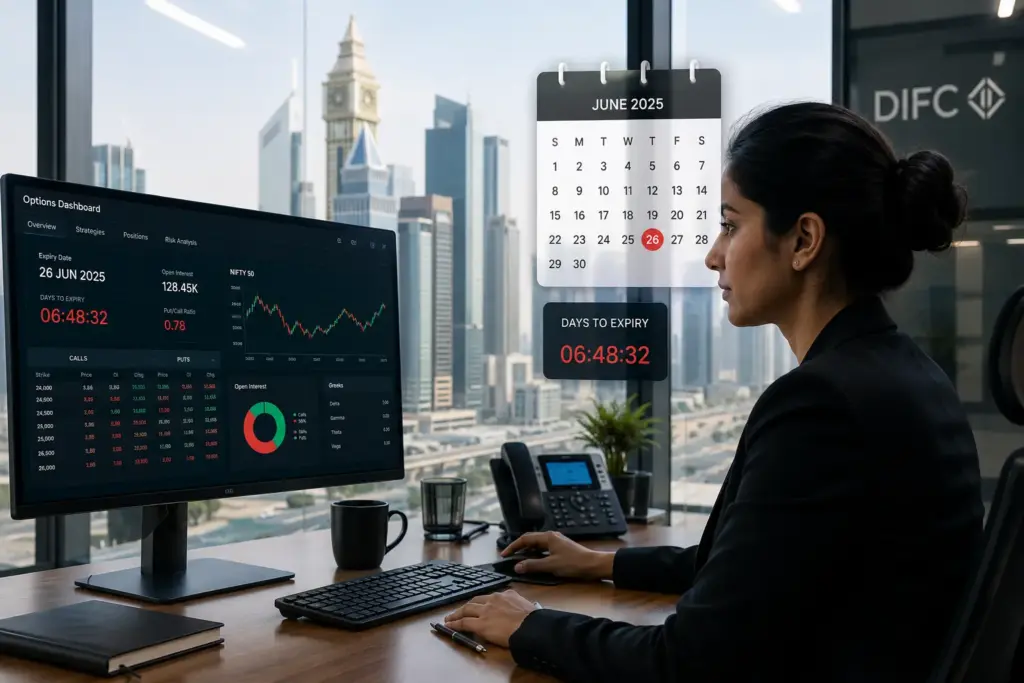
Confident financial analyst reviewing an options trading dashboard with an expiration date countdown timer in a modern Dubai office overlooking the DIFC skyline.

Introduction

Every options contract carries a built-in deadline. Unlike shares, which you can hold indefinitely, an option is a time-bound agreement that eventually stops existing. This deadline, known as the expiration date, is one of the most important — and most misunderstood — parts of options trading. Whether you are just starting to explore options fundamentals or already trading call options and put options, understanding how expiration works can be the difference between a well-timed trade and a costly surprise. This guide breaks down expiration dates in plain language, so you can plan your strategy with confidence.

What Is an Options Expiration Date?

An options expiration date is the final day on which an option contract remains valid. After this date, the contract ceases to exist — it either gets exercised, settled, or simply expires worthless. Every option is tied to a specific underlying asset, a strike price, and this fixed expiry. Think of it like a coupon with a use-by date: the right it grants you to buy or sell the underlying asset only lasts until that date. Once it passes, the coupon has no value, regardless of what happens in the market afterward.

Why Does the Expiration Date Matter So Much?

The expiration date shapes almost every decision an options trader makes. It determines how much time value remains in the contract, how sensitive the price is to market swings, and how urgently a position needs to be managed. A three-month option behaves very differently from a one-week option, even if both share the same strike price and underlying asset. Investors who ignore expiration timelines often misjudge risk, because they focus only on price direction and forget that time itself is working for or against them.

Ready to Trade Global Options?

Access exchange-traded futures and options on major global markets with institutional-grade execution.

What Happens to an Option on Its Expiration Day?

On expiration day, one of three outcomes occurs, depending on whether the option is in-the-money, at-the-money, or out-of-the-money.

In-the-Money Options at Expiration

If a call option’s strike price is below the current market price, or a put option’s strike price is above it, the contract holds intrinsic value. Most brokers automatically exercise these contracts, converting the option into a position in the underlying asset or settling it in cash, depending on the contract type.

Out-of-the-Money Options at Expiration

If the option has no intrinsic value at the close of trading, it simply expires worthless. The holder loses the premium paid, but nothing more — this capped downside is one of the defining features of buying options rather than trading them on margin.

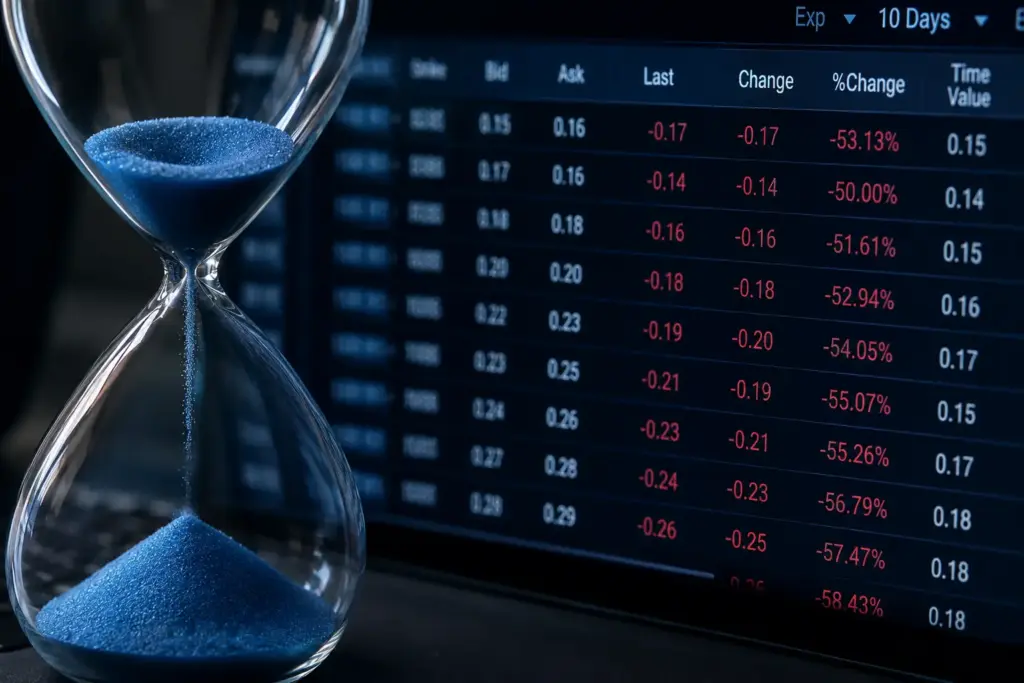
Close-up of an hourglass beside a stock market trading screen showing declining options premium values, symbolizing options time decay (Theta) before expiration.

How Does Time Decay Relate to the Expiration Date?

As an option approaches expiration, its extrinsic value erodes — a phenomenon often called time decay. This decay accelerates in the final weeks and days of a contract’s life, which is why understanding intrinsic value and time value together is essential. Sellers of options often benefit from this decay, while buyers need the underlying asset to move quickly enough to offset the value being lost each day.

What Are the Different Types of Expiration Cycles?

Exchanges typically offer several expiration cycles to suit different trading styles:

  • Weekly expirations — Shorter-term contracts favoured by active traders seeking quick, event-driven moves.
  • Monthly expirations — The traditional cycle, widely used for both hedging and speculation.
  • Quarterly expirations — Aligned with major index and futures contract cycles, popular among institutional investors.
  • LEAPS (long-term options) — Contracts expiring a year or more out, used for longer-term strategic positioning.

Choosing between these cycles often depends on whether you are managing a long or short position in derivatives and how much time you believe your market view needs to play out.

How Should Investors Choose the Right Expiration Date?

There is no single “correct” expiration date — the right choice depends on your strategy, conviction, and risk tolerance. Short-dated options are cheaper but decay faster and require precise timing. Longer-dated options cost more upfront but give your market view more room to develop. Investors should also weigh their exposure using notional value calculations, ensuring position sizes remain appropriate relative to their overall portfolio.

Speak to a DIFC-Based Advisor

Get tailored guidance on structuring your options strategy around the right expiration cycle.

What Common Mistakes Do Investors Make with Expiration Dates?

Many new investors buy options with expiration dates too close to their expected market move, leaving no margin for error if the timing is slightly off. Others hold onto out-of-the-money contracts too long, hoping for a reversal, only to watch time decay erase the remaining value. A disciplined approach means setting a clear exit plan well before the expiration date arrives, rather than reacting under pressure in the final days.

Conclusion: Key Takeaways

Options expiration dates are not just a technical detail — they are central to how an option is priced, managed, and ultimately resolved. Understanding when a contract expires, how time decay accelerates as that date approaches, and how different expiration cycles suit different strategies will help you trade with greater precision.

Key takeaways:

  • Every option has a fixed expiration date after which the contract stops existing.
  • In-the-money options are typically exercised or cash-settled; out-of-the-money options expire worthless.
  • Time decay accelerates as expiration approaches, affecting buyers and sellers differently.
  • Weekly, monthly, quarterly, and long-term (LEAPS) cycles each suit different trading goals.
  • Matching your expiration choice to your market conviction is one of the most important skills in options trading.

At PhillipCapital DIFC, we help investors build informed, well-timed options strategies backed by regulated infrastructure and expert guidance.

Frequently Asked Questions (FAQs)

What happens if I forget about my option's expiration date?

If your option is in-the-money, most brokers will automatically exercise or settle it. If it’s out-of-the-money, it simply expires worthless with no further action needed.

Can I close an options position before expiration?

Yes. Most traders close positions before expiration by selling the contract back on the exchange, rather than waiting to exercise or let it expire.

Do all options expire on the same day of the month?

No. Expiration schedules vary by exchange and contract type, spanning weekly, monthly, quarterly, and longer-term cycles.

Is a longer expiration date always safer?

Not necessarily. Longer-dated options cost more and still carry market risk — they simply give more time for a thesis to play out.

Start Trading with PhillipCapital DIFC

Open a regulated trading account and access global options markets today.

trading account opening uae banner

Disclaimer:

Trading foreign exchange and/or contracts for difference on margin carries a high level of risk, and may not be suitable for all investors as you could sustain losses in excess of deposits. The products are intended for retail, professional and eligible counterparty clients. Before deciding to trade any products offered by PhillipCapital (DIFC) Private Limited you should carefully consider your objectives, financial situation, needs and level of experience. You should be aware of all the risks associated with trading on margin. The content of the Website must not be construed as personal advice. For retail, professional and eligible counterparty clients. Before deciding to trade any products offered by PhillipCapital (DIFC) Private Limited you should carefully consider your objectives, financial situation, needs and level of experience. You should be aware of all the risks associated with trading on margin.

Rolling Spot Contracts and CFDs are complex instruments and come with a high risk of losing money rapidly due to leverage. 78% of our retail client accounts lose money while trading with us. You should consider whether you understand how Rolling Spot Contracts and CFDs work, and whether you can afford to take the high risk of losing your money.