
implied volatility vs historical volatility Introduction Volatility sits at the...
Read MoreOptions Greeks : Delta, Gamma, Theta, Vega
The Greeks: Delta, Gamma, Theta, and Vega Explained for Options Traders
Every option price moves for a reason. Sometimes it is the underlying stock or index shifting a few points. Sometimes it is a week ticking off the calendar. Sometimes the market simply becomes more nervous, and that alone changes what an option is worth. The Greeks are the toolkit that separates these causes from each other, and they turn “why did my option premium change” into a measurable, trackable answer.
This guide walks through the four Greeks that matter most in day-to-day options trading: Delta, Gamma, Theta, and Vega. Each one answers a different question about risk, and together they give a trader a fuller picture of what is actually driving an option’s price. Retail investors exploring exchange traded derivatives for the first time, and professional or institutional desks refining hedges, will find practical explanations, worked examples, and a comparison framework they can apply immediately.
By the end, the goal is not to memorise formulas. It is to understand, intuitively, what each Greek represents, how the four interact, and how investors evaluating call and put positions can use them to size risk more deliberately.
Table of Contents
- What Are the Greeks in Options Trading?
- What Is Delta and How Does It Measure Price Sensitivity?
- What Is Gamma and Why Does It Matter for Delta?
- What Is Theta and How Does Time Decay Affect an Option?
- What Is Vega and How Does Volatility Change Option Value?
- How Do the Four Greeks Interact in a Real Position?
- Delta vs Gamma vs Theta vs Vega: A Side-by-Side Comparison
- What Mistakes Do Traders Commonly Make With the Greeks?
- How Can Investors Use the Greeks for Risk Management?
- Frequently Asked Questions
What Are the Greeks in Options Trading?
The Greeks are a set of risk measures that show how an option’s price is expected to change when one specific factor moves, such as the underlying asset’s price, time, or volatility, while the other factors stay constant. Delta, Gamma, Theta, and Vega are the four most widely used. Each isolates a different driver of an option’s premium.
An option’s price does not move in isolation. It responds to at least four separate forces: the price of the underlying asset, the passage of time, changes in expected volatility, and, less prominently for most retail strategies, shifts in interest rates (captured by a fifth Greek, Rho). Trying to explain an option’s daily price change without separating these forces is a bit like trying to explain why a car is slowing down without knowing whether the driver braked, the road inclined uphill, or a headwind picked up. The Greeks isolate each force so an investor can see which one is actually doing the work.
These figures are generated by options pricing models, most commonly the Black-Scholes model, which uses the underlying price, strike price, time to expiry, volatility, and the risk-free rate to calculate a theoretical option value. The Greeks are essentially the mathematical derivatives of that pricing formula. Investors do not need to calculate them by hand. Most trading platforms display Delta, Gamma, Theta, and Vega alongside the option’s bid and ask price, updated continuously as market conditions shift.
It helps to think of the Greeks less as academic statistics and more as a dashboard. A pilot does not need to understand aerodynamics equation by equation to fly safely, but they do need instruments that show altitude, speed, and fuel level. The Greeks serve the same function for an options position, showing exposure to price direction, the rate of change in that exposure, the daily cost of holding the position, and sensitivity to market sentiment.
What Is Delta and How Does It Measure Price Sensitivity?
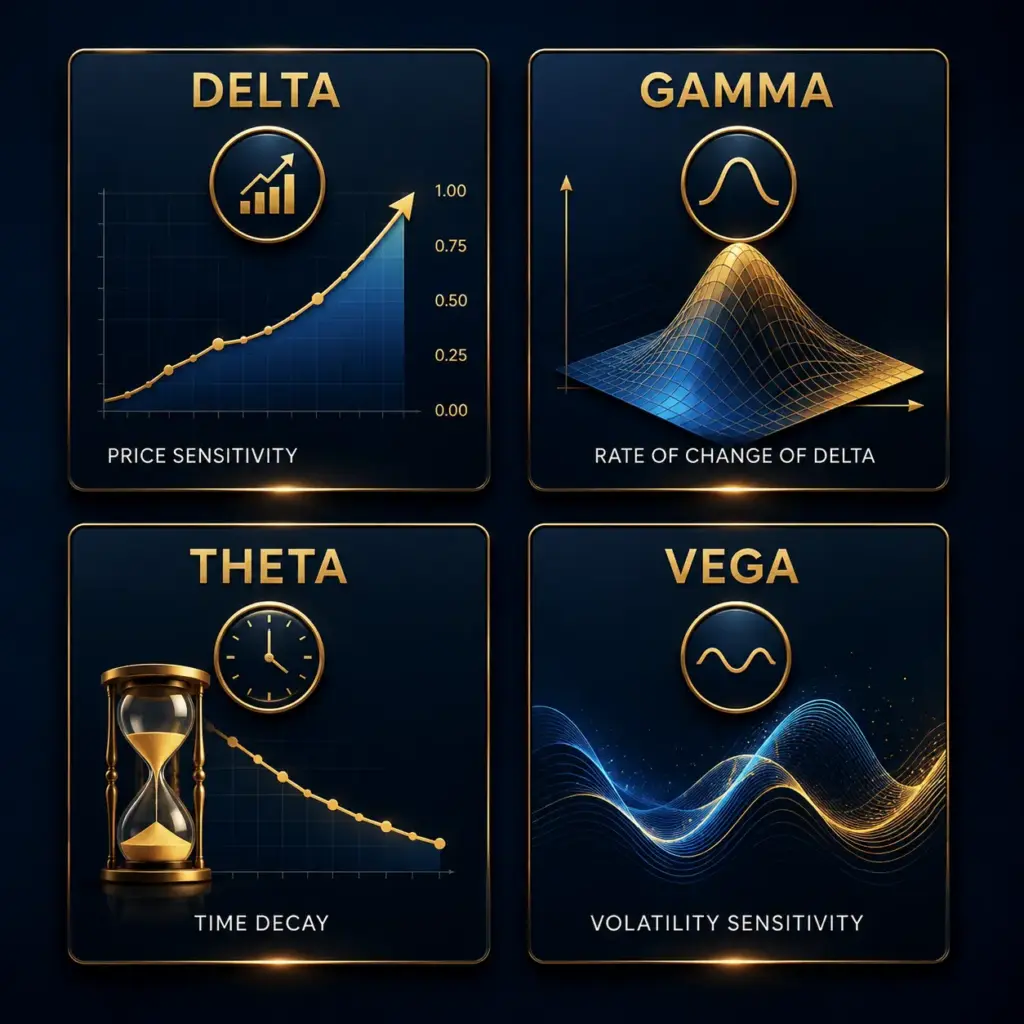
Delta measures how much an option’s price is expected to move for every one-point move in the underlying asset. Call options have a Delta between 0 and 1, and put options have a Delta between negative 1 and 0. A Delta of 0.50 means the option’s price should move roughly half a point for every one-point move in the underlying.
Delta is the Greek most investors encounter first, because it answers the most intuitive question: if the stock or index moves, how much does my option move with it? A call option with a Delta of 0.60 is expected to gain roughly 0.60 in value if the underlying rises by one point, all else being equal. A put option with a Delta of negative 0.40 is expected to gain roughly 0.40 in value if the underlying falls by one point, since put values rise as the underlying declines.
Delta also serves a second, equally important purpose: it functions as an approximate probability that the option will expire in the money. An option with a Delta near 0.50 is considered roughly at the money, sitting close to the current underlying price, with something near a coin-flip chance of finishing in the money. An option with a Delta near 0.90 is deep in the money and behaves almost like owning the underlying asset outright, moving nearly point for point with it. An option with a Delta near 0.10 is far out of the money, with a much smaller chance of finishing profitably, and its price barely reacts to small moves in the underlying.
Consider a hypothetical illustration. An investor holds a call option on a stock trading near its strike price, with a Delta of 0.50. If the stock rises by two points, the option’s price would be expected to rise by roughly one point, holding time and volatility constant. If the same investor instead held a deep in-the-money call with a Delta of 0.85, that same two-point move in the stock would be expected to add roughly 1.70 to the option’s price. This is why traders sometimes describe buying deep in-the-money options as a way to get stock-like exposure with less capital committed, since the position behaves more like the underlying asset itself.
Delta is also additive across a position, which makes it useful for gauging overall directional exposure. A trader holding several call and put contracts on the same underlying can sum the Deltas, weighted by contract size, to see whether the combined position behaves more like a long or short exposure to that underlying. This aggregate figure is sometimes called the position’s net Delta, and professional desks use it to keep an overall book within a defined directional risk limit.
What Is Gamma and Why Does It Matter for Delta?
Gamma measures the rate at which an option’s Delta changes as the underlying asset’s price moves. If Delta tells an investor how fast the option price is moving right now, Gamma tells them how quickly that speed itself is changing. High Gamma means Delta will shift rapidly as the underlying moves, which increases both opportunity and risk.
Gamma is often described as the “Delta of Delta,” and that description is useful because it highlights that Delta is not a fixed number. As the underlying price moves, Delta recalculates, and Gamma is the measure of how much that recalculation shifts with each point of movement. Options that are at the money, meaning their strike price sits close to the current underlying price, tend to have the highest Gamma. Options that are deep in the money or far out of the money tend to have lower Gamma, because their Delta is already close to its maximum or minimum and has less room to change.
Time to expiry also affects Gamma significantly. As an option approaches its expiration date, Gamma for at-the-money contracts tends to rise sharply, because there is less time left for the underlying to move away from the strike, which makes small price changes more consequential to the option’s moneyness. This is one reason short-dated, at-the-money options are considered higher risk instruments: their Delta can swing from near 0.30 to near 0.70 within a single trading session if the underlying moves meaningfully.
A practical scenario helps illustrate why Gamma matters. Suppose a trader sells a call option that is currently at the money, with a Delta of 0.50 and a Gamma of 0.08. If the underlying rises by three points, the Delta does not stay at 0.50. It increases by roughly three times the Gamma, moving to somewhere near 0.74. The option seller’s exposure to further upside has grown substantially in just that single move, even though the underlying only moved a modest amount. This is why option sellers, particularly those running strategies with significant short Gamma exposure, monitor Gamma closely and often adjust or hedge their positions as the underlying approaches the strike price.
Gamma is generally highest for at-the-money options with less time to expiry, and lowest for options that are either deep in the money, deep out of the money, or have a long time remaining before expiration. Investors reviewing options with different strike prices will notice this pattern clearly when comparing Gamma across a full option chain.
What Is Theta and How Does Time Decay Affect an Option?
Theta measures how much an option’s price is expected to decline each day, purely from the passage of time, assuming the underlying price and volatility stay constant. It is usually expressed as a negative number for option buyers, since options are wasting assets that lose extrinsic value as expiration approaches.
Every option has two components to its price: intrinsic value, which reflects how far in the money the option currently is, and extrinsic value, sometimes called time value, which reflects the possibility that the option could become more valuable before expiration. Theta measures the daily erosion of that extrinsic value. An option with a Theta of negative 0.05 is expected to lose roughly 0.05 in price each day, all else being equal, purely because one less day remains until expiry.
Time decay is not linear. It accelerates as expiration approaches, particularly for options that are at or near the money. An option with sixty days remaining might lose a small, steady amount of value each day. The same option with five days remaining, if it is still near the strike price, can lose a much larger amount daily, because there is very little time left for the underlying to move in the holder’s favour. This accelerating pattern is one of the most important concepts for options buyers to internalise: holding a long option position through its final weeks, especially if the position is not moving in the intended direction, can be costly even if the underlying price barely changes.
Theta works differently depending on which side of the trade an investor is on. An option buyer, whether holding a call or a put, generally has negative Theta, meaning time decay works against them. An option seller generally has positive Theta, meaning time decay works in their favour, since the option they sold loses value each day it is held, which benefits the seller if they intend to buy it back later or let it expire worthless. This dynamic is central to many income-generating options strategies, where the goal is deliberately structured around collecting Theta over time.
Consider a hypothetical example. An investor buys a call option 45 days before expiry with a Theta of negative 0.04. If the underlying price and volatility remain unchanged, the option would be expected to lose roughly 0.04 in value simply from one day passing. Over a week of no movement in the underlying, the cumulative time decay could total roughly 0.28, even though nothing else about the market changed. This is why professional traders often say that a directional view on an underlying asset is not, by itself, enough to justify buying an option. The move also has to happen quickly enough to outpace Theta.
What Is Vega and How Does Volatility Change Option Value?
Vega measures how much an option’s price is expected to change for every one percentage point change in the underlying asset’s implied volatility. Implied volatility reflects the market’s expectation of how much the underlying might move going forward. Higher implied volatility generally increases option premiums, and Vega quantifies exactly how much.
Unlike Delta, Gamma, and Theta, which relate to price movement or time, Vega relates to uncertainty itself. Two options on the same underlying, with the same strike price and expiry, can be priced very differently depending on how much the market expects that underlying to move before expiration. An option with a Vega of 0.10 is expected to gain roughly 0.10 in price if implied volatility rises by one percentage point, and lose roughly 0.10 if implied volatility falls by one percentage point, holding everything else constant.
Vega tends to be highest for at-the-money options and for options with more time remaining until expiry. This makes sense intuitively: an option with several months left has more time for volatility to play a meaningful role in the outcome, so its price is more sensitive to changes in volatility expectations. An option expiring within a few days has very little time for volatility to matter, so its Vega is typically small, even if implied volatility swings sharply.
A common scenario where Vega becomes highly relevant is around scheduled events, such as earnings announcements or major economic data releases. Implied volatility on options tied to the affected underlying often rises in the days leading up to the event, as the market prices in the uncertainty of the outcome, and then falls sharply immediately afterward once the news is known. This post-event drop in implied volatility is often called “volatility crush.” An investor holding a long option purely for the anticipated event can find that even a correct directional call does not fully offset the loss in value from Vega, if implied volatility collapses more than the underlying’s price move compensates for.
Understanding Vega is particularly important for investors comparing call and put options purchased during periods of market stress, when implied volatility tends to be elevated across the board. Options purchased when volatility is already high carry more Vega risk, since a subsequent decline in volatility, even without any move in the underlying, can erode the position’s value.
How Do the Four Greeks Interact in a Real Position?
No option position experiences the effect of just one Greek at a time. In practice, Delta, Gamma, Theta, and Vega all act simultaneously, sometimes reinforcing each other and sometimes working against each other, which is why professional risk desks monitor all four together rather than in isolation.
Consider a trader who buys a call option 30 days before expiry, at the money, when implied volatility is moderate. On any given day, several things are happening at once. If the underlying rises, Delta and Gamma work in the trader’s favour, since the option gains value and its Delta increases, accelerating further gains if the underlying keeps rising. At the same time, Theta is quietly working against the position, shaving a small amount of value off the option each day regardless of what the underlying does. If implied volatility happens to rise on the same day, perhaps due to broader market uncertainty, Vega adds a further tailwind to the option’s price. If volatility instead falls, Vega works against the position, potentially offsetting some or all of the gain from the underlying’s move.
This is why an option can sometimes move in a direction that seems to contradict the underlying asset’s price action. A call option might lose value on a day the underlying rises modestly, if the gain from Delta is smaller than the combined drag from Theta and a drop in implied volatility. This outcome often puzzles investors new to options trading, but it becomes intuitive once the Greeks are understood as separate, simultaneous forces rather than a single combined number.
Professional and institutional desks often manage portfolios by keeping certain Greeks close to neutral. A strategy sometimes referred to as Delta-hedging involves adjusting a position, often by trading the underlying asset itself, to keep net Delta close to zero, isolating exposure to the other Greeks. This approach is common among market makers and structured product desks that want to profit from Theta or Vega without taking on directional risk from the underlying’s price movement. Retail investors exploring options exercise and assignment mechanics will find that understanding how these Greeks interact also clarifies why an option’s behaviour near expiry can differ meaningfully from its behaviour with more time remaining.
Trading exchange traded options through a regulated venue gives investors access to live Greeks data, transparent pricing, and standardised contract terms, which makes it considerably easier to track how these interacting forces are affecting a position in real time.
Trade Exchange Traded Options With Transparent, Regulated Access
Access live options pricing, standardised contracts, and a broad range of global underlyings through a DFSA-regulated brokerage built for informed decision-making.
Delta vs Gamma vs Theta vs Vega: A Side-by-Side Comparison
Each Greek isolates a different driver of an option’s price, and comparing them side by side makes it easier to see how they complement one another.
| Greek | What It Measures | What Increases It | Typical Impact on Long Option Price |
|---|---|---|---|
| Delta | Sensitivity to a one-point move in the underlying price | Being deep in the money; less time to expiry for deep options | Increases as the underlying moves in the option’s favour |
| Gamma | The rate of change in Delta itself | Being at the money; approaching expiry | Highest near the strike price close to expiration |
| Theta | Daily loss in value from the passage of time | Less time remaining to expiry; being at the money | Erodes option value every day, accelerating near expiry |
| Vega | Sensitivity to a one percentage point change in implied volatility | More time remaining to expiry; being at the money | Rises when implied volatility increases, falls when it drops |
A useful way to read this table is by asking what an investor is really exposed to when holding an option. A long call or put carries positive Delta or negative Delta depending on direction, positive Gamma, negative Theta, and positive Vega. An option seller carries the mirror image: the opposite Delta exposure, negative Gamma, positive Theta, and negative Vega. Recognising this pattern helps investors understand, at a glance, whether time and volatility are working for or against a given position.
What Mistakes Do Traders Commonly Make With the Greeks?
The most common mistake is treating Delta as the only Greek that matters, while ignoring Theta and Vega until they have already eroded meaningful value from a position. A close second is misreading Delta itself as a guaranteed price target rather than an estimate that changes continuously as the underlying moves, which is exactly what Gamma measures.
- Ignoring time decay until it becomes painful. Many new options buyers focus entirely on predicting direction and overlook the fact that Theta works against them every single day, whether the market moves or not. Holding a long option through a period of sideways price action can be costly purely from time decay, even if the eventual directional call turns out to be correct but arrives too late.
- Underestimating Vega around known events. Buying options ahead of earnings, central bank announcements, or other high-visibility events often means paying an elevated price for implied volatility that is already priced in. If the event resolves without the anticipated volatility, or the outcome is less surprising than expected, the resulting volatility crush can erode the position’s value even when the directional view was correct.
- Treating Delta as static. Because Gamma changes Delta continuously, an option’s exposure to the underlying is not fixed the moment the trade is placed. A position that started with a moderate Delta can behave very differently after a sharp move in the underlying, particularly for options that are close to the strike price and close to expiry, where Gamma is typically at its highest.
- Overlooking how the Greeks interact in combination strategies. Investors constructing spreads, combining multiple calls and puts, sometimes evaluate each leg’s Greeks individually without summing the net exposure of the full position. A spread’s combined Delta, Gamma, Theta, and Vega can look very different from any single leg in isolation, and understanding the net position is essential before entering a multi-leg trade.
- Confusing Delta with probability in absolute terms. While Delta is often used as an approximate proxy for the probability an option finishes in the money, it is not an exact probability calculation, and relying on it as one without understanding its limitations can lead to miscalibrated expectations about outcomes.

How Can Investors Use the Greeks for Risk Management?
Investors can use the Greeks to size positions more deliberately, decide which strikes and expiries fit their market view, and recognise when a position’s risk profile has shifted enough to warrant an adjustment. Used consistently, the Greeks turn options trading from a purely directional bet into a more measured exercise in managing multiple, quantifiable risks.
- Matching Delta to conviction level. An investor with a strong directional view and a shorter time horizon might select an option with higher Delta, since it behaves more like the underlying asset and captures a larger share of any move. An investor with a more speculative or exploratory view might choose a lower-Delta option, accepting less sensitivity to the underlying in exchange for a lower upfront cost.
- Watching Gamma near expiry. Positions that are at or near the money as expiration approaches carry the highest Gamma, meaning Delta can shift rapidly with small moves in the underlying. Investors holding such positions, particularly option sellers, often monitor these contracts more closely or consider closing or rolling them well before the final days of the contract’s life, when Gamma-driven swings tend to be most pronounced.
- Budgeting for Theta explicitly. Rather than treating time decay as background noise, disciplined investors calculate roughly how much a position is expected to lose per day purely from Theta and weigh that against the expected timeline for their directional thesis to play out. If the anticipated move is unlikely to happen before cumulative Theta erodes a meaningful share of the premium, that is a signal to reconsider the trade’s structure or timing.
- Being selective about entering positions when implied volatility is elevated. Since Vega magnifies the impact of volatility shifts, investors often pay close attention to where current implied volatility sits relative to its recent range before buying options. Purchasing when volatility is already elevated increases the risk that a subsequent decline in volatility works against the position, independent of how the underlying moves.
- Reviewing the position’s Greeks as a set, not individually. Before entering any options trade, reviewing the combined Delta, Gamma, Theta, and Vega gives a fuller picture of what is actually being risked. A position with a favourable Delta but an unfavourable combination of Theta and Vega may carry more risk than it initially appears, and vice versa.
- Institutional and professional investors managing larger derivatives books often formalise this process further, aggregating Greeks across an entire portfolio to understand net exposure to price, time, and volatility at any given moment, and adjusting hedges accordingly as market conditions evolve.
Institutional-Grade Derivatives Access for Professional Portfolios
From hedge funds to corporate treasuries, get direct market access to major global futures and options exchanges, backed by dedicated derivatives specialists.
Frequently Asked Questions (FAQs)
Is a higher Delta always better for an option buyer?
Not necessarily. A higher Delta means the option moves more closely with the underlying asset, but it typically also costs more upfront, since the option is more likely to be in the money. Investors need to weigh the higher sensitivity against the higher premium, and match the choice to their conviction level, capital available, and time horizon rather than assuming higher Delta is automatically the better trade.
Why does my option lose value even when the stock price does not move?
This is almost always Theta, the daily time decay every option experiences as it approaches expiration. Options are wasting assets, meaning their extrinsic value declines with each passing day regardless of what the underlying does. If implied volatility also falls on a day the underlying is flat, Vega compounds the decline further.
What does it mean when an option has high Gamma?
High Gamma means the option’s Delta will change quickly as the underlying price moves, which is most common for at-the-money options close to expiration. This makes the position’s directional exposure less stable and more sensitive to short-term price swings, which can increase both potential reward and potential risk.
Should beginners worry about Vega, or is it mainly for advanced traders?
Vega matters for any options buyer, not just advanced traders, particularly around events like earnings or major economic releases when implied volatility tends to be elevated. A beginner who buys an option purely on a directional hunch without checking where implied volatility currently sits may be paying a premium that is vulnerable to a volatility crush even if the directional call turns out correct.
A Final Word on Trading the Greeks
The Greeks do not predict the future. They describe, with precision, how an option’s price is expected to respond to the forces already at play: the underlying’s movement, the passage of time, and shifts in market expectations around volatility. Investors who take the time to understand Delta, Gamma, Theta, and Vega gain a clearer, more disciplined lens for evaluating options trades, moving beyond a simple directional guess toward a fuller view of what is actually being risked and why.
Options pricing and the Greeks work in tandem with the broader mechanics covered in Options Fundamentals and Intrinsic Value and Time Value. Building familiarity across these related concepts gives investors a more complete foundation before evaluating any specific options strategy or position size.
Start Trading Options With a DFSA-Regulated Broker
Get access to real-time Greeks, transparent pricing, and a full suite of exchange traded derivatives across global markets, supported by a dedicated trading desk.

Disclaimer:
Trading foreign exchange and/or contracts for difference on margin carries a high level of risk, and may not be suitable for all investors as you could sustain losses in excess of deposits. The products are intended for retail, professional and eligible counterparty clients. Before deciding to trade any products offered by PhillipCapital (DIFC) Private Limited you should carefully consider your objectives, financial situation, needs and level of experience. You should be aware of all the risks associated with trading on margin. The content of the Website must not be construed as personal advice. For retail, professional and eligible counterparty clients. Before deciding to trade any products offered by PhillipCapital (DIFC) Private Limited you should carefully consider your objectives, financial situation, needs and level of experience. You should be aware of all the risks associated with trading on margin.
Rolling Spot Contracts and CFDs are complex instruments and come with a high risk of losing money rapidly due to leverage. 78% of our retail client accounts lose money while trading with us. You should consider whether you understand how Rolling Spot Contracts and CFDs work, and whether you can afford to take the high risk of losing your money.

Rho and Interest Rate Sensitivity
Rho options greek interest rate sensitivity Introduction Most options traders...
Read More

Gamma Risk and Gamma Scalping
Gamma Risk and Gamma Scalping Gamma Risk and Gamma Scalping:...
Read More
Delta Hedging and Delta Neutrality
Delta Hedging and Delta Neutrality Delta Hedging and Delta Neutrality:...
Read More
The Greeks: Delta, Gamma, Theta, and Vega
Options Greeks : Delta, Gamma, Theta, Vega The Greeks: Delta,...
Read More
Black-Scholes Model Basics
Black-Scholes model Black-Scholes Model Basics: How Options Traders Understand Fair...
Read More
Options Exercise & Assignment
Options Exercise & Assignment Table of Contents Introduction What Does...
Read More
American vs European Options
American vs European Options Table of Contents Introduction What Is...
Read More
Options Expiration Dates
Options Expiration Dates Table of Contents Introduction What Is an...
Read More
Intrinsic Value and Time Value
Intrinsic Value and Time Value Introduction When you buy or...
Read More
In-the-Money, At-the-Money, Out-of-the-Money Options
In-the-Money, At-the-Money, Out-of-the-Money Options Introduction If you have started exploring...
Read More

Call Options Explained
Call Options Explained Table of Contents Introduction What Exactly Is...
Read More
Options Fundamentals
Options Fundamentals Table of Contents Introduction What Is an Option...
Read More
VIX Futures & Volatility Futures
VIX Futures & Volatility Futures Table of Contents Introduction What...
Read More
Precious Metals Futures
Precious Metals Futures What Are Precious Metals Futures? A Guide...
Read More
Agricultural Futures
Agricultural Futures Agricultural Futures: Hedging and Trading Strategies Agricultural futures...
Read More
Energy Futures Trading
Energy Futures Trading Introduction Energy is the lifeblood of the...
Read More
Commodity Futures
Commodity Futures What Are Commodity Futures? A Comprehensive Guide for...
Read More

Interest Rate Futures
Interest Rate Futures Mastering Interest Rate Futures: A Strategic Guide...
Read More

Cash Settlement vs Physical Delivery
Cash Settlement vs Physical Delivery in Trading Cash Settlement vs...
Read More
Futures Settlement Methods
Futures Settlement Methods Introduction Navigating the financial markets requires a...
Read More
Margin Calls & Mark-to-Market
Margin Calls & Mark-to-Market Table of Contents Introduction to Futures...
Read More
Initial vs. Maintenance Margin
Initial vs. Maintenance Margin Understanding Initial and Maintenance Margins: A...
Read More
Contango & Backwardation Explained
Contango and Backwardation Explained Contango and Backwardation Explained: Navigating Futures...
Read More