implied volatility vs historical volatility Introduction Volatility sits at the...
Read MoreWhat is a CFD
What Is a CFD? A Beginner's Guide to Contracts for Difference
Contracts for Difference, better known as CFDs, are one of the most talked about ways to trade financial markets in the UAE and beyond. They let investors take a view on the price of an asset without ever owning that asset outright.
This guide walks through what a CFD actually is, how the mechanics of margin and leverage work, how CFDs compare with spot FX trading and traditional share dealing, and the practical risks every investor should understand before placing a first trade.
Whether you are a retail investor exploring leveraged products for the first time or simply want a refresher before opening an account, this article builds the foundation you need.
Table of Contents
- What Is a CFD and How Does It Work?
- How Does Profit and Loss Work on a CFD Trade?
- What Is Margin and Why Does It Matter for CFDs?
- Going Long or Short: Why CFDs Offer Two-Way Flexibility
- CFDs vs Spot FX: What Is the Difference?
- What Assets Can You Trade Using CFDs?
- What Costs Come With Trading a CFD?
- What Are the Main Risks of CFD Trading?
- Who Typically Trades CFDs?
- Common Mistakes First-Time CFD Traders Make
- Frequently Asked Questions
What Is a CFD and How Does It Work?
A CFD, or Contract for Difference, is an agreement between a trader and a broker to exchange the difference in the price of an asset between when the position is opened and when it is closed. No physical shares, currency, or commodity ever changes hands. Instead, the trader is speculating purely on price movement.
Think of a CFD as a side agreement layered on top of a real market. If you believe the price of gold, an index, or a company’s shares is going to rise, you can open a CFD position that mirrors that price movement without buying the physical gold bar, the index basket, or the shares themselves. If the price moves in the direction you expected, the difference is credited to your account. If it moves against you, the difference is deducted.
This structure is what gives CFDs their appeal. Investors can gain exposure to global markets using a single trading account, including markets that would otherwise be difficult or expensive to access directly. It also means CFDs are traded on margin, a concept covered in detail later in this guide, which allows a trader to control a larger position than the cash sitting in their account would normally allow.
CFDs fall under the broader family of derivatives, financial contracts whose value is derived from an underlying asset such as a stock, an index, a currency pair, or a commodity. Unlike futures contracts, which have a fixed expiry and standardised contract size, most CFDs have no set expiry date and can be closed whenever the trader chooses.
How Does Profit and Loss Work on a CFD Trade?
Profit or loss on a CFD is calculated as the difference between the opening price and the closing price of the position, multiplied by the number of units traded. If the market moves in your favour, you profit; if it moves against you, you incur a loss, and both are magnified by leverage.
To make this concrete, imagine an investor opens a CFD position on a stock index at a price of 18,000 points, buying the equivalent of 1 unit per point. If the index later rises to 18,150, the position has gained 150 points. Multiplied by the value per point, that gain, minus any financing and spread costs, is what gets added to the trading account. Had the index fallen by the same amount instead, the trader would have recorded an equivalent loss.
Because a CFD position is only ever closed by an opposite and equal trade, the profit or loss is not “locked in” until that closing trade happens. This is why monitoring an open CFD position matters. Prices can move quickly, and unrealised gains can just as quickly turn into unrealised losses before a position is closed.
See CFD Margin Requirements Before You Trade
Check real margin rates across equities, indices, commodities, and FX CFDs.

What Is Margin and Why Does It Matter for CFDs?
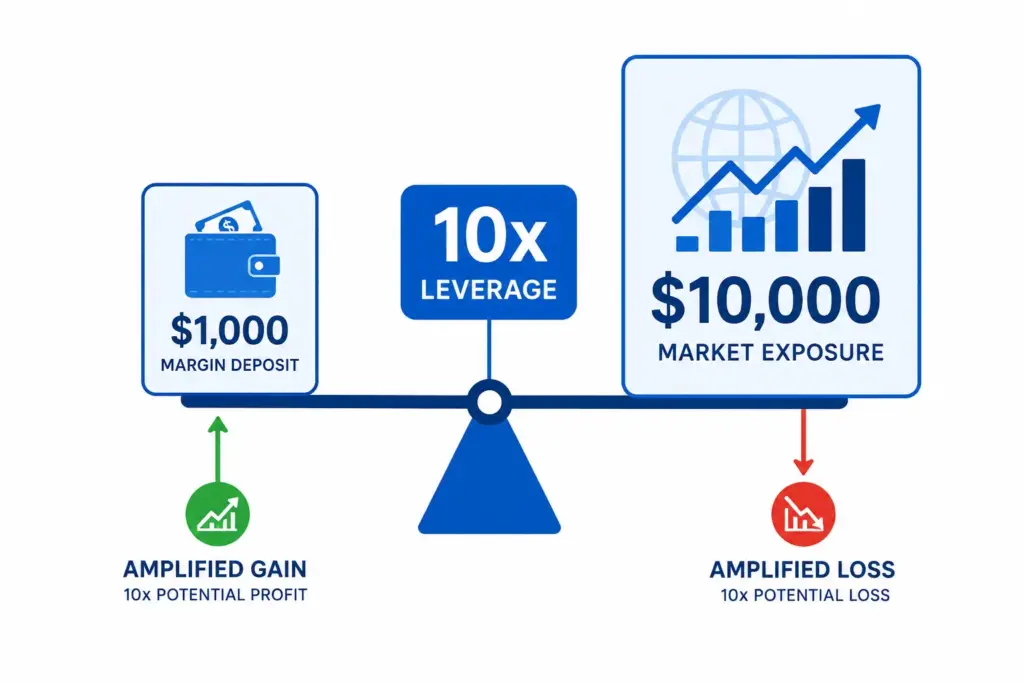
Margin is the portion of a position’s total value that a trader must deposit upfront in order to open a CFD trade. It is not a fee; it is closer to a security deposit, and it is what makes CFDs a leveraged product. Instead of committing the full value of the position, a trader commits only a fraction of it, with the broker extending exposure to the remainder.
Leverage is expressed as a ratio, ten times or twenty times, for example, and describes how much market exposure a given amount of margin controls. If a broker offers 10x leverage on a particular CFD, a trader depositing 1,000 units of currency in margin can open a position with 10,000 units of market exposure.
This magnifies both potential gains and potential losses in equal measure, which is why leverage is often described as a double-edged tool rather than a shortcut to bigger profits.
Brokers monitor open positions against account equity in real time. If losses on an open position erode the margin below a required maintenance level, the trader may receive a margin call, a request to deposit additional funds or reduce the position size. Positions that fall below the minimum required margin and are not topped up in time can be automatically closed by the broker to prevent the account balance from going negative. Understanding margin requirements before opening a position is one of the most important habits a CFD trader can build.
Going Long or Short: Why CFDs Offer Two-Way Flexibility
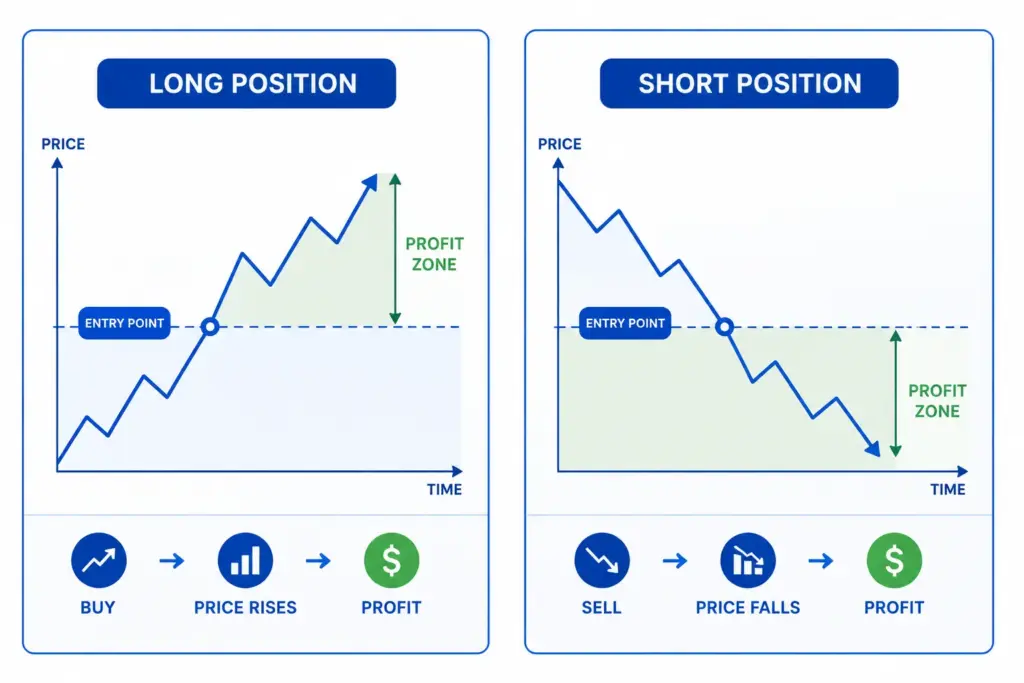
One of the defining features of CFD trading is that investors can take a position whether they expect prices to rise or fall. A long position profits when the underlying asset’s price increases, while a short position profits when the price decreases, giving traders flexibility that traditional buy-and-hold investing does not offer in the same way.
Going long is intuitive: an investor buys a CFD expecting the price to climb, then closes the position by selling at a higher price to capture the difference. Going short works in reverse. The trader opens the position by effectively selling a CFD at the current price, expecting it to fall, and later closes it by buying back at a lower price.

Because no physical asset is being borrowed or delivered, as would be required for a traditional short sale of shares, CFDs make shorting considerably more straightforward from an operational standpoint.
This two-way flexibility is particularly useful during periods of falling or volatile markets, when traditional investors holding only long positions in stocks or funds may have limited ways to respond. Investors may consider using short CFD positions as one way to express a bearish view or, in some cases, to hedge an existing long-term holding, though hedging strategies should be evaluated carefully and are not appropriate for every investor.
CFDs vs Spot FX: What Is the Difference?
CFDs and spot FX are closely related but not identical. Spot FX refers specifically to the buying and selling of currency pairs for near-immediate settlement, while CFDs are a broader contract structure that can be written on currencies, indices, commodities, and shares alike, all sharing the same no-ownership, margin-traded principle.
In practice, many brokers offer FX exposure through both spot FX contracts and FX CFDs, and the trading experience can look almost identical on the screen. The distinction matters most when it comes to contract structure, rollover mechanics, and how positions are quoted. The table below breaks down the main points of difference. For a deeper look at how currency markets are quoted and structured, see this guide to forex market structure and trading hours.
| Comparison Point | CFDs | Spot FX |
|---|---|---|
| Underlying assets | Shares, indices, commodities, currency pairs, and more | Currency pairs only |
| Ownership of asset | Never owned; contract tracks price difference | Never physically delivered in most trading accounts; still currency-specific |
| Expiry | Typically no fixed expiry; open until closed | Traditionally a two-day settlement cycle, rolled forward if held |
| Margin and leverage | Available across multiple asset classes | Available, often at different margin rates than other CFDs |
| Pricing reference | Bid-ask spread on the underlying instrument | Bid-ask spread expressed in pips |
| Typical use case | Diversified speculation across multiple markets from one account | Focused currency market speculation or corporate FX exposure management |
For an investor who wants exposure to currency markets specifically, spot FX trading and FX CFDs often achieve a similar economic outcome. Where CFDs stand apart is their reach across asset classes, letting an investor hold index, commodity, and equity exposure through the same account structure and margining framework used for currency positions.
What Assets Can You Trade Using CFDs?
CFDs can be written on almost any actively traded financial instrument, which is part of their appeal to investors who want diversified market exposure from a single account. The four broad categories investors typically access are equities, indices, commodities, and currency pairs.
- Equity CFDs: track the price of individual listed companies without requiring the investor to hold the underlying shares.
- Index CFDs: track the value of a basket of stocks that make up a benchmark index, offering broad market exposure in a single position.
- Commodity CFDs: track prices of physical commodities such as energy, metals, or agricultural products, without the logistics of physical delivery.
- FX CFDs: track the exchange rate between two currencies, similar in economic effect to spot FX trading.
Because each of these markets has its own volatility profile, trading hours, and typical margin requirements, investors should evaluate each asset class on its own terms rather than assuming that experience trading one type of CFD automatically transfers to another. Investors interested in a broader range of leveraged instruments beyond CFDs may also want to explore futures and options trading, which follows a different contract structure but shares some of the same margin principles.
Trade Over 500 CFD Instruments From One Account
Access equities, indices, commodities, and FX CFDs with a DIFC-regulated broker.
What Costs Come With Trading a CFD?
CFD trading typically involves a handful of recurring costs: the bid-ask spread, overnight financing charges on positions held past the trading day, and in some markets, a commission on top of the spread. Understanding these costs upfront helps investors judge whether a strategy remains viable after expenses.
The spread is the gap between the price at which you can buy, the ask, and the price at which you can sell, the bid, a CFD at any given moment. This is usually the largest and most immediate cost of entering a trade. Overnight financing, sometimes called a swap or holding cost, is charged, or in some cases credited, when a leveraged position remains open past the market’s daily cut-off, reflecting the cost of the notional funding being extended by the broker. Some CFD markets, particularly equity CFDs, may also carry an explicit commission charged per trade in addition to the spread.
Because leverage amplifies the impact of every cost relative to the margin deposited, even small recurring charges can add up meaningfully for positions held over longer periods. Investors evaluating a CFD strategy may consider factoring in the total cost of holding a position, not just the entry spread, when assessing whether a trade remains attractive.
What Are the Main Risks of CFD Trading?
The central risk in CFD trading is that leverage magnifies losses in the same proportion it magnifies gains, meaning a relatively small adverse price movement can result in a loss that is large relative to the margin deposited. This is the single most important concept for any investor new to CFDs to internalise before trading.
Beyond leverage itself, CFD traders are exposed to market volatility risk, where fast-moving prices can trigger losses before a trader has time to react, and liquidity risk, where thinly traded underlying assets can widen spreads or make it harder to close a position at the expected price. Margin call risk is another factor: if losses erode account equity below the maintenance margin threshold, a trader may be required to add funds quickly or see the position closed automatically.
Because of these risks, regulators and brokers alike are required to communicate clearly that CFDs are complex instruments not suited to every investor. It is common industry practice for brokers to disclose the percentage of retail client accounts that lose money trading CFDs, a figure that varies by provider and time period, precisely because leverage-driven losses are a well-documented feature of the product rather than an edge case. Investors should evaluate their own risk tolerance, financial situation, and understanding of how margin works before considering CFDs as part of a trading approach.
Who Typically Trades CFDs?
CFDs attract a fairly wide range of market participants, from retail investors looking for diversified, leveraged exposure to professional and institutional traders using CFDs for tactical positioning or short-term hedging. What generally unites CFD traders is a comfort with active position management rather than passive, long-term holding.
Retail investors are often drawn to CFDs for the ability to access global indices, commodities, and international equities through one account, without the operational complexity of holding physical shares across multiple exchanges. Professional and institutional traders, meanwhile, may use CFDs to express short-term tactical views, manage exposure around specific events, or hedge parts of a broader portfolio, generally with more sophisticated risk controls in place.
Regardless of experience level, CFD trading rewards investors who actively monitor open positions, understand margin requirements in detail, and size trades in proportion to their overall account, rather than treating leverage as a way to amplify conviction alone.
Common Mistakes First-Time CFD Traders Make
Most losses among new CFD traders can be traced back to a handful of recurring mistakes rather than pure bad luck in the market. Recognising these patterns early can meaningfully change the trajectory of a trading journey.
- Over-leveraging a position: using the maximum leverage available rather than sizing a position based on account risk tolerance.
- Ignoring overnight financing costs: holding positions for extended periods without accounting for accumulating holding charges.
- Trading without a defined exit plan: entering positions without predetermined levels for taking profit or limiting losses.
- Underestimating volatility around news events: holding leveraged positions through scheduled economic announcements without adjusting size or using protective orders.
- Chasing losses: increasing position size after a loss in an attempt to recover it quickly, rather than reassessing the original trade thesis.
Building good habits around position sizing, cost awareness, and disciplined exits tends to matter more for long-term outcomes than any single trade idea.
Ready to Explore Leveraged Trading With PhillipCapital DIFC?
Speak with our team about opening a regulated trading account.
Frequently Asked Questions (FAQs)
Yes, CFD trading is legal in the UAE when conducted through a properly licensed and regulated broker. Investors should confirm that any broker offering CFDs holds the relevant regulatory licence, such as one issued by the Dubai Financial Services Authority for firms operating within the DIFC, before opening an account.
No, a CFD never involves ownership of the underlying asset. The contract only reflects the price difference between the opening and closing of the position, which is why CFDs are classified as derivative instruments rather than direct investments in shares, currencies, or commodities.
The amount needed depends on the margin requirement of the specific CFD and the position size an investor wants to open, since margin is only a fraction of the total position value. Investors should check the specific margin rates for the asset class they intend to trade and consider starting with a size proportionate to their overall risk tolerance.
This depends on the account protections offered by the broker and the jurisdiction’s regulatory framework. Many regulated brokers offer negative balance protection for retail clients, meaning losses are capped at the funds in the account, though investors should always confirm this directly with their broker rather than assume it applies universally.
Disclaimer:
Trading foreign exchange and/or contracts for difference on margin carries a high level of risk, and may not be suitable for all investors as you could sustain losses in excess of deposits. The products are intended for retail, professional and eligible counterparty clients. Before deciding to trade any products offered by PhillipCapital (DIFC) Private Limited you should carefully consider your objectives, financial situation, needs and level of experience. You should be aware of all the risks associated with trading on margin. The content of the Website must not be construed as personal advice. For retail, professional and eligible counterparty clients. Before deciding to trade any products offered by PhillipCapital (DIFC) Private Limited you should carefully consider your objectives, financial situation, needs and level of experience. You should be aware of all the risks associated with trading on margin.
Rolling Spot Contracts and CFDs are complex instruments and come with a high risk of losing money rapidly due to leverage. 78% of our retail client accounts lose money while trading with us. You should consider whether you understand how Rolling Spot Contracts and CFDs work, and whether you can afford to take the high risk of losing your money.
Rho and Interest Rate Sensitivity
Rho options greek interest rate sensitivity Introduction Most options traders...
Read MoreGamma Risk and Gamma Scalping

Gamma Risk and Gamma Scalping Gamma Risk and Gamma Scalping:...
Read MoreDelta Hedging and Delta Neutrality

Delta Hedging and Delta Neutrality Delta Hedging and Delta Neutrality:...
Read MoreThe Greeks: Delta, Gamma, Theta, and Vega

Options Greeks : Delta, Gamma, Theta, Vega The Greeks: Delta,...
Read MoreBlack-Scholes Model Basics

Black-Scholes model Black-Scholes Model Basics: How Options Traders Understand Fair...
Read MoreOptions Exercise & Assignment

Options Exercise & Assignment Table of Contents Introduction What Does...
Read MoreAmerican vs European Options

American vs European Options Table of Contents Introduction What Is...
Read MoreOptions Expiration Dates
Options Expiration Dates Table of Contents Introduction What Is an...
Read MoreIntrinsic Value and Time Value
Intrinsic Value and Time Value Introduction When you buy or...
Read MoreIn-the-Money, At-the-Money, Out-of-the-Money Options

In-the-Money, At-the-Money, Out-of-the-Money Options Introduction If you have started exploring...
Read MoreCall Options Explained
Call Options Explained Table of Contents Introduction What Exactly Is...
Read MoreOptions Fundamentals

Options Fundamentals Table of Contents Introduction What Is an Option...
Read MoreVIX Futures & Volatility Futures

VIX Futures & Volatility Futures Table of Contents Introduction What...
Read MorePrecious Metals Futures

Precious Metals Futures What Are Precious Metals Futures? A Guide...
Read MoreAgricultural Futures

Agricultural Futures Agricultural Futures: Hedging and Trading Strategies Agricultural futures...
Read MoreEnergy Futures Trading

Energy Futures Trading Introduction Energy is the lifeblood of the...
Read MoreCommodity Futures

Commodity Futures What Are Commodity Futures? A Comprehensive Guide for...
Read MoreInterest Rate Futures

Interest Rate Futures Mastering Interest Rate Futures: A Strategic Guide...
Read MoreCash Settlement vs Physical Delivery

Cash Settlement vs Physical Delivery in Trading Cash Settlement vs...
Read MoreFutures Settlement Methods

Futures Settlement Methods Introduction Navigating the financial markets requires a...
Read MoreMargin Calls & Mark-to-Market

Margin Calls & Mark-to-Market Table of Contents Introduction to Futures...
Read MoreInitial vs. Maintenance Margin

Initial vs. Maintenance Margin Understanding Initial and Maintenance Margins: A...
Read MoreContango & Backwardation Explained
Contango and Backwardation Explained Contango and Backwardation Explained: Navigating Futures...
Read More