
implied volatility vs historical volatility Introduction Volatility sits at the...
Read MoreGamma Risk and Gamma Scalping
Gamma Risk and Gamma Scalping: How Options Traders Manage the Curve Behind Delta
Most investors who trade options learn about Delta first. It tells you how much an option’s price moves when the underlying asset moves. What often gets overlooked is the Greek that governs how fast Delta itself changes: Gamma. Ignoring Gamma is one of the most common reasons a seemingly well hedged options position can suddenly start losing money as the market moves.
This guide walks through what Gamma actually measures, why it becomes more dangerous around expiry and near the strike price, and how professional and institutional desks use a technique called gamma scalping to turn that same risk into a repeatable trading approach. Retail investors exploring exchange traded derivatives for the first time, and professional traders refining a hedging book, will both find practical explanations and worked examples they can apply directly.
By the end, you should be able to look at an options position and understand not just where it stands today, but how its risk profile will shift as the underlying price moves and time passes. That is the real value of understanding Gamma.
Table of Contents
- What Is Gamma in Options Trading?
- Why Does Gamma Risk Matter for Options Traders?
- How Does Gamma Change Across Strike Prices and Time to Expiry?
- How Are Gamma and Delta Hedging Connected?
- What Is Gamma Scalping and How Does It Work?
- How Do Traders Execute a Gamma Scalping Strategy Step by Step?
- What Are the Risks and Costs of Gamma Scalping?
- Long Gamma vs Short Gamma: What Is the Difference?
- Who Uses Gamma Scalping in Practice?
- Common Mistakes When Managing Gamma Risk
- Conclusion
What Is Gamma in Options Trading?
Gamma measures how much an option’s Delta changes when the price of the underlying asset moves by one point. It is often described as the “Delta of Delta,” because while Delta tells you an option’s current sensitivity to price movement, Gamma tells you how quickly that sensitivity itself is shifting.
Think of Delta as the speed of a car and Gamma as its acceleration. A car moving at a constant 60 kilometres an hour has speed but no acceleration. An option with a Delta of 0.50 behaves similarly at that exact instant, but Gamma tells you whether that Delta is about to jump to 0.60 or fall to 0.40 as the underlying asset price shifts. Investors evaluating call and put positions need both figures, because a position that looks balanced on Delta alone can become badly unbalanced within minutes if Gamma is high.
Gamma is expressed as the change in Delta per one unit move in the underlying price. For example, if a call option has a Delta of 0.45 and a Gamma of 0.05, a one point rise in the underlying asset would push the Delta toward 0.50. Both call and put options carry positive Gamma when purchased outright, meaning the option owner’s Delta always moves in the trader’s favour as the underlying price moves, whether up or down. This asymmetry is exactly what makes Gamma such an important concept for anyone managing options risk on Futures & Options or CFD instruments.
Why Does Gamma Risk Matter for Options Traders?
Gamma risk refers to the danger that a position considered “hedged” today becomes significantly unhedged after even a modest price move, because Delta itself has shifted. A trader who is short options, meaning they have sold calls or puts, is typically short Gamma, and that combination can turn small market moves into outsized losses if the hedge is not rebalanced quickly.
For an option seller, negative Gamma means Delta moves against the position as the market moves. If a market maker sells a call option and the underlying stock rallies, the call’s Delta rises, meaning the option seller’s short position becomes more negative just as the underlying is going up, compounding the loss. The same effect works in reverse on the downside for a short put. This is why option sellers, including institutional market makers and structured note desks that write options as part of a hedging book, must actively rebalance their positions as prices move.
Gamma risk becomes especially acute in the final days before expiry, during earnings announcements, ahead of major central bank decisions, or during periods of unexpected volatility. A position that seemed conservatively hedged the week before can behave very differently once Gamma accelerates near the strike price. This is one reason professional risk desks track Gamma exposure continuously rather than only at the point a trade is opened.
Trade Options With a Regulated Futures & Options Desk
Access exchange traded options and futures contracts with margin efficient execution through a DFSA regulated broker in the DIFC.
How Does Gamma Change Across Strike Prices and Time to Expiry?
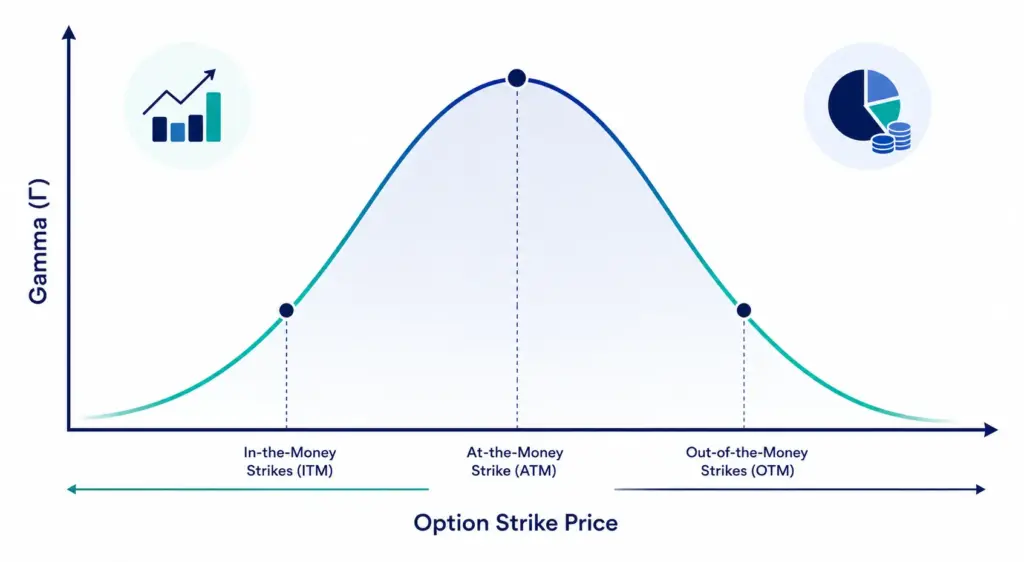
Gamma is highest for at the money options and rises sharply as expiry approaches, while it stays comparatively low and stable for options that are deeply in the money or deeply out of the money. This is why the final trading days of an option’s life are often described as the most volatile in terms of risk management, even if the underlying asset itself is calm.
- Gamma by moneyness. An at the money option, where the strike price is close to the current market price, has the highest Gamma because a small move in either direction can flip the option from being likely to expire worthless to likely to expire in the money, or vice versa. Deep in the money options behave more like the underlying stock itself, with a Delta close to 1 or negative 1 that barely changes as the price moves further, so their Gamma is low. Deep out of the money options have a Delta close to zero that also changes very little unless the underlying makes a dramatic move, so their Gamma is likewise low.
- Gamma and time to expiry. As an option approaches its expiration date, Gamma for at the money contracts increases substantially. This happens because there is less time remaining for the underlying price to drift away from the strike, so every incremental price move has a proportionally larger effect on the probability of finishing in the money. This is sometimes referred to informally as “gamma risk near expiry,” and it is a major reason many professional traders close or roll positions in the final days before expiration rather than holding them to the wire.
- Gamma and implied volatility. Higher implied volatility tends to spread Gamma more evenly across strikes, while lower implied volatility concentrates Gamma more sharply around the at the money strike. Investors comparing options across different underlying assets, such as a heavily traded index future versus a single stock option, should keep in mind that the shape of the Gamma curve will differ depending on how the market is pricing future volatility.
How Are Gamma and Delta Hedging Connected?
Delta hedging is the practice of buying or selling the underlying asset to offset an option position’s directional exposure, and Gamma determines how often that hedge needs to be adjusted. A position with low Gamma can be hedged once and largely left alone for a period of time, while a position with high Gamma requires frequent rebalancing because Delta keeps drifting away from neutral.
Consider a trader who sells a call option and simultaneously buys shares of the underlying stock to become Delta neutral. If the stock price does not move, the hedge holds. But because the short call carries negative Gamma, any move in the stock price shifts the position’s overall Delta, meaning the trader is no longer perfectly hedged. To restore neutrality, the trader must adjust the stock hedge, buying more shares if the stock falls or selling shares if the stock rises, for a short Gamma position.
This constant rebalancing is the mechanical link between Delta hedging and Gamma. A trader who is short Gamma is forced to buy high and sell low as they rebalance, which is a losing pattern over time unless the premium collected from selling the option compensates for it. A trader who is long Gamma experiences the opposite: they are forced to sell high and buy low as they rebalance, which can generate profit if the underlying moves enough to offset the cost of holding the option. This second scenario is the foundation of gamma scalping.
What Is Gamma Scalping and How Does It Work?
Gamma scalping is a trading technique in which a trader holds a long options position, typically a long straddle or long strangle, and repeatedly adjusts the Delta hedge as the underlying price moves, capturing small profits from each rebalancing trade. The strategy is designed to profit from the underlying asset’s actual price movement, known as realised volatility, rather than from predicting the direction the market will move.
The mechanics work like this. A trader buys a call and a put on the same underlying asset, often at or near the same strike price, creating a position with positive Gamma and, ideally, close to zero Delta at the outset. As the underlying price rises, the position’s Delta becomes positive because the call gains value faster than the put loses it. The trader then sells a portion of the underlying asset to bring Delta back toward neutral, locking in a small gain from that upward move. If the price later falls back down, the position’s Delta turns negative, and the trader buys back the underlying at a lower price than they sold it, again locking in a gain from the round trip.
Each rebalancing trade on its own may look small. The strategy’s profitability comes from doing this repeatedly over the life of the option, as long as the underlying asset moves enough, in either direction, to generate hedging gains that exceed the cost of the option position itself, known as Theta decay. This is why gamma scalping is often described as a volatility trading strategy rather than a directional one. It rewards movement, not a specific forecast of where the market ends up.
Access Institutional Futures & Options Infrastructure
Professional and institutional desks running volatility and hedging strategies can access direct market access, competitive margining, and global exchange connectivity.
How Do Traders Execute a Gamma Scalping Strategy Step by Step?
A gamma scalping strategy generally follows a consistent sequence: establish a long Gamma options position, set an initial Delta hedge, monitor the position as prices move, rebalance the hedge at defined intervals or price thresholds, and track whether the accumulated hedging gains are outpacing the option’s time decay. The specific rules a trader follows will vary, but the underlying logic tends to remain the same.
- Select the underlying and expiry. Traders typically choose a liquid underlying asset, such as a widely traded stock, index future, or currency pair, and an expiry long enough to allow for multiple rebalancing opportunities without excessive Theta decay eating into returns too quickly.
- Build the long Gamma position. A long straddle, buying both a call and a put at the same strike, or a long strangle, buying a call and put at different strikes, are the most common structures because they combine positive Gamma with limited directional bias.
- Establish the initial Delta hedge. The trader calculates the position’s net Delta and buys or sells the appropriate amount of the underlying asset, or an equivalent futures contract, to bring the overall position close to Delta neutral.
- Set rebalancing triggers. Some traders rebalance on a fixed schedule, such as once a day, while others rebalance whenever Delta drifts beyond a set threshold, such as plus or minus 0.10. Rebalancing too often increases transaction costs, while rebalancing too rarely leaves the position more directionally exposed than intended.
- Execute the hedge adjustments. Each time the underlying price moves and Delta shifts, the trader buys or sells the underlying, or an equivalent futures contract, to restore neutrality, capturing the gain or loss from that specific rebalancing trade.
- Track performance against Theta decay. Because long options positions lose value over time, the trader needs the cumulative gains from rebalancing to exceed the premium paid for the options, plus transaction costs, for the strategy to be profitable overall.
What Are the Risks and Costs of Gamma Scalping?
The central risk in gamma scalping is that realised volatility, the actual movement of the underlying asset, turns out to be lower than the implied volatility priced into the options when they were purchased, meaning the rebalancing gains fail to cover the cost of the position. Transaction costs, bid ask spreads, and the operational demands of frequent rebalancing add further layers of risk that can erode what otherwise appears to be a sound strategy.
- Theta decay versus realised movement. Every long option position loses a portion of its value each day purely due to the passage of time, all else being equal. Gamma scalping only works if the underlying asset moves enough, and often enough, for the accumulated rebalancing gains to outweigh this steady erosion. A market that stays unusually quiet, sometimes called a low realised volatility environment, can turn a theoretically sound gamma scalping position into a losing one.
- Transaction costs and slippage. Because the strategy requires frequent buying and selling of the underlying asset or futures contract, commissions, bid ask spreads, and slippage on each trade can accumulate meaningfully over the life of the position. This is one reason gamma scalping tends to be more commonly used by professional and institutional traders with access to lower transaction costs and efficient execution infrastructure, rather than by retail investors trading in small size.
- Operational and monitoring demands. Rebalancing a Delta hedge requires continuous monitoring of the position, particularly for at the money options approaching expiry when Gamma accelerates. Traders without the systems or discipline to monitor and rebalance consistently may find their intended long Gamma strategy behaving more like an unhedged directional bet.
- Volatility risk itself. Because the options were purchased at a specific implied volatility level, a decline in implied volatility can reduce the value of the position even if the rebalancing trades themselves have been profitable, since the options premium contracts. This interplay between implied and realised volatility is a core consideration for any trader running this type of strategy.
Long Gamma vs Short Gamma: What Is the Difference?
The distinction between being long Gamma and short Gamma determines whether a trader benefits from market movement or is harmed by it, and whether rebalancing a Delta hedge produces a profit or a loss over time.
| Comparison Point | Long Gamma | Short Gamma |
|---|---|---|
| Typical position | Bought calls, puts, straddles, or strangles | Sold (written) calls, puts, or covered option strategies |
| Effect of underlying price movement | Benefits from movement in either direction | Rebalancing pattern |
| Rebalancing pattern | Sell high, buy low when adjusting the hedge | Buy high, sell low when adjusting the hedge |
| Effect of time passing | Loses value through Theta decay | Gains value through Theta decay |
| Preferred market condition | Higher realised volatility than implied volatility priced in | Lower realised volatility than implied volatility priced in |
| Common user | Volatility traders, gamma scalpers, protective option buyers | Market makers hedging inventory, income focused option writers |
Understanding this table helps explain why gamma scalping is inherently a long Gamma strategy. The trader wants the underlying to move, because each rebalancing trade following a price swing locks in a gain. A short Gamma position, by contrast, is typically favoured by traders who expect the market to stay range bound, and who are compensated for taking on that risk through the premium they collect when selling the option.

Who Uses Gamma Scalping in Practice
Gamma scalping is used most extensively by professional options market makers, institutional volatility trading desks, and hedge funds running relative value or dispersion strategies, because it requires efficient execution, continuous monitoring, and the infrastructure to trade the underlying asset in size without excessive cost. Retail investors can apply a simplified version of the concept, but the strategy’s profitability tends to depend heavily on execution quality.
Gamma scalping is used most extensively by professional options market makers, institutional volatility trading desks, and hedge funds running relative value or dispersion strategies, because it requires efficient execution, continuous monitoring, and the infrastructure to trade the underlying asset in size without excessive cost. Retail investors can apply a simplified version of the concept, but the strategy’s profitability tends to depend heavily on execution quality.
Market makers who provide liquidity in listed options often end up holding large short Gamma positions as a byproduct of filling client orders. To manage this exposure, many run continuous Delta hedging programmes that resemble gamma scalping in reverse, constantly buying and selling the underlying to control the risk created by their short option inventory. Institutional desks with access to global exchange connectivity across futures and options markets are typically better positioned to manage this kind of continuous rebalancing efficiently, since transaction costs and execution speed directly affect the strategy’s outcome.
Proprietary trading firms and volatility focused hedge funds sometimes run gamma scalping as a standalone strategy, particularly ahead of known catalysts such as earnings announcements or macroeconomic data releases, where realised volatility is expected to rise. Corporate treasury desks managing currency or commodity exposure may also use elements of this approach when hedging option based structures tied to Spot FX or DGCX Products.
Common Mistakes When Managing Gamma Risk
The most frequent mistakes in managing Gamma risk involve underestimating how quickly it accelerates near expiry, rebalancing too infrequently to keep pace with a fast moving market, and confusing implied volatility assumptions with what the market actually delivers. Recognising these patterns can help investors avoid some of the more common pitfalls associated with options positions carrying significant Gamma.
- Holding short Gamma positions too close to expiry. Traders who sell options and hold them into the final days before expiration, when Gamma is at its highest for at the money strikes, can face sudden and sharp Delta shifts that are difficult to hedge quickly enough.
- Rebalancing on too wide a threshold. Waiting for large Delta drift before adjusting a hedge can mean the position is effectively unhedged for meaningful stretches, exposing the trader to directional risk they did not intend to carry.
- Ignoring the cost of transacting. Some traders build a gamma scalping plan around theoretical profits without properly accounting for bid ask spreads and commissions, which can turn a marginally profitable strategy into a losing one once real world costs are included.
- Assuming implied volatility equals realised volatility. A long Gamma strategy purchased at a specific implied volatility level needs the underlying to actually move by a comparable or greater amount. Assuming the market will oblige, without considering historical realised volatility patterns for that specific asset, is a common planning error.
- Overlooking correlated risk across a portfolio. A trader holding several options positions across related underlying assets may believe their overall Gamma exposure is balanced, when in fact correlated price moves across those assets can compound rather than offset each other.
Ready to Put Options Strategy Into Practice?
Speak with our team about account setup, margin requirements, and access to exchange traded Futures & Options products across global markets.
Conclusion
Gamma is the mechanism that explains why an options position that looked hedged yesterday can behave very differently today. For option sellers, it represents a risk that must be actively managed through continuous rebalancing. For option buyers running a gamma scalping approach, that same characteristic becomes the source of potential profit, provided the underlying asset moves enough to outweigh the cost of holding the position. Whether an investor is trading a single call option or running an institutional volatility book, understanding how Gamma behaves across strike prices, expiry dates, and changing implied volatility is a foundational part of managing options risk with discipline.
Frequently Asked Questions (FAQs)
Is gamma scalping profitable for retail investors?
Gamma scalping can be applied by retail investors, but its profitability depends heavily on transaction costs and execution quality relative to institutional desks. Retail traders often face wider spreads and less efficient rebalancing tools, which can erode the small, repeated gains the strategy relies on.
What happens to Gamma on the day of expiry?
Gamma for at the money options typically reaches its highest level on expiry day, since even small price moves can determine whether the option finishes in the money or worthless. This is why many professional traders close or adjust positions before the final trading session rather than holding them until expiry.
Is gamma scalping the same as delta hedging?
Gamma scalping uses Delta hedging as its core mechanism, but the two are not identical. Delta hedging on its own is simply the practice of neutralising directional exposure, while gamma scalping specifically aims to generate profit from the repeated rebalancing that a long Gamma position requires.
Can Gamma be negative?
Gamma itself is always positive for long option positions and negative for short option positions, but Gamma as a Greek measured on the option itself is technically always a positive value for both calls and puts when purchased. It is the position’s overall Gamma, long or short, that determines whether that Gamma works for or against the trader.
Disclaimer:
Trading foreign exchange and/or contracts for difference on margin carries a high level of risk, and may not be suitable for all investors as you could sustain losses in excess of deposits. The products are intended for retail, professional and eligible counterparty clients. Before deciding to trade any products offered by PhillipCapital (DIFC) Private Limited you should carefully consider your objectives, financial situation, needs and level of experience. You should be aware of all the risks associated with trading on margin. The content of the Website must not be construed as personal advice. For retail, professional and eligible counterparty clients. Before deciding to trade any products offered by PhillipCapital (DIFC) Private Limited you should carefully consider your objectives, financial situation, needs and level of experience. You should be aware of all the risks associated with trading on margin.
Rolling Spot Contracts and CFDs are complex instruments and come with a high risk of losing money rapidly due to leverage. 78% of our retail client accounts lose money while trading with us. You should consider whether you understand how Rolling Spot Contracts and CFDs work, and whether you can afford to take the high risk of losing your money.

Rho and Interest Rate Sensitivity
Rho options greek interest rate sensitivity Introduction Most options traders...
Read More
Gamma Risk and Gamma Scalping
Gamma Risk and Gamma Scalping Gamma Risk and Gamma Scalping:...
Read More
Delta Hedging and Delta Neutrality
Delta Hedging and Delta Neutrality Delta Hedging and Delta Neutrality:...
Read More
The Greeks: Delta, Gamma, Theta, and Vega
Options Greeks : Delta, Gamma, Theta, Vega The Greeks: Delta,...
Read More
Black-Scholes Model Basics
Black-Scholes model Black-Scholes Model Basics: How Options Traders Understand Fair...
Read More
Options Exercise & Assignment
Options Exercise & Assignment Table of Contents Introduction What Does...
Read More
American vs European Options
American vs European Options Table of Contents Introduction What Is...
Read More
Options Expiration Dates
Options Expiration Dates Table of Contents Introduction What Is an...
Read More

Intrinsic Value and Time Value
Intrinsic Value and Time Value Introduction When you buy or...
Read More
In-the-Money, At-the-Money, Out-of-the-Money Options
In-the-Money, At-the-Money, Out-of-the-Money Options Introduction If you have started exploring...
Read More

Call Options Explained
Call Options Explained Table of Contents Introduction What Exactly Is...
Read More
Options Fundamentals
Options Fundamentals Table of Contents Introduction What Is an Option...
Read More
VIX Futures & Volatility Futures
VIX Futures & Volatility Futures Table of Contents Introduction What...
Read More
Precious Metals Futures
Precious Metals Futures What Are Precious Metals Futures? A Guide...
Read More
Agricultural Futures
Agricultural Futures Agricultural Futures: Hedging and Trading Strategies Agricultural futures...
Read More
Energy Futures Trading
Energy Futures Trading Introduction Energy is the lifeblood of the...
Read More
Commodity Futures
Commodity Futures What Are Commodity Futures? A Comprehensive Guide for...
Read More

Interest Rate Futures
Interest Rate Futures Mastering Interest Rate Futures: A Strategic Guide...
Read More

Cash Settlement vs Physical Delivery
Cash Settlement vs Physical Delivery in Trading Cash Settlement vs...
Read More
Futures Settlement Methods
Futures Settlement Methods Introduction Navigating the financial markets requires a...
Read More
Margin Calls & Mark-to-Market
Margin Calls & Mark-to-Market Table of Contents Introduction to Futures...
Read More
Initial vs. Maintenance Margin
Initial vs. Maintenance Margin Understanding Initial and Maintenance Margins: A...
Read More
Contango & Backwardation Explained
Contango and Backwardation Explained Contango and Backwardation Explained: Navigating Futures...
Read More