

implied volatility vs historical volatility Introduction Volatility sits at the...
Read MoreDelta Hedging and Delta Neutrality
Delta Hedging and Delta Neutrality: How Options Traders Manage Directional Risk
Every options position carries a hidden exposure to the price of the underlying asset. A trader might sell a call option believing the stock will stay flat, only to watch a small price move erase the expected profit. Delta hedging is the discipline that professional desks use to strip out that unwanted directional exposure, so the outcome of a trade depends on the factors the trader actually wants to be exposed to, such as volatility or time decay, rather than on which way the market happens to move.
This article breaks down what delta hedging actually means, how delta neutrality is built and maintained, and why the concept sits at the center of professional options risk management. It moves from the basic mechanics of delta, through the practical steps of constructing a hedge, to the real-world costs and challenges that make delta hedging both a science and a discipline.
Investors will also see how delta hedging connects to other Greeks, how retail and institutional approaches differ, and where PhillipCapital DIFC’s futures and options trading platform fits into a practical risk management workflow. Nothing here is a recommendation to buy or sell any specific instrument. It is intended purely as an educational foundation for understanding one of the most important risk management concepts in exchange-traded derivatives.
Table of Contents
- What Is Delta Hedging?
- What Is Delta Neutrality and Why Does It Matter?
- How Is Delta Calculated for an Option Position?
- How Do You Build a Delta-Neutral Position?
- Why Does a Delta-Neutral Position Need Constant Rebalancing?
- What Role Does Gamma Play in Delta Hedging?
- What Are the Costs and Practical Challenges of Delta Hedging?
- Delta Hedging vs Static Hedging: What Is the Difference?
- Who Actually Uses Delta Hedging in Practice?
- What Are the Most Common Mistakes in Delta Hedging?
- How Does Delta Hedging Fit Into a Broader Risk Management Strategy?
What Is Delta Hedging?
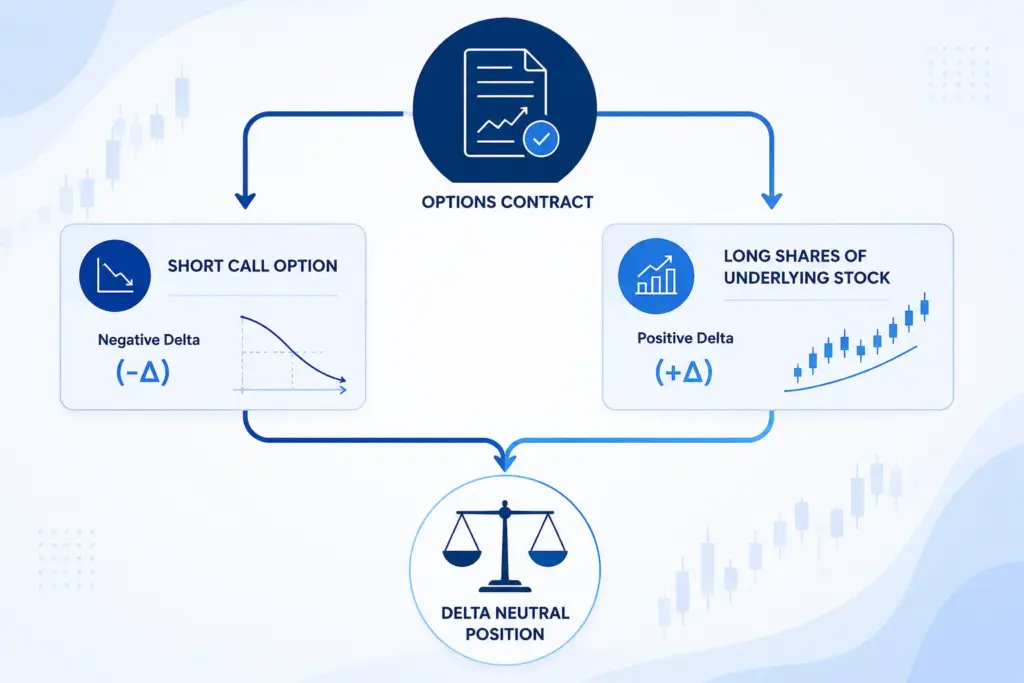
Delta hedging is a risk management technique where a trader offsets the directional exposure of an options position by buying or selling the underlying asset, or other options, in a proportion equal to the position’s delta. The goal is to make the combined portfolio’s value insensitive, at least for a small price move, to changes in the price of the underlying.
In plain terms, an option’s delta tells a trader how much the option’s price is expected to move for every one-unit move in the underlying asset. A call option with a delta of 0.50 is expected to gain roughly half a point for every one-point rise in the stock.
If a trader has sold that call, they are effectively short 50 shares’ worth of directional exposure. To neutralize that exposure, the trader can buy 50 shares of the underlying stock. If the stock rises, the loss on the short call is offset by the gain on the shares, and vice versa if the stock falls.
Delta hedging is most closely associated with market makers and options dealers, who quote prices on options throughout the day and cannot afford to carry large directional bets. Every time they sell a call or buy a put from a client, they immediately look to hedge the resulting delta exposure using the underlying stock, index futures, or other options. This lets them earn the bid-ask spread and the premium built into option prices without taking a large view on where the market is headed.
For retail and professional traders, delta hedging is used differently. Rather than hedging every single trade throughout the day, it is more commonly applied to protect a specific position from adverse short-term moves, to isolate a bet on volatility from a bet on direction, or to manage the risk of a larger portfolio that has become unintentionally directional.
What Is Delta Neutrality and Why Does It Matter?
A delta-neutral position is a portfolio whose combined delta adds up to zero, meaning that for small moves in the underlying asset, the portfolio’s value should remain approximately unchanged. Delta neutrality matters because it allows a trader to isolate exposure to other factors, such as volatility, time decay, or interest rates, without also carrying a bet on which direction the underlying will move.
Consider a trader who believes an underlying stock is about to become more volatile ahead of an earnings announcement, but has no strong opinion on whether the stock will rise or fall. Simply buying a call option would express a bullish view as well as a volatility view, since a call has positive delta. If the stock falls even though volatility rises as expected, the position could still lose money because of the directional exposure baked into the call.
By buying a call and simultaneously shorting the appropriate number of underlying shares to offset the call’s delta, the trader creates a position that is close to delta neutral at the moment it is put on. The remaining exposure is largely to gamma and vega, meaning the position benefits from large moves in either direction and from rising implied volatility, rather than from the stock going up specifically.
This is why delta neutrality is often described as a way to trade volatility rather than direction. It is a foundational concept behind strategies such as straddles, strangles, and the market-making models used across exchange-traded derivatives desks globally.
Delta neutrality is rarely a permanent state. As the underlying price moves, as time passes, and as implied volatility shifts, the delta of the options in the position changes. A position that was neutral this morning may no longer be neutral by the afternoon, which is why delta hedging is typically an ongoing, dynamic process rather than a single trade.
How Is Delta Calculated for an Option Position?
Delta is one of the option Greeks, a set of risk measures derived from options pricing models such as the Black-Scholes model, that describe how sensitive an option’s price is to different underlying factors. Delta specifically measures the rate of change in an option’s theoretical price relative to a one-unit change in the price of the underlying asset, and it is expressed as a number between -1 and 1.
Call options carry positive delta, ranging from 0 to 1, because their value rises as the underlying price rises. Put options carry negative delta, ranging from -1 to 0, because their value rises as the underlying price falls. A delta of 0.50 on a call, for example, means the option’s price is expected to increase by approximately 0.50 for every one-point increase in the underlying, all else being equal.
Delta also serves as a rough proxy for the probability that an option will expire in the money, although this is only an approximation and not an exact probability. An at-the-money option typically has a delta close to 0.50 for a call or -0.50 for a put, since there is roughly an even chance of finishing above or below the strike price. A deep in-the-money call can have a delta approaching 1, since it behaves almost like owning the underlying stock outright, while a deep out-of-the-money call can have a delta close to zero, since it is unlikely to have any intrinsic value at expiry.
Delta by Option Type and Moneyness
| Option Type | Deep Out-of-the-Money | At-the-Money | Deep In-the-Money |
|---|---|---|---|
| Call Option | Near 0.00 | Around 0.50 | Approaching 1.00 |
| Put Option | Near 0.00 | Around -0.50 | Approaching -1.00 |
To hedge a position, traders convert delta into a share equivalent. Since one standard exchange-traded option typically controls 100 shares of the underlying, an option with a delta of 0.50 represents exposure equivalent to 50 shares. A trader short 10 of these call contracts is short delta equivalent to 500 shares (10 contracts multiplied by 100 shares multiplied by 0.50 delta), and would need to buy roughly 500 shares of the underlying to bring that position back to delta neutral.
How Do You Build a Delta-Neutral Position?
Building a delta-neutral position starts with calculating the net delta of every option in the portfolio, converting that into a share-equivalent figure, and then trading the underlying asset in the opposite direction to offset it. This can be done using the underlying stock itself, index or single-stock futures, or other options with an offsetting delta.
The process generally follows these steps:
- Identify the option position and its delta. This could be a single option, a spread, or a multi-leg strategy. Each leg contributes its own delta to the total.
- Calculate the net delta of the full position. Add the deltas of all legs together, weighting each by the number of contracts, to arrive at a single net delta figure for the portfolio.
- Convert net delta into a share-equivalent exposure. Multiply the net delta by the contract multiplier, typically 100 shares per contract, and by the number of contracts held.
- Trade the underlying, or an offsetting option, to neutralize the exposure. If the position is net long delta, sell shares or futures, or buy puts, to offset it. If the position is net short delta, buy shares or futures, or buy calls, to offset it.
- Confirm the resulting portfolio delta is close to zero. Small residual deltas are normal since exact neutrality is difficult to maintain continuously, but the goal is to keep the net exposure within an acceptable tolerance.
Worked Example
A trader sells 5 call option contracts on a stock, and each contract has a delta of 0.40. The total delta exposure from the calls is calculated as 5 contracts multiplied by 100 shares multiplied by 0.40 delta, which equals 200. Because the trader is short the calls, the position delta is negative 200, meaning the trader effectively benefits if the stock falls and loses if the stock rises.
To hedge this, the trader buys 200 shares of the underlying stock. Owning 200 shares carries a delta of positive 200 (since each share has a delta of 1), which offsets the negative 200 delta from the short calls. The combined position now has a net delta close to zero. If the stock moves up or down by a small amount, the gain or loss on the 200 shares should approximately offset the loss or gain on the short call position, leaving the trader more exposed to how implied volatility and time decay behave rather than to the stock’s direction.
This example uses hypothetical figures for illustration only and does not represent actual market prices, deltas, or trading outcomes.
Understand Options Pricing Before You Trade
Get access to global exchange-traded derivatives with a broker built for serious options traders.
Why Does a Delta-Neutral Position Need Constant Rebalancing?
A delta-neutral position needs constant rebalancing because delta itself is not a fixed number. It changes as the underlying price moves, as time passes toward expiry, and as implied volatility shifts, which means a hedge that is neutral at one moment can quickly become unbalanced.
This constant shifting of delta is driven primarily by gamma, another of the option Greeks, which measures how much an option’s delta changes for a given move in the underlying. A position with high gamma will see its delta change rapidly even after small price moves, requiring more frequent rebalancing. A position with low gamma will stay closer to neutral for longer, needing less frequent adjustment.
Consider the earlier example of a trader who is short calls and long shares to stay delta neutral. If the underlying stock rallies, the delta of the short calls becomes more negative in absolute terms, since the calls move closer to being in the money, and the trader’s net position becomes short delta overall. To rebalance, the trader typically needs to buy more shares. If the stock instead falls, the calls lose delta, and the trader’s position becomes long delta, requiring the trader to sell some of the shares they are holding.
This process of continuously adjusting the hedge as the underlying moves is often referred to as dynamic hedging. In practice, professional desks do not rebalance continuously, since that would be prohibitively expensive. Instead, they set rebalancing rules based on time intervals, such as once a day or several times a day, or based on delta thresholds, where a hedge is only adjusted once the net delta crosses a predefined limit.
The frequency of rebalancing directly affects both the accuracy of the hedge and its cost. Rebalancing too rarely leaves the position exposed to larger, unhedged directional swings between adjustments. Rebalancing too frequently increases transaction costs and can erode the profitability of the strategy, particularly for options that expire soon and whose gamma tends to be highest.
What Role Does Gamma Play in Delta Hedging?
Gamma plays a central role in delta hedging because it determines how quickly and how often a hedge needs to be adjusted. While delta measures the current directional sensitivity of an option, gamma measures how that sensitivity itself changes as the underlying price moves, making gamma effectively the acceleration behind delta hedging.
Options with high gamma are the hardest to keep delta neutral. At-the-money options close to expiry typically carry the highest gamma of all, since even a small move in the underlying can push the option from being roughly 50 delta to being deep in or out of the money. This is why traders sometimes describe the final days before an option’s expiry as a period where gamma risk becomes especially acute, since the option’s delta can swing dramatically from one trading session to the next.
Long options positions, whether calls or puts, are generally long gamma, meaning their delta moves in the trader’s favor as the underlying moves. A long gamma position benefits from large price swings because the position’s delta adjusts to capture more of the move. Short options positions are generally short gamma, meaning delta moves against the trader as the underlying moves, which is precisely why option sellers who delta hedge often need to buy high and sell low on the underlying just to stay neutral, a dynamic sometimes called negative gamma bleed.
How Gamma Affects Hedging Behavior
| Position Type | Gamma Exposure | Hedging Behavior Required |
|---|---|---|
| Long Call or Long Put | Positive (long) gamma | Sell underlying as price rises, buy as price falls, generally favorable |
| Short Call or Short Put | Negative (short) gamma | Buy underlying as price rises, sell as price falls, generally costly |
| Deep In or Out-of-the-Money Option | Low gamma | Delta changes slowly, less frequent rebalancing needed |
| At-the-Money Option Near Expiry | High gamma | Delta changes rapidly, frequent rebalancing needed |
Understanding gamma alongside delta is essential for anyone managing an options book, because a position that looks neutral today based on delta alone can become significantly directional after even a modest market move if its gamma is high. This is one reason experienced traders monitor delta and gamma together rather than delta in isolation, and it connects closely to the broader set of options pricing and Greeks that professional traders track as market conditions evolve.
What Are the Costs and Practical Challenges of Delta Hedging?
Delta hedging is not free, and its practical costs can meaningfully affect the profitability of an options strategy. The main costs include transaction costs from frequent trading, slippage between the theoretical hedge ratio and the price actually achieved in the market, and the ongoing erosion of option value from time decay, which continues regardless of how well a position is hedged for direction.
Transaction Costs and Slippage
Every time a trader rebalances a delta hedge, they incur trading costs, including brokerage commissions, exchange fees, and the bid-ask spread on the underlying asset. For a market maker running thousands of hedges a day, these costs can add up quickly. For a retail or professional trader, frequent rebalancing on a single position can also erode returns, particularly on lower-priced or less liquid underlying assets where spreads are wider.
Time Decay Working Against Option Buyers
An option’s time value declines as expiry approaches, a phenomenon known as time decay. A trader who is long an option and delta hedging it is generally paying for gamma exposure through this time decay. If the underlying does not move enough to compensate for the time decay lost each day, the position can lose money even though it was properly delta hedged throughout its life. This trade-off between gamma and time decay is one of the central tensions in options trading.
Discrete Hedging vs Continuous Models
Options pricing models such as Black-Scholes assume that hedging can happen continuously and without transaction costs, which is not how markets actually work. In reality, traders can only rebalance at discrete intervals, whether that is several times a day or once a day, which introduces a gap between the theoretical hedge and the practical one. This gap, sometimes called hedging error, tends to grow when the underlying makes large, sudden moves between rebalancing points, such as during a market gap after unexpected news.
Liquidity and Execution Risk
Delta hedging assumes the trader can buy or sell the underlying asset at or near the prevailing market price whenever needed. In less liquid underlyings, or during periods of market stress, this assumption can break down. Wider spreads, thinner order books, and rapid price swings can all make it more expensive, or in extreme cases temporarily impossible, to execute a hedge at a reasonable price.
Model Risk
The delta figure a trader uses to hedge is only as reliable as the model used to calculate it. Inputs such as implied volatility, dividend expectations, and interest rate assumptions all affect the calculated delta. If these inputs are inaccurate, the resulting hedge ratio may not actually neutralize the position’s real-world sensitivity to the underlying, leaving the trader with residual directional risk they did not intend to carry.
Trade Options With Institutional-Grade Market Access
Access global exchanges through a DFSA-regulated derivatives desk built for professional and institutional traders.
Delta Hedging vs Static Hedging: What Is the Difference?
Delta hedging and static hedging are two distinct approaches to managing risk in an options portfolio, and understanding the difference helps investors see why dynamic hedging is the standard approach among professional options desks despite its added complexity and cost.
Static hedging involves putting on a hedge once and leaving it in place until expiry, without adjusting it as market conditions change. A simple example is buying a protective put against a stock holding and holding both positions unchanged until the put expires. Delta hedging, by contrast, is an ongoing process where the hedge ratio is recalculated and adjusted repeatedly as the underlying price, time to expiry, and implied volatility change.
Delta Hedging vs Static Hedging
| Comparison Point | Delta Hedging (Dynamic) | Static Hedging |
|---|---|---|
| Adjustment Frequency | Rebalanced continuously or at set intervals as delta changes | Set once and held until expiry or a predefined trigger |
| Primary Goal | Neutralize directional exposure while isolating other Greeks such as volatility Provide a fixed level of downside or upside protection | Provide a fixed level of downside or upside protection |
| Transaction Costs | Higher, due to repeated trading of the underlying | Lower, since the hedge is put on once |
| Complexity | Requires ongoing monitoring of delta and gamma | Simpler to implement and monitor |
| Typical Users | Market makers, options desks, active professional traders | Long-term investors seeking portfolio insurance |
| Effectiveness in Fast Markets | Can lag behind rapid price moves between rebalancing points | Protection level is known in advance regardless of path taken |
Neither approach is inherently superior. Static hedging suits investors who want a known, fixed level of protection and are comfortable holding a position without active management, such as buying a put to protect a long-term equity holding through an earnings event. Delta hedging suits traders and desks who need to keep a book of options positions close to directionally neutral on an ongoing basis, particularly when they are actively trading volatility or providing liquidity in the options market.
Who Actually Uses Delta Hedging in Practice?
Delta hedging is used across a range of market participants, but the intensity and frequency of hedging activity differs significantly between market makers, professional proprietary traders, and retail or institutional investors managing their own portfolios.
- Market Makers and Options Dealers
Market makers are the most active users of delta hedging. Because they are constantly quoting prices and executing trades with clients on both sides of the market, their books accumulate delta exposure throughout the trading day. Delta hedging allows them to remain close to neutral so their profitability comes from the bid-ask spread and the volatility risk premium embedded in options, rather than from directional bets on the underlying.
- Proprietary and Volatility Trading Desks
Professional trading firms that specifically trade volatility as an asset class rely heavily on delta hedging. Strategies such as gamma scalping, where a trader profits from buying low and selling high on the underlying as they rebalance a long-gamma position, depend entirely on disciplined and frequent delta hedging to isolate the volatility exposure they are trying to capture.
- Institutional Investors and Hedge Funds
Institutional investors may use delta hedging less frequently but still strategically, particularly when managing large derivatives overlays on a portfolio, hedging currency or interest rate exposure embedded in structured positions, or running relative value strategies across correlated instruments.
- Retail and Active Individual Traders
Retail traders typically apply delta hedging in a simplified form, most often to protect a specific position around a known event, such as an earnings announcement, or to convert a directional options trade into more of a volatility play. Because retail traders usually do not have the infrastructure for continuous rebalancing, they tend to hedge less frequently and accept a wider tolerance around delta neutrality than institutional desks.
Regardless of the type of participant, the underlying logic is the same. Delta hedging separates the directional component of an options position from the other risk factors, allowing the trader to express a more precise view rather than an unintentionally blended one
What Are the Most Common Mistakes in Delta Hedging?
Even experienced traders can fall into predictable traps when managing delta-hedged positions. Understanding these common mistakes helps investors approach the strategy with realistic expectations rather than assuming it removes risk entirely.
- Treating delta neutral as risk free. A delta-neutral position still carries gamma, vega, and theta risk. It is neutral to small directional moves only, not to volatility changes, time decay, or large price gaps.
- Ignoring gamma when setting a rebalancing schedule. Using the same rebalancing frequency for a low-gamma, far-dated option and a high-gamma, near-expiry option can leave one position under-hedged and the other over-traded.
- Underestimating transaction costs. Frequent rebalancing in a low-liquidity underlying can quietly erode the profitability of an otherwise well-designed strategy through spreads and commissions.
- Relying on a single volatility input. Since delta is derived from an options pricing model, using a stale or inaccurate implied volatility assumption can distort the calculated hedge ratio and leave real exposure unaccounted for.
- Forgetting about dividends and corporate actions. Upcoming dividends, stock splits, or other corporate actions can shift an option’s delta in ways that a simple hedging model may not immediately capture, particularly for single-stock options.
- Overreacting to noise. Rebalancing too aggressively in response to minor, insignificant price fluctuations increases costs without meaningfully improving the accuracy of the hedge.
- Losing sight of the original objective. A trader who set up a delta-neutral position to isolate a volatility view can drift away from that goal if repeated rebalancing decisions are made reactively rather than according to a consistent plan.
Recognizing these pitfalls does not eliminate the inherent complexity of delta hedging, but it does help investors approach the strategy with a clearer sense of what it can and cannot achieve.
How Does Delta Hedging Fit Into a Broader Risk Management Strategy?
Delta hedging is one component within a larger toolkit of options risk management, working alongside the other Greeks to give traders a fuller picture of how a position will behave under different market conditions. On its own, delta hedging addresses only directional risk, which is why professional traders typically monitor it together with gamma, theta, and vega rather than in isolation.
A trader managing a book of options positions generally tracks how the portfolio’s overall delta, gamma, theta, and vega evolve as market conditions change, adjusting hedges not just for direction but for the interaction between these different sensitivities. For example, a portfolio that is delta neutral but heavily short gamma and short vega carries a very different risk profile from one that is delta neutral but long gamma and long vega, even though both would appear similarly “hedged” if delta were the only measure being watched.
This is also where understanding the fundamentals of options basics, including calls, puts, strike price, and how contracts are exercised, becomes valuable, since delta hedging builds directly on top of these foundational concepts. A trader needs a solid grasp of how option value is affected by moneyness, time to expiry, and volatility before the mechanics of hedging that value make full sense in practice.
Delta hedging also connects closely to the concept of the option Greeks, Delta, Gamma, Theta, and Vega, as a family of related risk measures, since a trader cannot manage delta risk responsibly without also understanding how gamma will change that delta, how theta will erode the position’s value over time, and how vega will affect it if implied volatility shifts. Approaching delta hedging as part of this broader picture, rather than as an isolated technique, is what separates a mechanical hedge from a genuinely risk-managed options position.
Frequently Asked Questions (FAQs)
What does it mean for an options position to be delta neutral?
A delta-neutral position is one where the combined delta of all its components adds up to approximately zero, meaning small moves in the underlying asset should have little effect on the position’s overall value. It does not mean the position is free of all risk, since exposure to volatility, time decay, and gamma typically remains.
How often should a delta hedge be rebalanced?
There is no single correct frequency, since it depends on the position’s gamma, the trader’s cost tolerance, and how actively the underlying is moving. High-gamma positions, such as at-the-money options close to expiry, generally require more frequent rebalancing than low-gamma, longer-dated positions.
Can delta hedging eliminate all risk in an options position?
No. Delta hedging only offsets the directional risk captured by delta at a given moment. A delta-neutral position can still lose money due to changes in implied volatility, time decay, large price gaps between rebalancing points, or shifts in gamma that make the hedge less accurate.
Is delta hedging something only market makers and professional traders use?
Market makers and professional trading desks are the most frequent and systematic users of delta hedging, since it is central to how they manage risk across large options books. Retail and active individual traders can apply the same principles on a smaller scale, most commonly to manage the risk of a specific position around a known market event.
Disclaimer:
Trading foreign exchange and/or contracts for difference on margin carries a high level of risk, and may not be suitable for all investors as you could sustain losses in excess of deposits. The products are intended for retail, professional and eligible counterparty clients. Before deciding to trade any products offered by PhillipCapital (DIFC) Private Limited you should carefully consider your objectives, financial situation, needs and level of experience. You should be aware of all the risks associated with trading on margin. The content of the Website must not be construed as personal advice. For retail, professional and eligible counterparty clients. Before deciding to trade any products offered by PhillipCapital (DIFC) Private Limited you should carefully consider your objectives, financial situation, needs and level of experience. You should be aware of all the risks associated with trading on margin.
Rolling Spot Contracts and CFDs are complex instruments and come with a high risk of losing money rapidly due to leverage. 78% of our retail client accounts lose money while trading with us. You should consider whether you understand how Rolling Spot Contracts and CFDs work, and whether you can afford to take the high risk of losing your money.

Rho and Interest Rate Sensitivity
Rho options greek interest rate sensitivity Introduction Most options traders...
Read More


Gamma Risk and Gamma Scalping
Gamma Risk and Gamma Scalping Gamma Risk and Gamma Scalping:...
Read More
Delta Hedging and Delta Neutrality
Delta Hedging and Delta Neutrality Delta Hedging and Delta Neutrality:...
Read More
The Greeks: Delta, Gamma, Theta, and Vega
Options Greeks : Delta, Gamma, Theta, Vega The Greeks: Delta,...
Read More
Black-Scholes Model Basics
Black-Scholes model Black-Scholes Model Basics: How Options Traders Understand Fair...
Read More
Options Exercise & Assignment
Options Exercise & Assignment Table of Contents Introduction What Does...
Read More
American vs European Options
American vs European Options Table of Contents Introduction What Is...
Read More
Options Expiration Dates
Options Expiration Dates Table of Contents Introduction What Is an...
Read More

Intrinsic Value and Time Value
Intrinsic Value and Time Value Introduction When you buy or...
Read More
In-the-Money, At-the-Money, Out-of-the-Money Options
In-the-Money, At-the-Money, Out-of-the-Money Options Introduction If you have started exploring...
Read More

Call Options Explained
Call Options Explained Table of Contents Introduction What Exactly Is...
Read More
Options Fundamentals
Options Fundamentals Table of Contents Introduction What Is an Option...
Read More
VIX Futures & Volatility Futures
VIX Futures & Volatility Futures Table of Contents Introduction What...
Read More
Precious Metals Futures
Precious Metals Futures What Are Precious Metals Futures? A Guide...
Read More
Agricultural Futures
Agricultural Futures Agricultural Futures: Hedging and Trading Strategies Agricultural futures...
Read More
Energy Futures Trading
Energy Futures Trading Introduction Energy is the lifeblood of the...
Read More
Commodity Futures
Commodity Futures What Are Commodity Futures? A Comprehensive Guide for...
Read More

Interest Rate Futures
Interest Rate Futures Mastering Interest Rate Futures: A Strategic Guide...
Read More

Cash Settlement vs Physical Delivery
Cash Settlement vs Physical Delivery in Trading Cash Settlement vs...
Read More
Futures Settlement Methods
Futures Settlement Methods Introduction Navigating the financial markets requires a...
Read More
Margin Calls & Mark-to-Market
Margin Calls & Mark-to-Market Table of Contents Introduction to Futures...
Read More
Initial vs. Maintenance Margin
Initial vs. Maintenance Margin Understanding Initial and Maintenance Margins: A...
Read More
Contango & Backwardation Explained
Contango and Backwardation Explained Contango and Backwardation Explained: Navigating Futures...
Read More