
Theta Decay and Time Value Theta Decay and Time Value:...
Read MoreTheta Decay and Time Value
Theta Decay and Time Value: How Time Erodes an Option's Price
Every option you buy or sell has a built in clock. From the moment a contract is opened, it begins losing a small piece of its value each day, purely because time is passing. This guide breaks down exactly why that happens, how to measure it, and what it means for anyone trading Futures and Options at PhillipCapital DIFC.
You will learn what time value actually represents inside an option’s premium, how Theta quantifies that daily erosion, and why the pace of decay is not constant but accelerates as expiration approaches. We will also look at how moneyness changes Theta’s impact, how buyers and sellers experience decay differently, and the practical mistakes retail investors tend to make when they ignore this Greek.
By the end, you should be able to look at any option chain and understand, at a glance, how much of the premium is time value, how fast that value is likely to erode, and how that erosion fits into a broader risk management approach involving the underlying asset, volatility, and strike price selection.
Table of Contents
- What Is Time Value in an Option’s Price?
- What Is Theta and How Does It Measure Time Decay?
- Why Does Theta Accelerate as Expiration Approaches?
- How Does Moneyness Affect Theta Decay?
- How Does Theta Differ for Option Buyers vs Option Sellers?
- How Can Traders Use Theta in an Options Strategy?
- What Common Mistakes Do Traders Make With Time Decay?
- How Does Theta Interact With the Other Greeks?
What Is Time Value in an Option's Price?
Time value is the portion of an option’s premium that exists purely because there is still time left before expiration for the underlying asset to move favorably. It is calculated as the option’s total premium minus its intrinsic value. A longer time to expiry generally means more time value, because there is more opportunity for the underlying price to shift in the buyer’s favor.
Every option premium is made up of two components: intrinsic value and time value. Intrinsic value is the amount an option would be worth if it were exercised right now, essentially the difference between the strike price and the current price of the underlying asset, when that difference is favorable to the holder. Time value is everything else. An option that is far out of the money, with no intrinsic value at all, is trading purely on time value and the market’s expectation that things could change before expiry.
Consider a call option on a stock trading at 100, with a strike price of 95. That option has 5 in intrinsic value, because the holder could theoretically buy the stock at 95 and immediately sell it at 100. If the option is trading at 7, the remaining 2 is time value. This is the price investors are willing to pay for the possibility that the stock rises further before expiration, giving the option even more intrinsic value later.
Time value tends to be highest for at the money options with a long time to expiry, since these contracts carry the most uncertainty about how they will finish. As expiration nears, or as an option moves deep in or out of the money, time value shrinks. Investors evaluating F&O contracts on Dubai Gold and Commodities Exchange products or other exchange traded derivatives should think of time value as the “insurance premium” embedded in an option, a cost paid for optionality that steadily diminishes as the contract’s life runs out.
Ready to Put Options Theory Into Practice?
Access global Futures and Options markets with tools built for both new and experienced traders.
What Is Theta and How Does It Measure Time Decay?
Theta is the Greek that measures how much an option’s price is expected to fall each day, all else being equal, purely due to the passage of time. It is typically expressed as a negative number for long option positions, meaning the holder loses a small, quantifiable amount of premium every single day the position is held, even if the underlying asset does not move at all.
Theta is one of the five main Greeks used in options pricing and Greeks analysis, alongside Delta, Gamma, Vega, and Rho. While Delta tracks sensitivity to the underlying asset’s price and Vega tracks sensitivity to volatility, Theta isolates the effect of time alone. If an underlying asset’s price stays completely flat and implied volatility does not change, an option’s premium will still decline day after day, and that decline is Theta at work.
A practical way to think about Theta is as a daily “rent” the option buyer pays for holding the contract. If an option has a Theta of negative 0.05, the model expects the premium to fall by roughly 0.05 per day, assuming nothing else changes. Multiply that across the number of contracts and the multiplier for the underlying, and the dollar or dirham impact becomes clear on any sizable position.
Theta is derived from options pricing models, most commonly variations of the Black-Scholes framework covered in our guide on Black-Scholes Model Basics. These models treat time to expiration as one of the core inputs, alongside the underlying price, strike price, volatility, and interest rates, and Theta is simply the mathematical derivative of the option’s price with respect to time.
It is worth noting that Theta is rarely perfectly linear. The number quoted on any given day is an instantaneous estimate, and it changes as other factors, particularly time itself and volatility, shift. This is why understanding the shape of Theta decay, not just its current value, matters so much for anyone managing an options position over multiple days or weeks.
Why Does Theta Accelerate as Expiration Approaches?
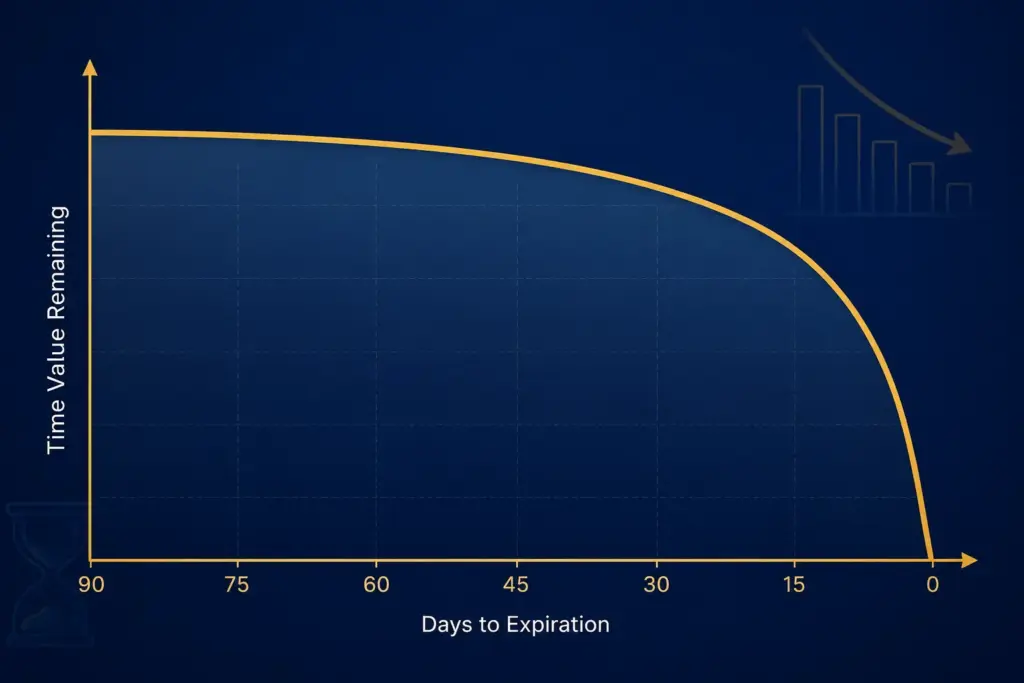
Theta accelerates as expiration nears because there is progressively less time for the underlying asset to move in the option holder’s favor, which compresses the probability distribution of possible outcomes. This means an at the money option loses value slowly with months left to expiry, but that decay speeds up dramatically in the final weeks and days before the contract expires.
This behavior is often visualized as a curve rather than a straight line. In the early life of an option, say with 90 days remaining, the daily loss in time value might be small, perhaps a fraction of a percent of the total premium.
As the same option moves inside 30 days, and especially inside the final week, the daily erosion accelerates sharply. By the last day or two before expiration, an at the money option can lose a meaningful chunk of its remaining value in a single session.
The mathematical reason behind this comes from how options models weigh time. The relationship between an option’s time value and time to expiration follows something closer to a square root function than a straight line. Because the square root of time decreases more slowly at first and then drops off more steeply as time to expiry gets very short, the resulting Theta curve is relatively flat early on and steep near expiration.
This has a direct practical consequence: an investor who buys a 60 day option and plans to hold it for two weeks experiences a very different decay profile than one who buys a two week option outright. The former is riding the flatter part of the curve, while the latter is exposed to the steepest part almost immediately. Traders using Futures and Options as part of a directional or hedging strategy should factor this acceleration into their entry timing and expected holding period.
It is also worth noting that acceleration is most pronounced for at the money contracts. Deep in the money and deep out of the money options behave somewhat differently, a distinction covered in more detail in the next section.
How Does Moneyness Affect Theta Decay?
Moneyness, meaning whether an option is in the money, at the money, or out of the money, significantly changes both the size of Theta and how it behaves as expiration approaches. At the money options typically carry the highest Theta because they hold the most time value and the most uncertainty about how they will finish, while deep in the money and deep out of the money options generally have smaller Theta values.
An at the money option has no intrinsic value, so its entire premium is time value, and it also represents the point of maximum uncertainty about whether it will expire in or out of the money. This combination makes at the money contracts the most sensitive to the passage of time, which is why they often show the steepest decay curves as expiration nears.
Deep in the money options behave differently. Much of their premium is intrinsic value, which does not decay with time, so the time value component, and therefore Theta, tends to be smaller relative to the option’s total price. Deep out of the money options also tend to have lower absolute Theta, not because there is less uncertainty, but because there is so little time value left to lose in the first place, the option is already cheap and has little premium remaining to erode.
Readers exploring our guide on In-the-Money, At-the-Money, and Out-of-the-Money Options will find this concept builds directly on moneyness classification. Understanding where a contract sits relative to the underlying asset’s price is the first step to estimating how exposed it is to time decay.
| Moneyness | Typical Theta Size | Time Value Composition | Decay Behavior Near Expiry |
|---|---|---|---|
| Out-of-the-Money | Low to moderate | Almost entirely time value | Decay flattens as premium approaches zero |
| At-the-Money | Highest | Entirely time value | Sharpest acceleration in final weeks |
| In-the-Money | Low relative to premium | Mostly intrinsic, some time value | Decay affects only the time value portion |
This table highlights why professional and institutional desks often monitor moneyness alongside days to expiry when structuring or unwinding positions. A trader holding an at the money straddle, for example, is far more exposed to time decay than one holding a deep in the money call used primarily as a stock replacement strategy.
How Does Theta Differ for Option Buyers vs Option Sellers?
Theta works against option buyers and in favor of option sellers, since time decay reduces the premium that buyers hold and that sellers are obligated to pay back. A long call or put position has negative Theta, meaning its value erodes daily, while a short call or put position has positive Theta, meaning the position gains value simply from the passage of time, assuming other factors stay constant.
This asymmetry is central to why many income focused strategies, such as covered calls or cash secured puts, are built around selling options rather than buying them. A seller collects the premium upfront and benefits every day that passes without the underlying asset moving unfavorably, effectively getting paid to wait. This is sometimes described as being “long Theta.”
Buyers, on the other hand, need the underlying asset to move enough, and quickly enough, to offset the daily erosion in premium. This is why purely directional option buying can be a difficult strategy in quiet or range bound markets. Even if an investor correctly predicts the eventual direction of a stock or commodity, a long option position can still lose money if the move takes too long to materialize and Theta erodes the premium faster than Delta can rebuild it.
Investors should also consider that selling options carries its own risks, particularly around unlimited or substantial downside exposure on uncovered positions, and margin requirements can be significant. Evaluating Theta exposure alongside Delta, Gamma, and Vega gives a more complete risk picture than looking at any single Greek in isolation, a point covered further in the closing section of this guide.
Manage Time Decay With the Right Trading Tools
Trade options across 15+ global exchanges with the platform and support to size positions with confidence.


How Can Traders Use Theta in an Options Strategy?
Traders use Theta by matching their strategy’s structure to their view on time decay, either positioning as net buyers when they expect a fast, large move, or as net sellers when they expect the underlying to stay range bound and want to collect premium as time passes. Many advanced strategies, such as calendar spreads and iron condors, are built specifically to exploit differences in Theta between contracts with different expiries or strikes.
A calendar spread, for instance, involves selling a near term option and buying a longer dated option at the same strike. Because the near term option decays faster than the longer dated one, the position can profit from the differential in Theta even if the underlying asset barely moves. This is a direct, practical application of the acceleration curve discussed earlier in this guide.
Iron condors and other premium selling strategies aim to collect time value from options that are unlikely to finish in the money, essentially positioning as a net seller of Theta across a defined range. These strategies tend to perform best in lower volatility environments where the underlying asset is expected to trade within a predictable band through expiration.
For investors trading Futures and Options at PhillipCapital DIFC across commodities, indices, FX, and rates, understanding Theta is not just an academic exercise. It directly affects position sizing, the choice between weekly, monthly, or longer dated contracts, and the timing of entries and exits. A trader rolling a position forward, for example, needs to weigh the cost of losing time value on the expiring contract against the time value embedded in the new one.
It is also worth building the habit of checking an option’s Theta alongside its Delta and Vega before entering any trade. A position with high positive Delta but also high negative Theta needs the underlying to move quickly enough to outpace decay, while a position designed to be Theta neutral or Theta positive may be more appropriate for investors expecting a quiet market.
What Common Mistakes Do Traders Make With Time Decay?
The most common mistake with time decay is buying options with very little time to expiration in the hope of quick gains, without accounting for how aggressively Theta accelerates in the final days of an option’s life. Other frequent errors include ignoring Theta entirely when comparing similar strikes across different expiries, and underestimating how much time value can be lost over a weekend or holiday period when markets are closed but the calendar keeps moving.
New options traders sometimes assume that because an underlying asset moved in the direction they expected, their option should be profitable. In reality, if the move was small or slow, Theta decay may have offset most or all of the gain from Delta. This is one of the most frustrating experiences for beginners and a leading reason many first time option buyers lose money even when their market view was directionally correct.
Another common error is holding losing long option positions into the final week before expiration in the hope of a reversal. Because Theta accelerates so sharply in this window, the position can lose value rapidly even without any adverse move in the underlying, making the odds of recovery mathematically worse with each passing day.
Investors evaluating American vs European Options should also note that exercise style does not change the basic mechanics of time decay, though it can affect strategy choices around early exercise and assignment, a topic explored further in our guide on Options Exercise and Assignment.
A more subtle mistake involves overlooking weekend and holiday decay. Options pricing models typically account for calendar days, not just trading days, meaning time value erodes even when markets are closed. A three day weekend can therefore represent a larger chunk of decay than the surrounding single trading days, something short term traders should factor into weekly and monthly contract choices.
How Does Theta Interact With the Other Greeks?
Theta does not operate in isolation. It interacts closely with Gamma, since options with high Gamma, meaning their Delta changes rapidly with small moves in the underlying, also tend to carry high Theta, reflecting the trade off between potential reward and the cost of holding that exposure. It also interacts with Vega, because a rise in implied volatility can offset some of the daily loss from Theta, while a drop in volatility can compound it.
This relationship between Gamma and Theta is sometimes described as a trade off: the market effectively charges option buyers a daily premium, measured by Theta, in exchange for the potential to benefit disproportionately from a large move, measured by Gamma. Investors interested in a deeper look at this dynamic can review our guide on Gamma Risk and Gamma Scalping, which explores how professional desks manage this relationship in active hedging programs.
Delta also plays a role, since a position’s overall profit or loss on any given day is the net result of the move driven by Delta and Gamma, offset by the daily cost from Theta and any shift in value from Vega. Traders following formal hedging approaches, such as those outlined in our guide on Delta Hedging and Delta Neutrality, often rebalance positions specifically to isolate and manage Theta exposure separately from directional risk.
Understanding these interactions gives investors a fuller picture than looking at Theta in isolation. A seemingly attractive Theta figure on an option might come paired with an unfavorable Gamma or Vega profile, and a complete risk assessment considers all of the Greeks together rather than any single measure on its own.
Take the Next Step With Confidence
Speak with our team to understand how Futures and Options can fit into your broader portfolio strategy.
Conclusion
Time value and Theta decay are foundational concepts for anyone trading options, whether as a retail investor exploring exchange traded derivatives for the first time or a professional desk managing a book of positions across multiple expiries. Time value represents the portion of an option’s premium tied to uncertainty and opportunity, while Theta quantifies exactly how much of that value is expected to erode each day.
The key takeaways are that Theta accelerates as expiration nears, peaks for at the money contracts, works against buyers while favoring sellers, and interacts closely with Gamma and Vega. Investors who build these dynamics into their strategy selection, whether choosing between buying and selling premium, or deciding how much time to expiry to target, are better positioned to manage risk deliberately rather than being surprised by it.
As with all derivatives trading, Investors should evaluate their own objectives, risk tolerance, and market outlook before entering any options position, and should consider seeking guidance suited to their individual circumstances.
Frequently Asked Questions (FAQs)
Does Theta decay happen every day, including weekends?
Yes, most options pricing models account for calendar days rather than only trading days, so time value continues to erode over weekends and holidays. This means a three day weekend can represent a larger single block of decay than the days immediately before or after it, which is worth factoring into short term trading decisions.
Why did my option lose value even though the stock moved in my favor?
This usually happens when the move in the underlying asset was too small or too slow to offset the daily Theta decay on the position. It is a common experience for option buyers, particularly with short dated, at the money contracts where Theta is at its highest.
Is Theta the same for calls and puts?
Theta is generally similar in magnitude for calls and puts at the same strike and expiry, since both are exposed to the same passage of time and similar levels of time value when at the money. Differences can emerge closer to expiry or with dividends and interest rate assumptions, but the core mechanics of time decay apply to both option types.
Can Theta ever be positive for a long option position?
In standard cases, a long call or put has negative Theta, meaning it loses value from time decay. However, certain deep in the money European style options can occasionally show a small positive Theta due to interest rate effects, though this is uncommon and generally a minor factor for most retail investors compared with the dominant effect of time value erosion.
Disclaimer:
Trading foreign exchange and/or contracts for difference on margin carries a high level of risk, and may not be suitable for all investors as you could sustain losses in excess of deposits. The products are intended for retail, professional and eligible counterparty clients. Before deciding to trade any products offered by PhillipCapital (DIFC) Private Limited you should carefully consider your objectives, financial situation, needs and level of experience. You should be aware of all the risks associated with trading on margin. The content of the Website must not be construed as personal advice. For retail, professional and eligible counterparty clients. Before deciding to trade any products offered by PhillipCapital (DIFC) Private Limited you should carefully consider your objectives, financial situation, needs and level of experience. You should be aware of all the risks associated with trading on margin.
Rolling Spot Contracts and CFDs are complex instruments and come with a high risk of losing money rapidly due to leverage. 78% of our retail client accounts lose money while trading with us. You should consider whether you understand how Rolling Spot Contracts and CFDs work, and whether you can afford to take the high risk of losing your money.

Gamma Risk and Gamma Scalping
Gamma Risk and Gamma Scalping Gamma Risk and Gamma Scalping:...
Read More
Delta Hedging and Delta Neutrality
Delta Hedging and Delta Neutrality Delta Hedging and Delta Neutrality:...
Read More
The Greeks: Delta, Gamma, Theta, and Vega
Options Greeks : Delta, Gamma, Theta, Vega The Greeks: Delta,...
Read More
Black-Scholes Model Basics
Black-Scholes model Black-Scholes Model Basics: How Options Traders Understand Fair...
Read More
Options Exercise & Assignment
Options Exercise & Assignment Table of Contents Introduction What Does...
Read More
American vs European Options
American vs European Options Table of Contents Introduction What Is...
Read More
Options Expiration Dates
Options Expiration Dates Table of Contents Introduction What Is an...
Read More

Intrinsic Value and Time Value
Intrinsic Value and Time Value Introduction When you buy or...
Read More
In-the-Money, At-the-Money, Out-of-the-Money Options
In-the-Money, At-the-Money, Out-of-the-Money Options Introduction If you have started exploring...
Read More

Call Options Explained
Call Options Explained Table of Contents Introduction What Exactly Is...
Read More
Options Fundamentals
Options Fundamentals Table of Contents Introduction What Is an Option...
Read More
VIX Futures & Volatility Futures
VIX Futures & Volatility Futures Table of Contents Introduction What...
Read More
Precious Metals Futures
Precious Metals Futures What Are Precious Metals Futures? A Guide...
Read More
Agricultural Futures
Agricultural Futures Agricultural Futures: Hedging and Trading Strategies Agricultural futures...
Read More
Energy Futures Trading
Energy Futures Trading Introduction Energy is the lifeblood of the...
Read More
Commodity Futures
Commodity Futures What Are Commodity Futures? A Comprehensive Guide for...
Read More

Interest Rate Futures
Interest Rate Futures Mastering Interest Rate Futures: A Strategic Guide...
Read More

Cash Settlement vs Physical Delivery
Cash Settlement vs Physical Delivery in Trading Cash Settlement vs...
Read More
Futures Settlement Methods
Futures Settlement Methods Introduction Navigating the financial markets requires a...
Read More
Margin Calls & Mark-to-Market
Margin Calls & Mark-to-Market Table of Contents Introduction to Futures...
Read More
Initial vs. Maintenance Margin
Initial vs. Maintenance Margin Understanding Initial and Maintenance Margins: A...
Read More
Contango & Backwardation Explained
Contango and Backwardation Explained Contango and Backwardation Explained: Navigating Futures...
Read More
Forward-Looking Basis
Forward-Looking Basis in Futures Trading Table of Contents Introduction What...
Read More

Futures Pricing And Valuation
Futures Pricing And Valuation Table of Contents What is the...
Read More