

Inverse Floaters Explained November 9, 2026 PhillipCapital DIFC Research Team...
Read MoreInverse Floaters Explained
Inverse Floaters Explained: How the Coupon Moves Against Interest Rates
Most bonds pay the same coupon until maturity, and floating-rate notes pay more when interest rates rise. An inverse floater turns that logic around. Its coupon is highest when benchmark rates are low and shrinks as they climb, which makes it one of the most distinctive payoff structures in fixed income and structured products.
This guide explains what an inverse floater is, how its coupon formula works, how issuers build one, and why its price reacts so strongly to rate moves. You will also find a comparison with floating-rate and fixed-rate bonds, a clear list of risks, and a practical checklist for reading a term sheet.
This guide is written for first-time investors and for readers who already know bonds. All examples use hypothetical numbers to show how the mechanics work.
Table of Contents
- What Is an Inverse Floater?
- How Does the Inverse Floater Coupon Formula Work?
- How Is an Inverse Floater Created?
- What Types of Inverse Floaters Exist?
- Why Is an Inverse Floater So Sensitive to Interest Rate Changes?
- How Does an Inverse Floater Compare With Other Bonds?
- How Do Inverse Floaters Fit Into Structured Notes and Portfolios?
- What Are the Main Risks of Inverse Floaters?
- What Mistakes Do Investors Commonly Make?
- How Can Investors Evaluate an Inverse Floater?
- Key Takeaways on Inverse Floaters
- Frequently Asked Questions About Inverse Floaters
What Is an Inverse Floater?
An inverse floater is a debt security whose coupon moves in the opposite direction to a reference interest rate. When the benchmark falls, the coupon rises. When the benchmark rises, the coupon shrinks, usually until it reaches a floor of zero.
The coupon is the periodic interest a bond pays. The reference rate, also called the benchmark, is a published short-term rate such as SOFR (the Secured Overnight Financing Rate in the United States) or EURIBOR (the euro interbank offered rate). A conventional floating-rate note adds a spread to that benchmark, so its income rises with rates. An inverse floater subtracts the benchmark from a fixed number, so its income falls with rates.
FINRA, the US securities industry regulator, has described the inverse floater as a tranche, meaning a slice of a securitisation, that pays an adjustable rate moving against an interest rate index. The structure also appears in structured notes, where it belongs to the family of payoff structures that link an investor’s return to an underlying rate instead of a fixed promise.
How Does the Inverse Floater Coupon Formula Work?
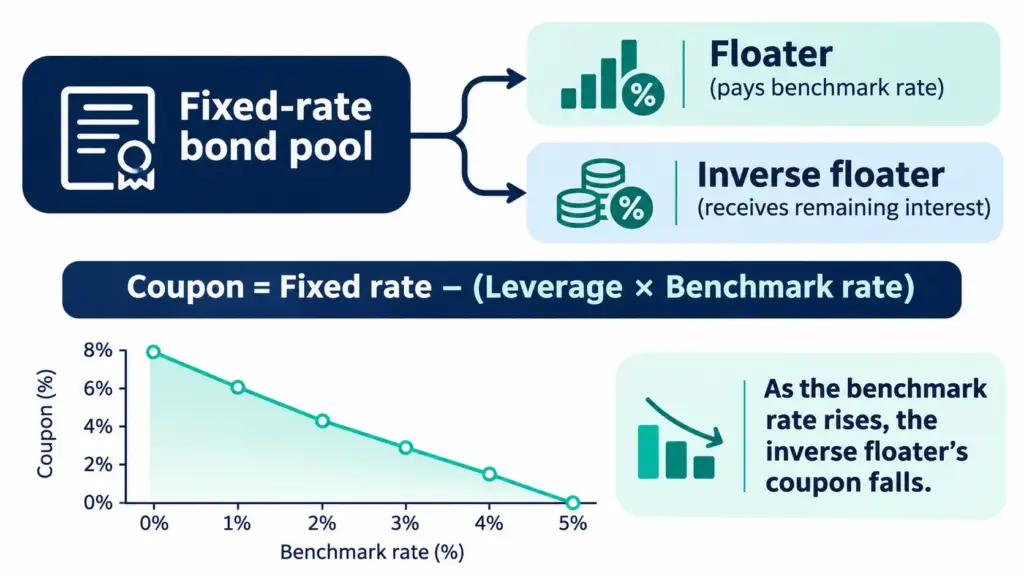
Most inverse floaters follow one formula: coupon equals a fixed rate minus a leverage multiple of the reference rate, with a minimum of zero. If the benchmark rises far enough, the coupon stops at zero rather than turning negative. The leverage multiple decides how sharply the coupon reacts.
The standard form is:
Coupon = K – (L x Reference Rate), never below 0%
Each part of the formula plays a distinct role:
- Fixed rate (K): This is the starting point of the formula and the highest coupon the note can pay, reached only if the reference rate falls to zero.
- Leverage factor (L): This is the multiple applied to the reference rate, so a factor of 1 moves the coupon one-for-one against the benchmark and a factor of 3 moves it three times as far.
- Reference rate: This is the published short-term rate that is reset at each coupon date, and the term sheet names it precisely.
- Floor: Most structures set the minimum coupon at zero, so the investor is not asked to pay interest back when the benchmark is high.
- Ceiling: In normal conditions the benchmark does not fall below zero, so K acts as the practical ceiling on income, and where the benchmark can turn negative the term sheet states whether the coupon is capped at K.
The table below shows how two hypothetical structures behave across a range of benchmark levels. The first uses K of 12% with a leverage factor of 1. The second uses K of 24% with a leverage factor of 3.
Hypothetical Coupon Paths for Two Inverse Floater Structures (illustrative only)
| Reference rate | Coupon at 1x leverage (12% – 1 x rate) | Coupon at 3x leverage (24% – 3 x rate) |
|---|---|---|
| 0% | 12% | 24% |
| 2% | 10% | 18% |
| 4% | 8% | 12% |
| 6% | 6% | 6% |
| 8% | 4% | 0% (floor) |
| 12% | 0% (floor) | 0% (floor) |
The 3x structure pays more when rates are low but loses its entire coupon at a much lower benchmark level. This is the central trade-off: higher leverage raises potential income in falling-rate conditions and also raises the speed at which income disappears when rates climb. The formula describes coupon income only. How the market price of the security behaves is a separate question, covered later in this guide.
Ready to Understand Rate-Linked Bonds Better?
Speak with a PhillipCapital DIFC representative about which payoff profiles suit your investment objectives and risk profile.
How Is an Inverse Floater Created?
Issuers commonly create an inverse floater by splitting one fixed-rate bond, or a pool of them, into two securities. The floater receives a short-term benchmark rate. The inverse floater receives whatever interest is left over, so its income rises when the floater’s rate falls. The relative size of the two pieces sets the leverage.
Consider a hypothetical pool of $100 million of bonds paying 6% a year, which produces $6 million of interest. The issuer splits it into a $50 million floater and a $50 million inverse floater.
If the benchmark is 3%, the floater receives $1.5 million, and the remaining $4.5 million goes to the inverse floater. That is 9% on $50 million, which matches the formula of 12% minus the benchmark. In this case K is 12% and L is 1.
Now change the split to a $75 million floater and a $25 million inverse floater. At a 3% benchmark the floater receives $2.25 million, leaving $3.75 million for the inverse floater, which is 15% on $25 million. The formula becomes 24% minus 3 times the benchmark. A smaller inverse piece sitting behind a larger floater means higher leverage.
Two general relationships follow from this construction. Leverage equals the floater size divided by the inverse floater size. The fixed rate K equals the collateral coupon multiplied by the collateral size divided by the inverse floater size. The floater’s coupon must also be capped, at 12% and 8% in the two examples above, because the pool can only pass on the interest it actually earns.
Not every inverse floater is built by splitting a bond. Banks can also issue inverse floating rate notes directly and typically hedge them in the derivatives market. In that case the formula comes straight from the issuer’s term sheet, and the leverage is stated outright instead of being derived from the size of two pieces.
What Types of Inverse Floaters Exist?
Inverse floaters appear in three main forms: tranches of mortgage-backed securities, residual certificates in municipal bond trusts, and notes issued directly by banks. All three share the same inverse relationship with a benchmark, but their cash flows, risks and terms differ, so no single formula or explanation applies to every one.
- Mortgage-backed inverse floaters: These are tranches of collateralised mortgage obligations (CMOs), where homeowner mortgage payments are divided into slices, and their cash flows also depend on how quickly borrowers prepay their loans.
- Municipal bond trust inverse floaters: In the US municipal market, a fixed-rate municipal bond is commonly placed in a trust that issues short-term floating certificates and a residual inverse certificate, and the residual holder receives the interest left after the floating certificates are paid.
- Bank-issued inverse floating rate notes: These are structured notes whose coupon formula, floor, leverage and maturity are set in the term sheet, and whose repayment depends on the issuer’s creditworthiness.
Caps, floors and ranges differ between products. Some notes only pay the inverse coupon while the benchmark stays inside a stated band. Others fix the coupon for an initial period and switch to the inverse formula afterwards. Investors should evaluate each security on its own terms rather than assume that one description fits all.
Why Is an Inverse Floater So Sensitive to Interest Rate Changes?
An inverse floater is sensitive because its price behaves like a leveraged version of the underlying fixed-rate bond. The floater piece trades close to its face value, so almost all price movement of the pool lands on the smaller inverse piece. A modest change in yields can therefore cause a much larger percentage change in the inverse floater’s price.
The logic is simple. The value of the inverse floater equals the value of the collateral minus the value of the floater. Using the earlier hypothetical $100 million pool, suppose rising yields push the collateral down by 5% to $95 million. The floater stays near $50 million, so the inverse floater falls from $50 million to $45 million, a loss of 10%. In the 3x structure, the inverse piece is only $25 million, so the same $5 million drop is a 20% loss.
This gives a useful rule of thumb. The inverse floater’s price change is roughly the collateral’s price change multiplied by (1 + L), where L is the leverage factor. Put in terms of bond duration, the inverse floater’s duration is roughly (1 + L) times the duration of the collateral. If the collateral had a modified duration of 5 years, a 1x inverse floater would be near 10 years and a 3x inverse floater near 20 years. These figures are approximations that treat the floater as trading at face value and ignore floors, caps and convexity.
Rising rates also hurt twice. The coupon falls, and the higher yield used to discount the remaining cash flows lowers the price. This is the same inverse relationship between bond yields and interest rates that applies to every bond, only magnified by leverage.
How Does an Inverse Floater Compare With Other Bonds?
An inverse floater differs from a floating-rate note and a fixed-rate bond mainly in how its income and price respond to rate changes. It gains income when rates fall, a floating-rate note gains income when rates rise, and a fixed-rate bond keeps the same income regardless. The comparison below sets out the key differences.
Inverse Floater vs Floating-Rate Note vs Fixed-Rate Bond
| Feature | Inverse floater | Floating-rate note | Fixed-rate bond |
|---|---|---|---|
| Coupon behaviour | Falls as the benchmark rises | Rises as the benchmark rises | Stays the same |
| When rates rise | Income falls, price usually drops sharply | Income rises, price stays steady | Income unchanged, price falls |
| When rates fall | Income rises, price usually gains sharply | Income falls, price stays steady | Income unchanged, price rises |
| Price sensitivity | High, magnified by leverage | Low | Moderate, set by duration |
| Income predictability | Low, can reach zero | Moderate, resets each period | High |
| Typical added risk | Leverage, liquidity and valuation complexity | Falling income when rates drop | Rising-rate price risk |
The contrast with a floating-rate note is the most useful one. A floating-rate note is built to keep its price stable and let income adjust. An inverse floater does the reverse: its income swings and its price swings as well, and both move in the same direction when rates change.
How Do Inverse Floaters Fit Into Structured Notes and Portfolios?
Inverse floaters appear in structured notes as rate-linked payoff structures. Investors may consider them as a way to express a view that short-term rates will fall, and institutions may use them to offset income exposure to floating-rate assets. Because they combine leverage with limited liquidity, risk profiling and position sizing matter before any decision.
A structured note combines a bond with one or more derivatives so that the payoff follows an underlying reference, in this case an interest rate. For a broader introduction to how these building blocks fit together, the overview of the main types of structured products is a useful starting point.
Capital protection deserves a careful look. Some structured notes include capital protection, meaning the issuer promises to return a stated share of the invested amount at maturity, subject to the issuer’s credit standing. An inverse floater does not carry that promise by default. If it is sold before maturity, its price can fall below the purchase price, and whether a particular note offers protection depends entirely on its terms. The guide to capital protection structures explains the main variations.
The shape of the fixed income yield curve also matters. The coupon follows a short-term benchmark, while the price follows the value of longer-dated collateral. When short-term rates fall relative to longer-term yields, the structure tends to behave favourably. When short-term rates stay high or rise, both income and price come under pressure.
In portfolio construction, professionals usually treat an inverse floater as a long-duration, leveraged position rather than as a conservative income holding. It is often sized as a small part of a portfolio and sometimes paired with floating-rate assets, whose income would fall when rates fall. Investors can read about PhillipCapital DIFC’s approach to wealth management and structured notes for context on how structured notes are accessed.
Looking at Structured Notes in the UAE?
See how PhillipCapital DIFC supports access to wealth management and structured notes.
What Are the Main Risks of Inverse Floaters?
The main risks are amplified interest rate risk, income that can fall to zero, thin liquidity, hard-to-verify pricing and issuer or collateral credit risk. These risks can compound each other, because a rate rise can reduce income and price at the same time while making the security harder to sell.
- Amplified interest rate risk: Leverage means price losses from rising rates are a multiple of those on the underlying fixed-rate bond.
- Income risk: The coupon can fall to zero when the benchmark is high enough, leaving the investor with no income and a lower price.
- Liquidity risk: FINRA has noted that inverse floater CMOs are thinly traded and typically highly leveraged, so selling before maturity may be difficult or costly.
- Valuation risk: The same FINRA release points out that prices for individual inverse floaters are often set by theoretical models, which means a quoted value may differ from what a buyer would pay.
- Credit risk: The investor depends on the issuer of a note, or on the quality of the collateral behind a securitised structure, to make the promised payments.
- Prepayment and extension risk: For mortgage-backed versions, faster or slower borrower prepayments change the timing of cash flows and can move returns away from expectations.
- Early redemption risk: Some notes can be called by the issuer, which may end the income stream at a point the investor did not choose.
What Mistakes Do Investors Commonly Make?
The most common mistakes are focusing on the starting coupon, overlooking leverage, ignoring the zero floor, assuming the product is a low-risk bond, and underestimating how hard it can be to sell. Each of these stems from reading an inverse floater as if it behaved like an ordinary bond.
- Judging by the headline coupon: A high opening coupon usually reflects a low benchmark and a leverage factor, and it can fall quickly if the benchmark rises.
- Ignoring the leverage factor: Two notes with similar starting coupons can behave very differently if one has a leverage factor of 1 and the other has a factor of 3.
- Overlooking the floor: The zero floor limits how low the coupon can go, but it does not protect the price of the security.
- Treating it as a conservative bond: Because the issuer is a bank or the collateral is a bond pool, some investors assume low risk, whereas the structure itself adds substantial rate sensitivity.
- Skipping exit planning: Limited trading activity means the price on the day an investor wants to sell may be well below the price on the day they bought.
How Can Investors Evaluate an Inverse Floater?
Investors should evaluate an inverse floater by working through the term sheet in order: the formula, leverage, floor and cap, issuer, call terms and liquidity, then testing results under different rate scenarios. The aim is to understand the worst plausible outcome before looking at the best one.
- Identify the formula. Write down K, L and the named reference rate, and confirm how often the rate resets.
- Calculate the leverage. Confirm the leverage factor and estimate the approximate duration using the (1 + L) rule of thumb described earlier.
- Check the floor and any cap. Find the minimum coupon, the maximum coupon and any band within which the formula applies.
- Run rate scenarios. Calculate the coupon at a lower, unchanged and higher benchmark, and consider how the price might behave in each case.
- Review the issuer and collateral. Look at the issuer’s credit standing, or the quality of the pool behind a securitised structure.
- Read the call and maturity terms. Check whether the issuer can redeem early and what happens to the income stream if it does.
- Assess liquidity. Ask how the security is priced and traded, and what exit options exist before maturity.
- Match it to the risk profile. Investors should evaluate whether the leverage, time horizon and potential for loss fit their own objectives and circumstances.
Want to Discuss Structured Products With a Specialist?
Talk to the PhillipCapital DIFC team about products, access and account requirements.
Key Takeaways on Inverse Floaters
An inverse floater pays a coupon that moves against a reference rate, using a formula of a fixed rate minus a leverage multiple of the benchmark, usually with a floor at zero. Its price behaves like a leveraged form of the underlying bond, which is why rate moves have an outsized effect.
The structure can be built by splitting a fixed-rate bond, or issued directly as a structured note, and the details vary by product. Investors may consider inverse floaters when they have a specific view on falling short-term rates or a need to offset floating-rate exposure, but should evaluate leverage, liquidity, valuation and issuer risk carefully first.
The coupon formula, the leverage factor and the exit options are the three items that most deserve attention. A security that looks attractive at a low benchmark can look very different once the benchmark rises.
Frequently Asked Questions (FAQs)
What is an inverse floater in simple terms?
An inverse floater is a bond-like security whose interest payment goes up when a benchmark interest rate goes down, and goes down when the benchmark goes up. Its coupon is calculated by subtracting a multiple of the benchmark from a fixed rate, usually with a minimum of zero.
Do inverse floaters benefit when interest rates rise or fall?
Inverse floaters generally benefit when interest rates fall. Falling rates increase the coupon and tend to lift the price, while rising rates reduce the coupon and tend to lower the price, often by more than a conventional bond because of leverage.
Can an inverse floater coupon go negative?
In most structures the coupon cannot go below zero, because the term sheet sets a floor at 0%. This protects the investor from having to pay interest, but it does not protect the market price of the security from falling.
Are inverse floaters risky for retail investors?
Inverse floaters carry higher risk than most conventional bonds because of leverage, limited liquidity and complex pricing, so they may not suit every investor. Regulators have raised concerns about their sale to retail clients, and investors should read the full terms and risk disclosures before considering one.
Disclaimer:
Trading foreign exchange and/or contracts for difference on margin carries a high level of risk, and may not be suitable for all investors as you could sustain losses in excess of deposits. The products are intended for retail, professional and eligible counterparty clients. Before deciding to trade any products offered by PhillipCapital (DIFC) Private Limited you should carefully consider your objectives, financial situation, needs and level of experience. You should be aware of all the risks associated with trading on margin. The content of the Website must not be construed as personal advice. For retail, professional and eligible counterparty clients. Before deciding to trade any products offered by PhillipCapital (DIFC) Private Limited you should carefully consider your objectives, financial situation, needs and level of experience. You should be aware of all the risks associated with trading on margin.
Rolling Spot Contracts and CFDs are complex instruments and come with a high risk of losing money rapidly due to leverage. 78% of our retail client accounts lose money while trading with us. You should consider whether you understand how Rolling Spot Contracts and CFDs work, and whether you can afford to take the high risk of losing your money.
Non-Linear Payoff Structures
Non-Linear Payoff Structures October 29, 2026 PhillipCapital DIFC Research Team...
Read More
Linear Payoff Structures
Linear Payoff Structures October 28, 2026 PhillipCapital DIFC Research Team...
Read More
One-Touch and No-Touch Features
One-Touch and No-Touch Features Table of Contents Introduction What Are...
Read More
Barrier Levels and Payoff Impact
Barrier Levels and Payoff Impact Introduction Structured products often look...
Read More
Continuous vs Discrete Observation
Continuous vs Discrete Observation Table of Contents Introduction What Does...
Read More


Barrier Levels and Types
Barrier Levels and Types Introduction Structured products are built around...
Read More
Contingent Conversion Features
Contingent Conversion Features Introduction Structured products have evolved considerably over...
Read More
Early Redemption Features
Early Redemption Features Table of Contents Introduction What Is an...
Read More
Coupon Payments in Autocalls
Coupon Payments in Autocalls Table of Contents Introduction What Is...
Read More
Observation Dates
Observation Dates Introduction If you have ever explored structured products...
Read More
Autocall Mechanics
Autocall Mechanics Introduction If you’ve come across the term “autocallable...
Read More
Autocallable Structures
Autocallable Structure Table of Contents Introduction What Is an Autocallable...
Read More
Knock-In and Knock-Out Features
Knock-In and Knock-Out Features Table of Contents Introduction What Are...
Read More

Participation Structures in Structured Products
Participation Structures Maximizing Market Opportunities: A Guide to Participation Structures...
Read More
Zero Capital Protection
Zero Capital Protection Understanding Zero Capital Protection: Risks, Rewards, and...
Read More
Full Capital Protection
Full Capital Protection Understanding Full Capital Protection in Structured Products:...
Read More
Partial Capital Protection
Partial Capital Protection Partial Capital Protection: The Strategic Bridge Between...
Read More
Capital Protection Structures
Capital Protection Structures Strategic Wealth Preservation: A Comprehensive Guide to...
Read More

How Structured Products Work
How Structured Products Work A Complete Guide for Investors Table...
Read More

Components of Structured Products
Components of Structured Products A Detailed Guide for UAE Investors...
Read More
Introduction to Structured Products
Introduction to Structured Products In today’s dynamic financial landscape, traditional...
Read More