

Linear Payoff Structures Linear Payoff Structures in Structured Products Structured...
Read MoreLinear Payoff Structures
Linear Payoff Structures in Structured Products
Structured notes can look complicated at first glance, yet many of them follow a simple idea: the more the underlying asset moves, the more the note pays or loses, in a steady proportion. That idea is called a linear payoff structure, and it is the easiest payoff shape to understand before moving on to barriers, coupons and early redemption features.
This guide explains what a linear payoff is, how the redemption amount is calculated, what sits inside the note, and which variations investors are likely to meet. It also walks through a worked scenario, compares linear payoffs with non-linear ones, and sets out the risks and checks that matter before any decision.
The content is educational and written for first-time investors as well as readers who already know the basics of derivatives and fixed income.
Table of Contents
- What Is a Linear Payoff Structure in Structured Notes?
- How Does the Payoff Line Work at Maturity?
- What Is Inside a Linear Structured Note?
- What Are the Main Types of Linear Payoff Structures?
- What Does a Linear Payoff Look Like in a Real Scenario?
- How Do Linear Payoffs Differ From Non-Linear Payoffs?
- What Risks Come With Linear Payoff Structures?
- Where Can Linear Structures Fit in a Portfolio?
- What Should Investors Check Before Choosing a Linear Note?
- Frequently Asked Questions
- Key Takeaways
What Is a Linear Payoff Structure in Structured Notes?
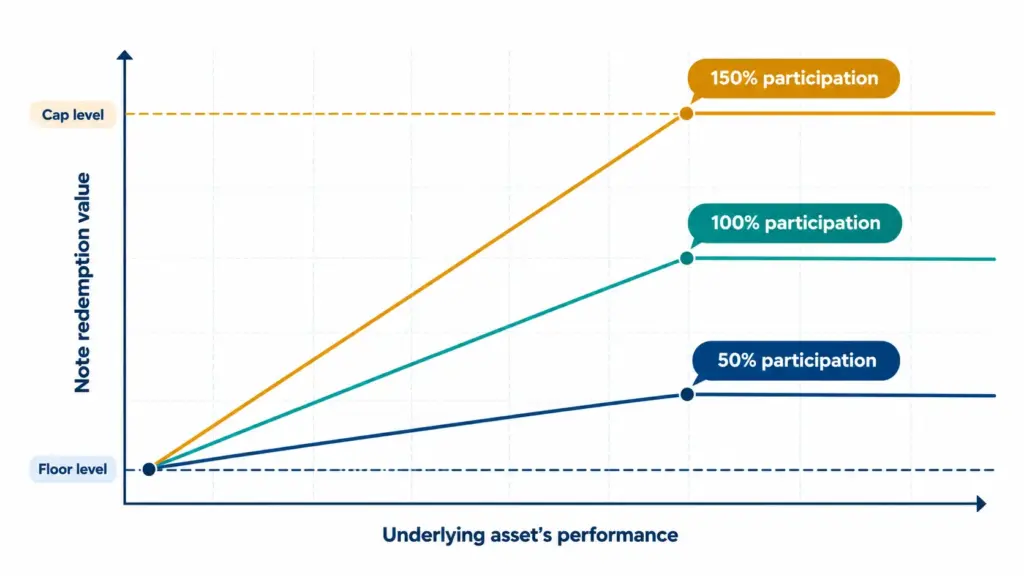
A linear payoff structure is a structured note whose value at maturity rises or falls in proportion to the performance of its underlying asset. With a 100 percent participation rate, a 10 percent move in the underlying produces roughly a 10 percent move in the payoff, before costs. Plotted on a chart, the result is a straight line.
The underlying asset can be a single stock, an equity index, a commodity, a currency pair or a basket of these. Because the payoff does not depend on whether a barrier was touched along the way, and does not switch on or off at a trigger level, investors can read the outcome directly from where the underlying finishes.
That simplicity is why linear notes are often the starting point when people learn about structured products. If you want the wider picture first, the structured products basics learning page explains how these instruments are assembled and why issuers design them.
How Does a Company Qualify as a Dividend Aristocrat?
At maturity, the note returns the invested amount adjusted by the underlying’s performance multiplied by the participation rate. A floor, if the note has one, sets the minimum redemption. A cap, if the note has one, sets the maximum. Between those two levels, the payoff stays a straight line.
The general calculation looks like this:
Redemption value = Nominal amount x [1 + Participation rate x (Final level / Initial level – 1)]
Three terms drive the result:
- Initial level is the price of the underlying on the strike date, which fixes the starting point for measuring performance.
- Final level is the price used at maturity, which may be a single closing price or an average of several observation dates.
- Participation rate is the share of the underlying’s move that the note passes on to the investor, and it sets the slope of the line.
A participation rate of 100 percent gives a slope of one, so the note moves one for one with the underlying. A rate of 50 percent gives a flatter line that passes on half of each move, while a rate of 150 percent gives a steeper line that magnifies each move. Where the note uses an average rather than a single final price, large last-minute swings have less influence on the outcome.
Build your understanding with a regulated partner
Explore the instruments available through PhillipCapital DIFC, a DFSA-regulated brokerage in Dubai.
What Is Inside a Linear Structured Note?
A linear structured note is usually a bond-like instrument combined with one or more derivatives. The bond element returns some or all of the principal, while the derivative element delivers exposure to the underlying asset. The issuer packages the two into one note with a single price and a single maturity date.
For a note with full or partial capital protection, the building blocks are typically a zero-coupon bond and a call option. The zero-coupon bond is bought at a discount and grows toward the protected amount at maturity. The money left over after buying that bond funds the call option, which supplies the upside participation.
This is also why participation rates differ from one note to the next. In general, higher interest rates make the bond portion cheaper, which leaves more budget for the option and can support a higher participation rate. Higher expected volatility in the underlying makes the option more expensive, which tends to reduce the participation rate. Longer terms and lower expected dividends on the underlying can also shift the terms.
For an unprotected tracker-style note, the structure is simpler because the note mainly delivers direct exposure to the underlying, with the issuer’s credit standing behind the promise to pay. The capital protection structures article explains how protection levels are built and what they cost in terms of upside.
What Are the Main Types of Linear Payoff Structures?
Linear payoffs come in several variations that differ in slope, floor and ceiling. The most common types are full participation trackers, partial participation notes, leveraged participation notes, capital-protected participation notes and capped participation notes. Each one changes how steeply the line rises and where it stops.
- Full participation tracker: This note passes on 100 percent of the underlying’s performance in both directions and carries no capital protection, so it behaves much like holding the underlying with an issuer’s promise attached.
- Partial participation note: This note passes on less than 100 percent of the upside, often in exchange for a floor or a lower cost, which gives the investor a flatter line.
- Leveraged participation note: This note passes on more than 100 percent of the upside, usually up to a cap, which magnifies gains but does not necessarily soften losses.
- Capital-protected participation note: This note sets a minimum redemption, such as the full nominal amount or a stated percentage of it, and participates in gains above the initial level. The partial capital protection guide covers the middle ground between full protection and none.
- Capped participation note: This note limits the maximum redemption, so the line rises until it reaches the cap and then flattens, which makes the full payoff a straight line with a ceiling.
When a floor or cap is added, the complete payoff chart has bends at those levels. Within each segment, however, the relationship between the underlying and the payoff is still linear.
What Does a Linear Payoff Look Like in a Real Scenario?
The table below uses simple, hypothetical numbers to show how three linear notes behave across different outcomes for the same underlying. The figures are illustrations only. They are not actual products, prices or returns, and they ignore fees, dividends, taxes and currency effects. They also assume the issuer meets its obligations.
All three notes start at a nominal value of 100 and run for three years:
- Note A is an unprotected tracker with 100 percent participation.
- Note B has full capital protection at maturity and 60 percent participation in gains.
- Note C has 150 percent participation in gains, a cap on redemption at 130, and one-for-one exposure to losses.
Hypothetical redemption value per 100 of nominal at maturity
| Underlying change over the term | Note A (tracker) | Note B (protected, 60% participation) | Note C (150% participation, capped at 130) |
|---|---|---|---|
| Down 30% | 70 | 100 | 70 |
| Down 10% | 90 | 100 | 90 |
| Unchanged | 100 | 100 | 100 |
| Up 10% | 110 | 106 | 115 |
| Up 20% | 120 | 112 | 130 |
| Up 40% | 140 | 124 | 130 |
Three lessons come out of the table. Note B never falls below 100 but gives up some upside for that comfort. Note C beats the tracker for moderate gains, then stops improving once the cap is reached. Note A is the most transparent but offers neither a floor nor a ceiling.
Investors comparing real notes should also remember that protection applies at maturity. Selling before then means accepting the market price of the note, which can be below the protected amount.
How Do Linear Payoffs Differ From Non-Linear Payoffs?
Linear payoffs change smoothly with the underlying’s final level, while non-linear payoffs change in jumps or depend on events along the way. Barrier-based and autocallable notes are common non-linear examples because outcomes can shift sharply when a barrier is breached or a trigger level is reached.
Linear versus non-linear structured payoffs
| Feature | Linear participation note | Barrier-based note | Autocallable note |
|---|---|---|---|
| Shape of payoff | Straight line, possibly with a floor or cap | Steps or kinks that depend on a barrier level | Fixed coupons or redemption linked to trigger levels |
| What drives the outcome | Final level of the underlying, or an average | Whether the underlying touches the barrier during the term | Whether the underlying meets the trigger on observation dates |
| Early redemption | Not usually built in | Not usually built in | Often built in, which can end the note before maturity |
| Ease of understanding | High, since each move maps to a payoff | Moderate, since path matters | Lower, since several features interact |
The practical difference is predictability. With a linear note, an investor can sketch the payoff on paper and estimate the result at any final level. With barrier features, two investors holding similar notes can see very different outcomes depending on the path the market took. The barrier levels and types article explains how knock-in and knock-out levels change that picture.
What Risks Come With Linear Payoff Structures?
Linear notes are simpler than many structured products, but they are not risk-free. The main risks are market movement in the underlying, the issuer’s ability to pay, limited liquidity before maturity, embedded costs and the opportunity cost of giving up dividends or capping gains.
- Market risk: If the underlying finishes below the initial level and the note has no floor, the investor bears losses in proportion to the participation rate.
- Issuer credit risk: The note is a claim on the issuer, so even a protected note depends on the issuer being able to pay at maturity.
- Liquidity risk: The secondary market for a structured note may be thin, and the price offered before maturity can be well below the value at maturity.
- Cost and pricing opacity: Fees and the issuer’s margin are built into the note’s pricing, so the participation rate already reflects those costs even if no separate charge is shown.
- Dividend leakage: Many notes track the price of the underlying and not its total return, which means dividends paid along the way may not reach the investor.
- Capped upside: A cap limits gains in strong markets, so the investor may receive less than a direct holding would have delivered.
- Currency risk: If the note or the underlying is denominated in a currency different from the investor’s base currency, exchange rate moves can add to or reduce the result.
The Risk Warning page on the PhillipCapital DIFC website sets out the firm’s general risk disclosures.
Where Can Linear Structures Fit in a Portfolio?
Linear notes can suit investors who want a clear, rule-based way to gain exposure to a market while shaping the level of protection, upside or cost. Fit depends on risk profile, time horizon and the rest of the portfolio, so suitability should be judged before any investment is made.
In portfolio construction, structured notes are usually treated as a complement, not a replacement, for core holdings. A protected participation note may sit alongside bonds and equities for investors who value a floor and are comfortable giving up some upside. A tracker-style note may suit investors who want exposure to a specific index, sector or underlying asset basket in a defined wrapper with a fixed maturity.
Investors may consider matching the note’s term to their own time horizon, checking how its exposure overlaps with assets they already hold, and sizing the position so that a poor outcome would not derail their wider plan. Diversification across issuers, underlyings and maturities can also reduce reliance on any single outcome.
PhillipCapital DIFC provides access to wealth management and structured notes for eligible clients. Availability and suitability depend on client classification and product terms, and the firm’s Wealth Management and Structured Notes page gives an overview of the service.
Talk through structured note options with the Research Desk team
Learn how wealth management and structured notes are offered through PhillipCapital DIFC.
What Should Investors Check Before Choosing a Linear Note?
Before choosing a linear note, investors should read the term sheet for the participation rate, strike level, observation method, cap, floor, maturity, issuer and costs. These terms decide the slope and shape of the payoff line, so small differences can change the outcome materially.
- Participation rate: A higher rate looks attractive, but investors should check what was given up to obtain it, such as a cap, a lower floor or a longer term.
- Strike and observation method: The note may measure performance from a single starting day or an average, and that choice affects how sensitive the result is to short-term swings.
- Cap and floor levels: These set the maximum and minimum redemption, so they define the best and worst outcomes at maturity.
- Issuer and credit standing: Investors should note who the issuer is and how the note ranks if the issuer runs into difficulty.
- Total return versus price return: The term sheet should say whether dividends are included, because that can change the outcome for income-paying underlyings.
- Secondary market terms: Investors should look for any stated early exit arrangements and understand how the price before maturity is set.
- Currency and denomination: The note’s currency should be compared with the investor’s own spending and reporting currency.
A common mistake is to compare notes on participation rate alone. A 120 percent rate with a tight cap and a long term can be less useful than a 90 percent rate with a floor and a shorter term, depending on the investor’s view and goals. Another common mistake is to assume protection applies on any day, when it usually applies only at maturity.
Frequently Asked Questions (FAQs)
Can I lose money in a linear structured note?
Yes, if the note has no capital protection or only partial protection. An unprotected tracker loses value roughly in line with the underlying’s fall. Even a fully protected note carries issuer credit risk and can be worth less than the protected amount if sold before maturity.
Do linear structured notes pay dividends?
Often they do not. Many notes track the price of the underlying and not its total return, so dividends are usually reflected in the note’s pricing instead of being paid out. The term sheet states whether dividends are included.
Can a linear structured note be sold before maturity?
Sometimes, but there is no guarantee of a buyer or a fair price. Where an early exit is available, the price depends on the underlying’s level, interest rates, time left and the issuer’s creditworthiness, so it can differ from the amount payable at maturity.
Is a higher participation rate always better?
No. A higher participation rate often comes with trade-offs such as a cap, a lower floor, a longer term or higher costs. The rate should be assessed together with the other terms, not on its own.
Key Takeaways
Linear payoff structures turn the performance of an underlying asset into a straight-line outcome that investors can sketch, test and compare. The slope comes from the participation rate, and any floor or cap changes where the line starts and stops.
- The payoff at maturity depends on the final level of the underlying relative to its starting level, multiplied by the participation rate.
- Protection, participation and cost are linked, so gaining one usually means giving up another.
- Issuer credit risk, liquidity and capped gains apply even to simple notes.
- Reading the term sheet carefully is the most reliable way to avoid surprises.
Ready to take the next step?
Speak with PhillipCapital DIFC to ask questions about products, account opening and service options.
Disclaimer:
Trading foreign exchange and/or contracts for difference on margin carries a high level of risk, and may not be suitable for all investors as you could sustain losses in excess of deposits. The products are intended for retail, professional and eligible counterparty clients. Before deciding to trade any products offered by PhillipCapital (DIFC) Private Limited you should carefully consider your objectives, financial situation, needs and level of experience. You should be aware of all the risks associated with trading on margin. The content of the Website must not be construed as personal advice. For retail, professional and eligible counterparty clients. Before deciding to trade any products offered by PhillipCapital (DIFC) Private Limited you should carefully consider your objectives, financial situation, needs and level of experience. You should be aware of all the risks associated with trading on margin.
Rolling Spot Contracts and CFDs are complex instruments and come with a high risk of losing money rapidly due to leverage. 78% of our retail client accounts lose money while trading with us. You should consider whether you understand how Rolling Spot Contracts and CFDs work, and whether you can afford to take the high risk of losing your money.

One-Touch and No-Touch Features
One-Touch and No-Touch Features Table of Contents Introduction What Are...
Read More
Barrier Levels and Payoff Impact
Barrier Levels and Payoff Impact Introduction Structured products often look...
Read More
Continuous vs Discrete Observation
Continuous vs Discrete Observation Table of Contents Introduction What Does...
Read More


Barrier Levels and Types
Barrier Levels and Types Introduction Structured products are built around...
Read More
Contingent Conversion Features
Contingent Conversion Features Introduction Structured products have evolved considerably over...
Read More
Early Redemption Features
Early Redemption Features Table of Contents Introduction What Is an...
Read More
Coupon Payments in Autocalls
Coupon Payments in Autocalls Table of Contents Introduction What Is...
Read More
Observation Dates
Observation Dates Introduction If you have ever explored structured products...
Read More
Autocall Mechanics
Autocall Mechanics Introduction If you’ve come across the term “autocallable...
Read More
Autocallable Structures
Autocallable Structure Table of Contents Introduction What Is an Autocallable...
Read More
Knock-In and Knock-Out Features
Knock-In and Knock-Out Features Table of Contents Introduction What Are...
Read More

Participation Structures in Structured Products
Participation Structures Maximizing Market Opportunities: A Guide to Participation Structures...
Read More
Zero Capital Protection
Zero Capital Protection Understanding Zero Capital Protection: Risks, Rewards, and...
Read More
Full Capital Protection
Full Capital Protection Understanding Full Capital Protection in Structured Products:...
Read More
Partial Capital Protection
Partial Capital Protection Partial Capital Protection: The Strategic Bridge Between...
Read More
Capital Protection Structures
Capital Protection Structures Strategic Wealth Preservation: A Comprehensive Guide to...
Read More

How Structured Products Work
How Structured Products Work A Complete Guide for Investors Table...
Read More

Components of Structured Products
Components of Structured Products A Detailed Guide for UAE Investors...
Read More
Introduction to Structured Products
Introduction to Structured Products In today’s dynamic financial landscape, traditional...
Read More