

Leveraged Structures in Structured Products November 11, 2026 PhillipCapital DIFC...
Read MoreLeveraged Structures in Structured Products
Leveraged Structures in Structured Products: How They Work, Payoffs and Risks
Leveraged structures let an investor take a larger market position than the cash outlay alone would suggest. Inside a structured product, that amplification is built into the payoff formula, so a modest move in a share, index, currency or commodity can translate into a much larger gain or loss on the product.
This guide explains how leveraged structures are built, which types exist, how to calculate their payoffs with worked examples, and where the real risks sit. It also separates leverage inside a product from margin leverage in CFDs and futures, a distinction many first-time investors miss.
Everything here is educational. Terms differ by issuer, so every example uses hypothetical numbers to show mechanics, not to forecast outcomes.
Table of Contents
- What Are Leveraged Structures in Structured Products?
- How Does Leverage Work Inside a Structured Note?
- What Are the Main Types of Leveraged Structures?
- How Is the Payoff of a Leveraged Structure Calculated?
- What Happens When a Barrier Is Touched?
- How Do Leveraged Structures Differ From Margin-Based Leverage?
- Where Do Leveraged Structures Fit in Wealth Management and Structured Notes?
- What Are the Main Risks of Leveraged Structures?
- What Mistakes Do Investors Commonly Make, and What Are the Best Practices?
- Frequently Asked Questions About Leveraged Structures
- What Should Investors Take Away About Leveraged Structures?
What Are Leveraged Structures in Structured Products?
Leveraged structures are structured products that magnify the return, and the loss, of an underlying asset such as a share, index, currency or commodity. A one percent move in the underlying can produce a larger move in the product’s value. The amplification comes from built-in options or financing, not from a margin loan.
Three terms make the rest of this guide easier. The underlying is the asset the product tracks. The payoff is the amount the investor receives at maturity or on sale, written as a function of the underlying. Leverage, also called gearing, is the ratio between the percentage change in the product and the percentage change in the underlying. A leverage of 3 means a 2% move in the underlying produces roughly a 6% move in the product.
Leveraged structures sit at the high-risk end of the structured product range. Capital protection structures sit at the opposite end and prioritise returning principal, while yield enhancement structures trade some upside for income. The full spectrum is mapped in our guide to types of structured products.
How Does Leverage Work Inside a Structured Note?
A leveraged structure gets its amplification from options or financing bundled into the product. In a note, the issuer combines a bond component with extra options so the holder participates by more than one-for-one. In a turbo, the issuer effectively finances part of the underlying’s value, so the holder pays only the remaining portion.
Most structured notes are built from two blocks: a bond component that earns interest, and an option component that creates the market exposure. The interest earned, plus any option premium the issuer collects, forms what practitioners call the option budget. Leverage appears when that budget buys more call options than a one-for-one position would need.
Because the budget is finite, extra upside has to be paid for somewhere. The usual funding sources are:
- Lower capital protection: the investor accepts a smaller guaranteed floor so the budget can buy more upside options.
- A cap on gains: the investor gives up the highest part of the upside, and the issuer uses that sacrifice to pay for extra participation below the cap.
- Geared downside: the investor takes losses at a rate above one-for-one when the underlying falls, which funds higher upside participation.
- Forgone coupons: income that would otherwise be paid is redirected into option purchases.
Turbos finance leverage differently. The investor pays the gap between the underlying price and a financing level, and the issuer covers the rest. The cost of that financing is built into the product’s pricing over time.
Every leveraged note also carries the credit risk of its issuer, because the payoff is a promise made by the issuing bank, not a claim on the underlying asset itself.
See How Structured Notes Are Built
Explore the products and services PhillipCapital DIFC offers across global markets.
What Are the Main Types of Leveraged Structures?
The three most common leveraged structures are leveraged participation notes, turbo (knock-out) structures and constant leverage structures. Each amplifies exposure differently: through a participation rate above 100%, through issuer financing with a barrier, or through daily rebalancing to a fixed multiple.
Leveraged Participation Notes
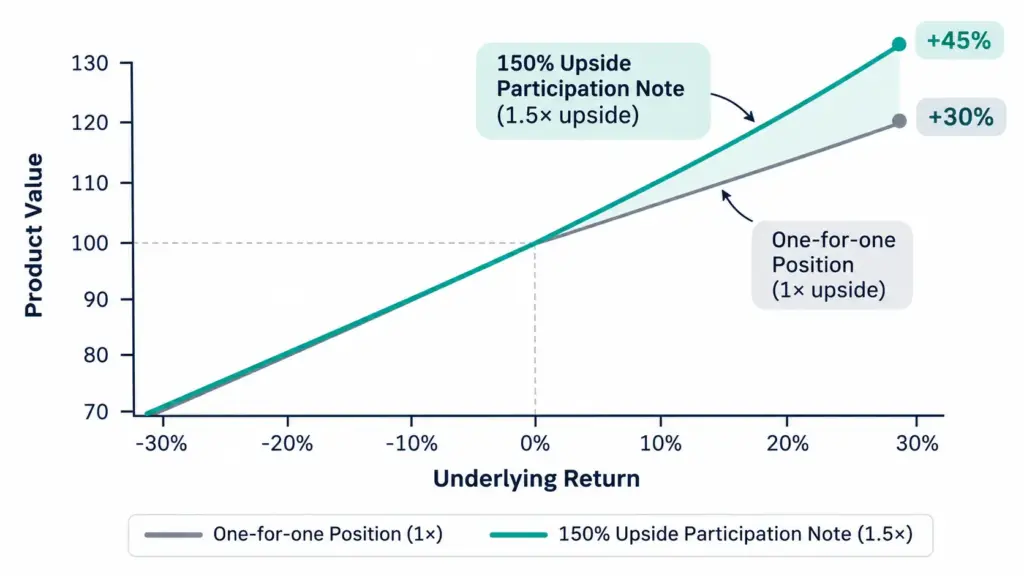
This note pays a percentage of the underlying’s performance, with the upside rate set above 100%. A 150% upside participation pays 1.5 points of return for each point the underlying gains. Many versions cap the gain or leave the downside ungeared. Our guide to participation structures covers the mechanics in more depth.
Turbo and Knock-Out Structures
A turbo has a financing level and a barrier. A long turbo gains when the underlying rises, and a short turbo gains when it falls. If the underlying touches the barrier, the product ends early and the holder receives either nothing or a small residual value, depending on design. The turbo structures guide explains the variations.
Constant Leverage Structures
These products, sometimes called factor structures, aim for a fixed multiple, such as 3x, of the underlying’s daily return. They rebalance every day, which keeps the ratio steady but makes the result depend on the path of prices. In choppy markets the product can lose value even when the underlying finishes near its starting level, which is why they suit short holding periods.
How Is the Payoff of a Leveraged Structure Calculated?
The payoff formula depends on the structure, so no single equation fits every product. For a leveraged note, redemption equals the notional multiplied by one plus the participation rate times the underlying’s return. For a turbo, value equals the multiplier times the gap between the underlying and the financing level.
Leveraged participation note at maturity. Let R be the underlying’s return over the note’s life, PR_up the upside participation rate and PR_down the downside participation rate.
- If R is zero or positive: Redemption = Notional x (1 + PR_up x R), reduced if a cap applies.
- If R is negative: Redemption = Notional x (1 + PR_down x R), never below zero.
These formulas assume no capital protection, no barrier, no fees and no issuer default. A protected version would add a floor, and a barrier version would change the downside rule.
The table below shows two hypothetical notes on a 100 notional with 150% upside participation. Structure A leaves the downside ungeared at 100%. Structure B gears the downside at 150% too.
| Underlying return | Structure A (150% up, 100% down) | Structure B (150% up, 150% down) |
|---|---|---|
| -30% | 70 | 55 |
| -10% | 90 | 85 |
| 0% | 100 | 100 |
| +10% | 115 | 115 |
| +30% | 145 | 145 |
Both notes gain identically on the way up but behave very differently on the way down, which is why the downside rate deserves as much attention as the headline upside rate.
Long turbo. Value = Multiplier x (Underlying – Financing level), floored at zero. Leverage = Underlying / (Underlying – Financing level). Suppose an index trades at 1,000, the financing level is 900 and the multiplier is 0.1. The turbo is worth 10 and carries leverage of 10 (1,000 divided by 100).
- If the index rises 5% to 1,050, the turbo is worth 15, a gain of 50%.
- If the index falls 5% to 950, the turbo is worth 5, a loss of 50%.
- If the index falls 10% to 900 and the barrier sits at the financing level, the turbo knocks out and the premium is lost.
The example ignores spreads and the gradual upward drift of the financing level, both of which affect real products.
Constant leverage over two days. Take a 2x daily-reset structure on an underlying that rises 10% on day one and falls 10% on day two. The underlying goes from 100 to 110 to 99, a loss of 1%. The structure goes from 100 to 120 to 96, a loss of 4%. The extra drag comes from daily compounding.
What Happens When a Barrier Is Touched?
A barrier is a preset price level that changes how the product behaves once the underlying touches it. In a turbo, touching the barrier ends the product. In some leveraged notes, a knock-in barrier switches on downside exposure only if it is breached. Barrier distance, observation method and gap risk all shape the outcome.
A knock-out barrier terminates the product, while a knock-in barrier activates a feature that was previously dormant. How close the barrier sits to the current price matters most: the closer it is, the higher the leverage and the likelier an early exit. Observation method matters too, since a barrier watched continuously can be triggered intraday, while one checked only on set dates cannot.
Gap risk arises when the market jumps past the barrier, for example overnight. The residual value returned to the holder is then based on where the issuer can unwind its hedge, which may be worse than the barrier level suggests. Our articles on barrier levels and types and knock-in and knock-out features cover these mechanics in detail.
How Do Leveraged Structures Differ From Margin-Based Leverage?
Leveraged structures embed amplification in the product’s design, usually with a premium paid upfront. Margin-based products such as CFDs and futures create leverage by letting the investor post a deposit against a much larger contract value. The loss profile, cost structure and holding horizon differ between the two.
The comparison below helps separate four common approaches. Product terms vary by issuer and provider, so the table describes typical features only.
Leveraged structures compared with margin-based leverage
| Feature | Leveraged participation note | Turbo (knock-out) | Constant leverage structure | CFD or futures position |
|---|---|---|---|---|
| Source of leverage | Extra options built into the payoff | Issuer finances part of the underlying through a financing level | Daily rebalancing to a fixed multiple | Margin deposit posted against full contract value |
| Typical loss limit | Amount invested, reached sooner if the downside is geared | Premium paid | Premium paid | Can exceed the deposit depending on account terms |
| Barrier or knock-out | Depends on the term sheet | Yes, central to the design | Issuer-specific, so check the documentation | Not part of the contract, though margin calls can close positions |
| Natural holding period | Fixed term to maturity | Short and tactical | Short, because of daily reset | Flexible |
| Ongoing cost | Embedded in pricing | Financing cost embedded in the financing level | Management fee and rebalancing cost | Spread plus financing or roll costs |
Investors who want to understand the margin side in more depth can start with the futures and options product page.
Where Do Leveraged Structures Fit in Wealth Management and Structured Notes?
Leveraged structures belong to the structured notes family within wealth management. They are usually considered as a small, tactical part of a portfolio for investors who understand the payoff and can tolerate large losses. Access typically depends on client classification, suitability checks and issuer availability.
PhillipCapital DIFC is regulated by the Dubai Financial Services Authority, and the DFSA public register entry lists structured products among the investments the firm deals in. The Wealth Management and Structured Notes page sets out how the firm approaches this product line. Investors should confirm current availability and eligibility directly, since not every structure is open to every client category.
In portfolio construction terms, a leveraged note is a satellite holding, not a core one. A core allocation might sit in bonds, diversified equities or capital protected notes, while a leveraged structure expresses a specific market view with a defined end date. Position sizing matters here: because the product can lose most or all of its value, investors may consider sizing it so that a total loss would not derail their wider financial plans.
Discuss Structured Notes With the PhillipCapital DIFC Team
Learn how client classification and suitability shape access to structured notes.
What Are the Main Risks of Leveraged Structures?
The main risks are amplified losses, issuer credit risk, knock-out and gap risk, path dependency, limited liquidity and cost drag. Because leverage works in both directions, a small adverse move can erase a large share of the amount invested. Each risk should be understood before investing.
- Amplified market risk: a leverage of 10 means a 10% adverse move in the underlying can wipe out the entire premium.
- Issuer credit risk: the payoff depends on the issuing institution’s ability to pay, regardless of how the underlying performs.
- Knock-out risk: a turbo can end permanently after a brief intraday spike, even if the market later recovers.
- Gap risk: prices can jump past a barrier, leaving a residual value below expectations.
- Path dependency: constant leverage products can lose value in volatile, sideways markets.
- Liquidity risk: secondary market prices depend on the issuer or a market maker, and spreads can widen in stressed conditions.
- Cost drag: financing, fees and bid-ask spreads reduce returns, and the effect grows the longer a position is held.
- Currency risk: if the underlying or the note is denominated in a different currency, exchange rate moves add another layer of volatility.
Regulators have taken these risks seriously. The Dutch Authority for the Financial Markets introduced a decision restricting turbos that caps leverage for retail offers and requires a standard risk warning stating that seven out of ten retail investor accounts lose money trading them. The European Securities and Markets Authority has also published an opinion on a German measure on turbos, describing them as high-risk leveraged products that expire immediately when a knock-out threshold is reached.
What Mistakes Do Investors Commonly Make, and What Are the Best Practices?
The most common mistake is focusing on the headline leverage figure while ignoring the downside rules, barrier and holding period. Sound practice starts with reading the term sheet, testing the payoff across several scenarios and sizing the position for a worst case.
Common mistakes include:
- Comparing only upside rates: a 150% upside rate sounds attractive, but the downside gearing and any cap can change the economics completely.
- Holding short-term products for the long term: turbos and constant leverage structures are designed for shorter horizons, and costs compound the longer they are held.
- Ignoring barrier distance: a barrier close to the current price makes an early exit much more likely.
- Overlooking issuer risk: the payoff is only as dependable as the institution behind it.
- Oversizing the position: a concentrated position in a high-leverage product can have outsized effects on the whole portfolio.
Best practices investors may consider include:
- Reading the full term sheet, including fees, barriers, observation dates and early termination terms.
- Running payoff scenarios for a rise, a fall and a sideways market before committing.
- Matching the product’s design horizon to the investor’s own view and time frame.
- Confirming the issuer’s credit standing and the secondary market arrangements.
- Reviewing the position regularly rather than treating it as a set-and-forget holding.
Frequently Asked Questions (FAQs)
What is a leveraged structured product?
A leveraged structured product is an investment whose payoff magnifies the movement of an underlying asset. It achieves this through embedded options, issuer financing or daily rebalancing. Gains and losses are both amplified, so the product carries a higher risk of significant loss than an unleveraged investment.
Can you lose more than you invest in a leveraged structure?
For notes and turbos bought outright, the loss is generally limited to the amount paid. The product’s value can fall to zero, but the holder does not usually owe more. Margin-based products such as CFDs and futures can behave differently, so the account terms should always be checked.
How is a turbo different from a leveraged note?
A turbo is a short-dated product with a financing level and a knock-out barrier, and it ends early if the barrier is touched. A leveraged note usually runs to a fixed maturity and pays according to a participation formula. Turbos are tactical, while notes are built around a set term.
Are leveraged structures suitable for long-term investing?
Most leveraged structures are designed for specific views over shorter periods, not for long-term holding. Financing costs, barrier risk and daily rebalancing effects can erode value over time. Suitability depends on the investor’s objectives, experience and risk capacity, and should be assessed individually.
Ready to Explore Leveraged Payoffs With Confidence?
Speak with the PhillipCapital DIFC team about your requirements.
What Should Investors Take Away About Leveraged Structures?
Leveraged structures amplify both gains and losses by building extra exposure into the product. The type of leverage, the downside rules, the barrier and the issuer all shape what an investor actually receives. Understanding the payoff formula before investing is the single most useful step.
The three main types, leveraged participation notes, turbos and constant leverage structures, solve different problems and carry different risks. Used thoughtfully and sized carefully, they can express a specific market view with a defined structure. Used without a clear understanding of the downside, they can lose value quickly.
Disclaimer:
Trading foreign exchange and/or contracts for difference on margin carries a high level of risk, and may not be suitable for all investors as you could sustain losses in excess of deposits. The products are intended for retail, professional and eligible counterparty clients. Before deciding to trade any products offered by PhillipCapital (DIFC) Private Limited you should carefully consider your objectives, financial situation, needs and level of experience. You should be aware of all the risks associated with trading on margin. The content of the Website must not be construed as personal advice. For retail, professional and eligible counterparty clients. Before deciding to trade any products offered by PhillipCapital (DIFC) Private Limited you should carefully consider your objectives, financial situation, needs and level of experience. You should be aware of all the risks associated with trading on margin.
Rolling Spot Contracts and CFDs are complex instruments and come with a high risk of losing money rapidly due to leverage. 78% of our retail client accounts lose money while trading with us. You should consider whether you understand how Rolling Spot Contracts and CFDs work, and whether you can afford to take the high risk of losing your money.

Inverse Floaters
Inverse Floaters Explained November 9, 2026 PhillipCapital DIFC Research Team...
Read More
Non-Linear Payoff Structures
Non-Linear Payoff Structures October 29, 2026 PhillipCapital DIFC Research Team...
Read More
Linear Payoff Structures
Linear Payoff Structures October 28, 2026 PhillipCapital DIFC Research Team...
Read More
One-Touch and No-Touch Features
One-Touch and No-Touch Features Table of Contents Introduction What Are...
Read More
Barrier Levels and Payoff Impact
Barrier Levels and Payoff Impact Introduction Structured products often look...
Read More
Continuous vs Discrete Observation
Continuous vs Discrete Observation Table of Contents Introduction What Does...
Read More


Barrier Levels and Types
Barrier Levels and Types Introduction Structured products are built around...
Read More
Contingent Conversion Features
Contingent Conversion Features Introduction Structured products have evolved considerably over...
Read More
Early Redemption Features
Early Redemption Features Table of Contents Introduction What Is an...
Read More
Coupon Payments in Autocalls
Coupon Payments in Autocalls Table of Contents Introduction What Is...
Read More
Observation Dates
Observation Dates Introduction If you have ever explored structured products...
Read More
Autocall Mechanics
Autocall Mechanics Introduction If you’ve come across the term “autocallable...
Read More
Autocallable Structures
Autocallable Structure Table of Contents Introduction What Is an Autocallable...
Read More
Knock-In and Knock-Out Features
Knock-In and Knock-Out Features Table of Contents Introduction What Are...
Read More

Participation Structures in Structured Products
Participation Structures Maximizing Market Opportunities: A Guide to Participation Structures...
Read More
Zero Capital Protection
Zero Capital Protection Understanding Zero Capital Protection: Risks, Rewards, and...
Read More
Full Capital Protection
Full Capital Protection Understanding Full Capital Protection in Structured Products:...
Read More
Partial Capital Protection
Partial Capital Protection Partial Capital Protection: The Strategic Bridge Between...
Read More
Capital Protection Structures
Capital Protection Structures Strategic Wealth Preservation: A Comprehensive Guide to...
Read More

How Structured Products Work
How Structured Products Work A Complete Guide for Investors Table...
Read More

Components of Structured Products
Components of Structured Products A Detailed Guide for UAE Investors...
Read More
Introduction to Structured Products
Introduction to Structured Products In today’s dynamic financial landscape, traditional...
Read More