

Non-Linear Payoff Structures October 29, 2026 PhillipCapital DIFC Research Team...
Read MoreNon-Linear Payoff Structures
Non-Linear Payoff Structures: How They Work and What Investors Should Know
Not all investments respond to market movements in the same way. While traditional investments such as shares generally move in line with the underlying asset, non-linear payoff structures produce returns that can change at specific price levels, depending on predefined conditions.
Commonly found in structured notes and derivative-based investments, non-linear payoff structures can include capped returns, capital protection, barrier conditions and early redemption features. These mechanisms allow investors to access different risk and return profiles, but they can also introduce complexity and unexpected losses.
Understanding how these structures work is essential before investing. This guide explains the different types of non-linear payoffs, how they are constructed, and how barriers, observation dates and market movements influence the final outcome. Through practical hypothetical examples, investors can learn what payoff diagrams reveal and which risks deserve closer attention.
This article is intended for educational purposes and does not constitute investment advice.
Table of Contents
- What Are Non-Linear Payoff Structures?
- How Does a Non-Linear Payoff Differ From a Linear One?
- Why Do Structured Notes Produce Non-Linear Payoffs?
- What Are the Common Non-Linear Payoff Shapes?
- How Does a Non-Linear Payoff Work in a Real Scenario?
- How Do Barriers and Observation Dates Change the Outcome?
- What Risks Come With Non-Linear Payoffs?
- What Mistakes Do Investors Often Make?
- How Can Investors Evaluate a Non-Linear Payoff Before Investing?
- What Is the Key Takeaway?
- Frequently Asked Questions
What Are Non-Linear Payoff Structures?
A non-linear payoff structure is an investment whose return does not move in a fixed proportion to the underlying asset. The payout may rise faster, slower or not at all across different price zones, and it can change abruptly at set trigger levels. Structured notes and options are the most common examples.
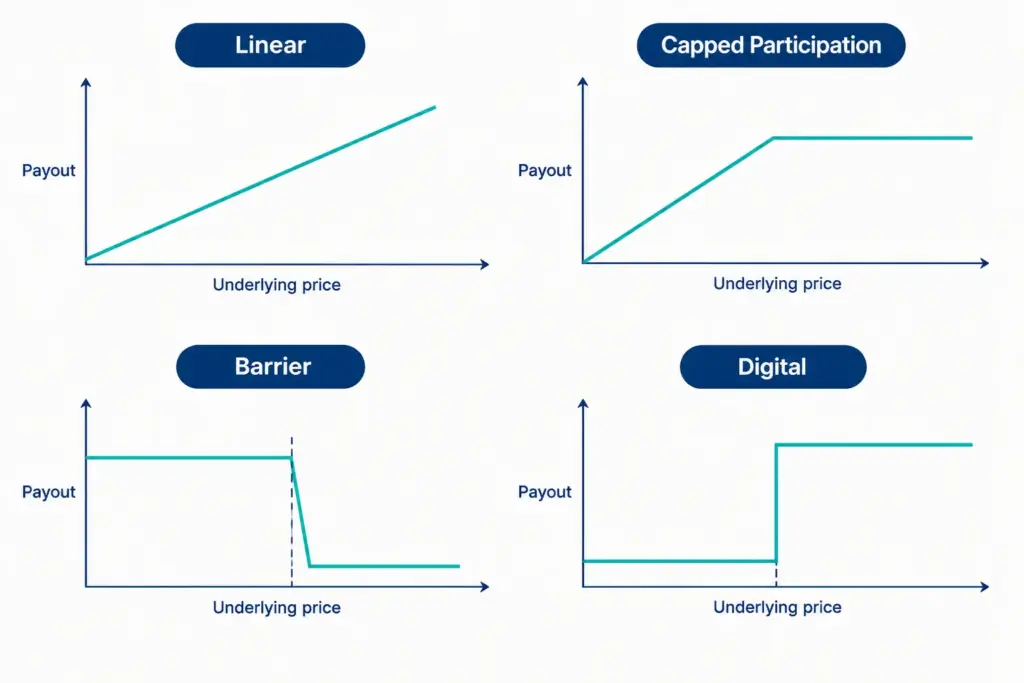
The word “payoff” simply means what the investor receives at maturity or expiry, compared with what was put in. Plot that result against the final price of the underlying asset, such as a stock index or a basket of shares, and you get a payoff diagram. A straight diagonal line is linear. Any diagram with a kink, a flat section, a step or a cliff is non-linear.
This matters because the shape of the line is the product. Two notes linked to the same index can behave very differently if one has a cap on gains and the other has a loss trigger. Reading the shape first, before looking at any headline feature, is the habit that separates informed investors from hopeful ones.
How Does a Non-Linear Payoff Differ From a Linear One?
A linear payoff changes one-for-one with the underlying asset, while a non-linear payoff changes by different amounts in different zones. Holding a share or a futures contract is linear. Holding an option or a structured note with caps, floors or barriers is non-linear.
Think of a linear payoff as a ramp with a constant slope, and a non-linear payoff as a staircase or a ramp with a bend. The table below sets the two side by side.
Linear vs Non-Linear Payoff Profiles
| Feature | Linear Payoff | Non-Linear Payoff |
|---|---|---|
| Shape of the payoff line | Straight diagonal line | Bent, flat, stepped or discontinuous line |
| Sensitivity to the underlying | Constant across all price levels | Varies by price zone, expiry and trigger levels |
| Typical instruments | Shares, ETFs, futures, spot FX | Options, structured notes, autocallables, barrier products |
| Gain and loss profile | Gains and losses usually mirror the market | Gains may be capped or leveraged; losses may be limited, delayed or sudden |
| Ease of understanding | Simple to visualise | Needs a payoff diagram and a read of the term sheet |
Neither type is better in every situation. Linear exposure is transparent but offers no built-in shaping of outcomes. Non-linear exposure lets an investor trade away some upside, or accept a specific risk, in return for a different outcome profile, as long as the trade-offs are fully understood.
Open a conversation with the desk before you decide
Speak with a PhillipCapital DIFC representative about which payoff profiles suit your investment objectives and risk profile.
Why Do Structured Notes Produce Non-Linear Payoffs?
Structured notes produce non-linear payoffs because they combine a bond-like component with one or more options. The bond element shapes the capital return, while the option element shapes how the note responds to the underlying asset. Different option mixes create different payoff shapes.
A structured note is usually assembled from two building blocks. The first is a debt component, which is intended to return some or all of the invested capital at maturity, subject to the issuer’s ability to pay. The second is a derivative component, often a call option or put option struck at a chosen level, which creates the link to the underlying asset basket. Readers new to options may find the options basics guide a useful companion here.
Because options themselves have kinked payoffs (a call option pays nothing below its strike price and rises above it), adding them to a bond bends the final line. Selling an option to fund another feature, such as a higher participation rate, adds a further bend elsewhere. The structured products basics guide walks through this assembly in more detail.
What Are the Common Non-Linear Payoff Shapes?
The most common non-linear shapes are capital-protected participation, capped participation, barrier or knock-in protection, autocallable redemption and digital payoffs. Each trades one feature for another, such as protection for a cap, or higher potential income for exposure to a loss trigger.
The table below compares them across the points investors usually care about. The types of structured products guide covers the wider family in more depth.
Common Non-Linear Payoff Shapes in Structured Notes
| Structure | How the Payoff Behaves | Main Benefit | Main Trade-Off |
|---|---|---|---|
| Capital-protected participation | Returns a set share of the underlying’s gains, with capital intended to be returned if the underlying falls | Defined floor on capital, if the issuer meets its obligations | Participation is often below 100%, and no income is typically paid along the way |
| Capped participation | Tracks gains up to a ceiling, then flat | Often allows a higher participation rate below the cap | Gains above the cap are given up |
| Barrier or knock-in protection | Capital returned in full unless the underlying touches a barrier level, after which losses follow the underlying | Protection that can absorb a moderate fall | Loss exposure can switch on suddenly if the barrier is breached |
| Autocallable | Redeems early if the underlying is at or above a trigger on an observation date | Potential for early redemption with defined payouts | Early redemption ends the investment, and a breach can bring loss exposure |
| Digital (binary) | Pays a fixed amount if a condition is met, nothing otherwise | Clear, fixed outcome | A small move across the trigger can change the result sharply |
A few points stand out from the comparison:
- Protection and upside usually pull in opposite directions, so a feature that adds one tends to cost some of the other.
- Discontinuous payoffs, such as barriers and digitals, create cliffs where a tiny market move can swing the result.
- Early redemption features change the time horizon, which affects what an investor can plan around.
See how structured notes fit a wider portfolio
Explore how PhillipCapital DIFC supports wealth management and structured notes for eligible investors.
How Does a Non-Linear Payoff Work in a Real Scenario?
A worked scenario shows the difference clearly. In a capped participation note, gains are shared until a ceiling is reached. In a barrier note, outcomes depend on whether a trigger level was touched. The figures below are hypothetical and are used only to illustrate the mechanics.
Scenario A: Capped participation note (hypothetical)
Assume an index starts at 100. The note offers 80% participation in the index’s rise, capped at a total gain of 40%, and capital is intended to be returned in full if the index ends below 100, subject to issuer credit.
- If the index ends at 110, the index has risen 10%, so the note returns 8% (80% of 10%).
- If the index ends at 160, the index has risen 60%. Eighty percent of that would be 48%, but the cap limits the return to 40%.
- If the index ends at 85, the investor receives the original capital back, with no gain.
The diagram for this note rises at a gentler slope than the index, then goes flat at the cap, with a floor under it. It is a clear example of a bent line.
Scenario B: Barrier note (hypothetical)
Assume the same starting level of 100 and a knock-in barrier at 60. If the index never trades at or below 60 during the term, capital is returned in full. If it does touch 60, protection falls away and the investor is exposed to the index’s final performance.
- If the index dips to 70 during the term and ends at 65, the barrier was never touched, so capital is returned in full.
- If the index dips to 55 and later recovers to end at 65, the barrier was touched, so the investor bears the 35% fall.
Both outcomes show the same final index level of 65, yet the results differ completely. That is the cliff effect of a discontinuous payoff, and it is why the next section matters.
How Do Barriers and Observation Dates Change the Outcome?
Barriers and observation dates decide when a trigger is tested. A barrier is a preset price level, and an observation date is the moment the level is checked. Whether a barrier is watched continuously or only on specific dates can change a note’s result even when the final price is identical.
Two design choices deserve attention:
- A knock-in barrier activates a feature, usually loss exposure, only if the underlying touches the level. A knock-out barrier cancels a feature, such as a coupon or participation, once the level is touched.
- Continuous observation checks the price throughout the term, while discrete observation checks only on fixed dates, so a temporary dip between those dates may not matter.
The distance between the starting level and the barrier is also critical. A barrier set far below the starting level gives a wider cushion, while one set close to it makes a trigger more likely. The PhillipCapital DIFC article on barrier levels and types and the barrier features guide explain how these choices affect payoff impact.
What Risks Come With Non-Linear Payoffs?
The main risks are market risk, issuer credit risk, liquidity risk and complexity risk. Non-linear payoffs can limit some outcomes but they do not remove risk. Any protection feature depends on the terms of the note and on the issuer’s ability to meet its obligations.
Investors should evaluate each of the following before committing capital:
- Issuer credit risk: A structured note is a debt obligation, so any capital protection depends on the issuer being able to pay at maturity.
- Market risk: If a barrier is breached or a trigger is missed, the investor may lose part or all of the invested capital.
- Liquidity risk: Many notes are designed to be held to maturity, and selling early may be difficult or may happen at an unfavourable price.
- Opportunity cost: Caps, limited participation and early redemption can mean giving up gains that a direct holding would have captured.
- Complexity risk: Layered features can hide how sensitive the outcome is to small market moves.
- Currency risk: Where the underlying asset or the note is denominated in a different currency, exchange-rate movements can affect the result.
What Mistakes Do Investors Often Make?
The most frequent mistakes are focusing on the best-case outcome, treating protection as a guarantee, ignoring issuer risk and skipping the payoff diagram. Most of these come from reading the headline feature rather than the full terms of the note.
- Reading only the upside case. A note’s maximum return is attractive on a brochure, but the downside and trigger conditions define the real risk.
- Assuming protection is absolute. Protection levels apply at specific dates and under specific conditions, and they rely on the issuer.
- Overlooking the barrier distance. A barrier that looks safe at the start can become close if markets move, so monitoring matters.
- Ignoring the holding period. Early exit prices can differ sharply from the amount payable at maturity.
- Concentrating in one underlying. A basket or index may behave differently from a single stock, and a single exposure raises the stakes of any trigger.
How Can Investors Evaluate a Non-Linear Payoff Before Investing?
Investors can evaluate a non-linear payoff by drawing or requesting the payoff diagram, testing it against several market scenarios, and reading the term sheet for triggers, caps, dates and issuer details. A structure should be matched to the investor’s risk profile and portfolio construction needs.
A simple review process looks like this:
- Identify the underlying asset or underlying asset basket and understand what drives it.
- Sketch the payoff diagram, marking any caps, floors, barriers and digital steps.
- Test at least three outcomes: a rising market, a flat market and a falling market, including a path where a barrier is touched and then recovered.
- Check the observation method, the observation dates and how early redemption works.
- Review the issuer, the currency and any fees, and confirm how the note can be sold before maturity.
- Consider how the note fits within existing holdings, including diversification and overall asset allocation.
Investors may consider discussing these steps with a qualified representative before making any decision, particularly where a note includes several layered features.
Test a structure against your goals
Review how derivatives-based strategies, including options, are accessed through PhillipCapital DIFC.
Key Takeaways
Non-linear payoff structures reshape how an investment responds to the market. They can add protection, cap gains, create income triggers or introduce cliffs, and every feature has a cost somewhere else in the payoff. The shape of the diagram, not the headline feature, tells the real story.
Investors may consider starting every review with the payoff diagram, testing it under different market paths, and checking the issuer and liquidity terms. A structure that is well understood can be a useful tool for portfolio construction. A structure that is not understood is a risk that is hard to size.
Frequently Asked Questions (FAQs)
What is an example of a non-linear payoff?
A call option is the simplest example. It pays nothing if the underlying asset ends below the strike price and increases as the asset rises above it. Structured notes with caps or barriers are also non-linear, because their returns change at set trigger levels.
Are non-linear payoff structures riskier than linear ones?
Not necessarily, but they are harder to assess. A capped note may limit upside, while a barrier note may bring sudden loss exposure. The risk depends on the specific terms, so investors should read the payoff diagram and term sheet before investing.
Do non-linear payoffs mean my capital is protected?
No, not automatically. Only notes that state a capital protection level offer it, and that protection depends on the issuer’s ability to pay and on the note being held to maturity. Many non-linear notes have no protection at all.
What is the difference between a knock-in and a knock-out barrier?
A knock-in barrier switches a feature on, usually loss exposure, when the underlying touches a level. A knock-out barrier switches a feature off, such as a coupon or participation, when the level is touched. Both are checked on the observation dates set in the terms.
Disclaimer:
Trading foreign exchange and/or contracts for difference on margin carries a high level of risk, and may not be suitable for all investors as you could sustain losses in excess of deposits. The products are intended for retail, professional and eligible counterparty clients. Before deciding to trade any products offered by PhillipCapital (DIFC) Private Limited you should carefully consider your objectives, financial situation, needs and level of experience. You should be aware of all the risks associated with trading on margin. The content of the Website must not be construed as personal advice. For retail, professional and eligible counterparty clients. Before deciding to trade any products offered by PhillipCapital (DIFC) Private Limited you should carefully consider your objectives, financial situation, needs and level of experience. You should be aware of all the risks associated with trading on margin.
Rolling Spot Contracts and CFDs are complex instruments and come with a high risk of losing money rapidly due to leverage. 78% of our retail client accounts lose money while trading with us. You should consider whether you understand how Rolling Spot Contracts and CFDs work, and whether you can afford to take the high risk of losing your money.

Linear Payoff Structures
Linear Payoff Structures October 28, 2026 PhillipCapital DIFC Research Team...
Read More
One-Touch and No-Touch Features
One-Touch and No-Touch Features Table of Contents Introduction What Are...
Read More
Barrier Levels and Payoff Impact
Barrier Levels and Payoff Impact Introduction Structured products often look...
Read More
Continuous vs Discrete Observation
Continuous vs Discrete Observation Table of Contents Introduction What Does...
Read More


Barrier Levels and Types
Barrier Levels and Types Introduction Structured products are built around...
Read More
Contingent Conversion Features
Contingent Conversion Features Introduction Structured products have evolved considerably over...
Read More
Early Redemption Features
Early Redemption Features Table of Contents Introduction What Is an...
Read More
Coupon Payments in Autocalls
Coupon Payments in Autocalls Table of Contents Introduction What Is...
Read More
Observation Dates
Observation Dates Introduction If you have ever explored structured products...
Read More
Autocall Mechanics
Autocall Mechanics Introduction If you’ve come across the term “autocallable...
Read More
Autocallable Structures
Autocallable Structure Table of Contents Introduction What Is an Autocallable...
Read More
Knock-In and Knock-Out Features
Knock-In and Knock-Out Features Table of Contents Introduction What Are...
Read More

Participation Structures in Structured Products
Participation Structures Maximizing Market Opportunities: A Guide to Participation Structures...
Read More
Zero Capital Protection
Zero Capital Protection Understanding Zero Capital Protection: Risks, Rewards, and...
Read More
Full Capital Protection
Full Capital Protection Understanding Full Capital Protection in Structured Products:...
Read More
Partial Capital Protection
Partial Capital Protection Partial Capital Protection: The Strategic Bridge Between...
Read More
Capital Protection Structures
Capital Protection Structures Strategic Wealth Preservation: A Comprehensive Guide to...
Read More

How Structured Products Work
How Structured Products Work A Complete Guide for Investors Table...
Read More

Components of Structured Products
Components of Structured Products A Detailed Guide for UAE Investors...
Read More
Introduction to Structured Products
Introduction to Structured Products In today’s dynamic financial landscape, traditional...
Read More