

Basket Products in Structured Notes November 16, 2026 PhillipCapital DIFC...
Read MoreBasket Products in Structured Notes
Basket Products in Structured Notes: How Multi-Asset Payoffs Work
A structured note linked to one stock rises or falls with that one company. A basket product spreads the link across several assets, such as a group of shares, indices or commodities, and the note’s payoff depends on how that group performs. The way the group’s performance is measured changes the risk an investor takes more than almost any other design choice.
This guide explains what basket products are, how the main calculation methods differ (weighted average, worst-of and best-of), why correlation sits at the heart of pricing, and how barriers, coupons and capital protection interact with a basket. It also walks through two worked examples using illustrative numbers.
It is written for investors meeting multi-asset structured notes for the first time, and for those who want a clearer view of the trade-offs before reading a term sheet.
Table of Contents
- What Is a Basket Product in Structured Notes?
- How Does a Basket Structured Note Work?
- How Is Basket Performance Calculated?
- Why Does Correlation Matter So Much in Basket Products?
- How Do Baskets Work With Capital Protection, Coupons and Barriers?
- What Do Basket Payoffs Look Like in Real Scenarios?
- Where Do Basket Products Fit in the PhillipCapital DIFC Structured Notes Range?
- What Are the Benefits of Basket Products?
- What Risks Do Investors Need to Understand?
- What Mistakes Do Investors Make, and What Is Good Practice?
- Frequently Asked Questions About Basket Products
- Key Takeaways for Investors
What Is a Basket Product in Structured Notes?
A basket product is a structured note whose payoff is linked to a group of assets instead of a single one. The group, known as the underlying asset basket, may hold shares, indices, commodities or currencies. A formula in the term sheet converts the basket’s movement into coupons and the final amount repaid.
The word “basket” simply describes the reference group. The investor does not own the assets in it. Instead, the investor holds a note, and the US Securities and Exchange Commission explains in its investor bulletin on structured notes that these notes are unsecured debt obligations of the issuer. The basket only determines how much the issuer pays.
Baskets are usually built around a theme or a purpose. Common examples include:
- A single-sector equity basket gives exposure to several companies in one industry, so the note does not depend on one company’s results.
- A regional index basket links the payoff to indices from different markets, which spreads exposure across economies.
- A commodity basket references several commodities, such as precious and base metals, within one payoff.
- A mixed-asset basket combines different asset classes, which widens the range of influences on the result.
For a wider view of how structured products are built, the Structured Products Basics learning hub covers the core components.
How Does a Basket Structured Note Work?
A basket note pairs a bond-like component with a derivative that references the basket. Each asset’s starting level is recorded at the initial fixing date. On later observation dates, and at maturity, current levels are compared with those starting points, and the term sheet formula determines coupons and the redemption amount.
In practice, the life of a basket note follows a predictable sequence:
- Initial fixing. The issuer records the starting level of every asset in the basket. These levels become the 100% reference points.
- Weights and method. The term sheet states whether the basket uses fixed weights, the weakest asset, the strongest asset or another rule, as explained in the section on how basket performance is calculated.
- Observation dates. The note checks the basket on set dates, which may be periodic for coupons and early redemption, or only at maturity.
- Payoff determination. The formula decides whether a coupon is paid, whether the note redeems early, and how much capital is returned at maturity.
- The investor receives cash or, in some designs, the underlying shares, depending on the note’s terms.
Because the note is a debt obligation, every promised payment also depends on the issuer’s ability to pay. That credit exposure sits alongside the market exposure to the basket.
Understand Structured Note Payoffs Before You Commit
See how PhillipCapital DIFC describes structured notes, settlement terms and minimum funding.
How Is Basket Performance Calculated?
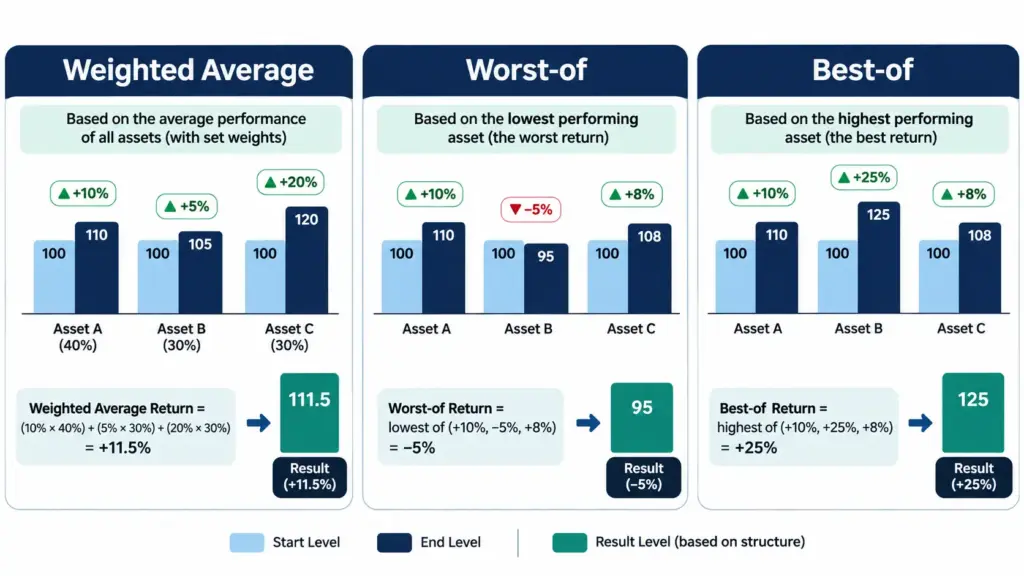
Basket performance is calculated by turning each asset’s final level into a percentage of its starting level, then combining those percentages using a rule. The three most common rules are the weighted average, the worst-of and the best-of. The rule chosen decides how much any single asset can help or hurt the investor.
For each asset, the starting point is the same simple ratio:
Performance level = Final price ÷ Initial price
A level of 110% means the asset finished 10% above its start. A level of 85% means it finished 15% below. The methods below differ only in how these levels are combined.
Weighted average
The basket return is the sum of each asset’s return multiplied by its weight:Basket return = (w1 × R1) + (w2 × R2) + (w3 × R3) + …
Here R is each asset’s return (performance level minus 100%) and the weights add up to 100%. This formula assumes fixed weights and no rebalancing between the initial fixing and the final date. Strong assets offset weak ones, so a single poor performer is diluted by the rest.Worst-of
The basket level is the lowest performance level among all assets:Worst-of level = the lowest of (Final price ÷ Initial price) across the basket
Only the weakest asset counts, and strong assets cannot compensate for it. This method is common when coupon barriers, early redemption triggers or knock-in barriers are tested against the basket.Best-of
The basket level is the highest performance level among all assets. Only the strongest asset counts, and weaker assets are ignored. Because this rewards the single best outcome, it tends to be priced higher inside a note than an average basket.Less common variants
- A Himalaya structure records the best performer on each observation date and then removes it from the basket, so the final payoff reflects the recorded returns.
- A ranked (rainbow-style) basket assigns weights by rank, giving the largest weight to the best performer, the next largest to the second best, and so on.
Why Does Correlation Matter So Much in Basket Products?
Correlation measures how closely the assets in a basket move together, on a scale from -1 to +1. It matters because it changes how far one asset is likely to drift from the rest. For worst-of structures, low correlation raises downside risk. For average baskets, low correlation reduces basket volatility.
When assets move together, the weakest performer sits close to the average. When they move independently, the weakest performer is more likely to finish well below the others, and the strongest is more likely to finish well above them. That single idea explains most of the pricing behaviour of basket products.
All else equal, a worst-of note can be structured with richer terms, such as a higher coupon, because the investor accepts more downside exposure. An average basket behaves the opposite way: lower correlation means gains and losses offset more, which lowers basket volatility and changes the participation rate or cap an issuer can set. The option pricing ideas behind this are covered in Options Pricing and Greeks.
The table below compares how each basket type responds.
How Common Basket Payoff Types Compare
| Basket type | What drives the payoff | Effect of lower correlation (all else equal) | Main watch point |
|---|---|---|---|
| Weighted average | Combined return of all assets by weight | Lower basket volatility, because gains and losses offset | Strong assets can mask one weak asset |
| Worst-of | The weakest asset only | Higher chance that one asset finishes far below the rest | Downside is driven by the single laggard |
| Best-of | The strongest asset only | Higher chance that one asset finishes far above the rest | Inclusion usually makes other terms less generous |
| Single asset (reference point) | One asset | Not applicable | Concentration in one company or market |
Correlations are not fixed. They can shift over time and can rise in stressed markets, which may reduce the diversification benefit when investors most want it.
How Do Baskets Work With Capital Protection, Coupons and Barriers?
A basket is only the reference. The note’s other features decide how the basket result becomes money. Capital protection, participation rates, coupons, early redemption and barriers can each be tested against the whole basket or against individual assets. Investors should always check which measure each feature uses.
Capital protection with a basket
In a capital-protected participation note, the final payment typically follows this formula:
Redemption = Notional × [Protection level + Participation rate × max(0, Basket return)]
This formula applies only to capital-protected participation structures. It assumes protection applies at maturity, no cap on gains, and an issuer that meets its obligations. Partial and zero protection notes use different floors. The Linear Payoff Structures article explains how participation behaves, and Non-Linear Payoff Structures covers shapes that bend at barriers or caps.
Coupons and early redemption
Conditional coupons and early redemption (autocall) tests are often linked to the worst-of level. For example, a coupon may be paid only if the weakest asset is at or above a coupon barrier on an observation date. Other notes test the average basket instead, so the term sheet is the only reliable guide.
Barriers
A knock-in barrier is a level that, once breached, converts protected-style repayment into market-linked repayment. In a worst-of note, the barrier is usually tested against the weakest asset. Observation may be continuous or only on the final date, which can change the outcome materially. The Barrier Features hub explains knock-in and knock-out mechanics in detail.
What Do Basket Payoffs Look Like in Real Scenarios?
Two simple examples show how the same three assets can produce very different outcomes. In the first, an average basket softens one weak asset. In the second, a worst-of note ties the result to that weak asset. All figures are illustrative only and do not represent any real product, price or market data.
Scenario 1: Capital-protected note on an equally weighted basket
Notional: USD 100,000, with three assets (A, B, C) at one-third weight each.
Terms: 100% capital protection at maturity, 100% participation, no cap.
Final results: Asset A +24%, Asset B -12%, Asset C +6%.
Basket return = (24% – 12% + 6%) ÷ 3 = 6%.
Redemption = USD 100,000 × (100% + 100% × 6%) = USD 106,000.
If all three assets had finished lower, the formula would floor the redemption at USD 100,000, assuming the issuer meets its obligations. Asset B’s fall was absorbed by the others.
Scenario 2: Worst-of note with a knock-in barrier
Terms: no capital protection, knock-in barrier at 60% of initial levels, observed on the final date only. Coupons are ignored for simplicity.
Rule: if the worst-of level is at or above 60%, the notional is repaid in full. If it is below 60%, redemption equals notional times the worst-of level.
Case 1. Final levels: A 118%, B 92%, C 105%. The worst-of level is 92%, above the barrier, so redemption is USD 100,000.
Case 2. Final levels: A 110%, B 52%, C 98%. The worst-of level is 52%, below the barrier, so redemption is USD 100,000 × 52% = USD 52,000, a loss of USD 48,000 before any coupons.
Asset A finished 10% higher in Case 2, yet it did not help. Some notes settle by delivering shares of the worst performer instead of cash, so settlement terms should be checked in the term sheet.
Where Do Basket Products Fit in the PhillipCapital DIFC Structured Notes Range?
Basket references belong to the wider structured notes family offered by PhillipCapital DIFC under Wealth Management and Structured Notes. The product page describes notes that combine fixed-income features with derivatives and may link to an asset, index, interest rate or basket of instruments, with terms set note by note.
As listed on the product page at the time of writing, the range includes reverse convertibles, autocall notes with guaranteed coupons, autocall notes with conditional coupons, and customised structured products from US and non-US equities. The page also states a minimum funding of USD 50,000, cash settlement with custody provided, no leverage, and offline execution.
Basket features, eligibility and availability are confirmed individually, so investors interested in a multi-asset structure should discuss the specific terms with the team before deciding. Descriptions of reverse convertibles and autocallable notes are available in the learning hub on Types of Structured Products.
Talk Through a Multi-Asset Structure With Our Team
Ask how basket-linked terms, barriers and coupons would work for your objectives.
What Are the Benefits of Basket Products?
Basket products offer multi-asset exposure inside one note, which can reduce reliance on any single company or market. Structuring choices such as weights, calculation method and barriers let issuers tailor the risk and return profile. These benefits come with trade-offs that depend on how the basket is measured.
- A basket can reduce dependence on one issuer’s results when an average method is used, because one weak asset is partly offset by the others.
- A single note can express a theme, such as a sector or region, without requiring separate positions in each asset.
- Weights and calculation methods can be tailored, which lets the structure reflect a specific view or risk tolerance.
- Worst-of designs may support richer coupon terms than comparable single-asset notes, in exchange for more downside exposure.
- Defined payoff rules make the outcome in each scenario calculable from the term sheet before investing.
What Risks Do Investors Need to Understand?
The main risks are issuer credit risk, market losses on the basket, amplified downside in worst-of structures, limited secondary market liquidity and the complexity of the payoff formula. Capital protection, where offered, applies at maturity and depends on the issuer meeting its obligations.
- Issuer credit risk is highlighted in the SEC’s structured notes bulletin, which explains that any principal protection is only as reliable as the issuing institution, and that an issuer default can mean losing some or all of the investment.
- Market risk means the basket can fall, and notes without full protection can return less than the amount invested.
- Worst-of risk means one weak asset can drive the whole result, regardless of how the rest of the basket performs.
- Correlation risk means assets that looked independent can fall together in stressed markets, reducing diversification.
- Liquidity risk means selling before maturity may be difficult, because many structured notes do not trade on an exchange and may be sold at a discount.
- Call risk means some notes can be redeemed early by the issuer or through autocall, which may end the coupon stream before the investor expects.
- Currency risk can arise when basket assets are priced in different currencies from the note.
- Complexity risk means payoff formulas, barriers and observation rules can make value hard to estimate through the life of the note.
What Mistakes Do Investors Make, and What Is Good Practice?
Common mistakes include focusing on the headline coupon, overlooking which measure a barrier is tested against, and assuming a larger basket means lower risk. Good practice starts with reading the term sheet closely and matching the structure to a clearly defined objective and risk tolerance.
Typical mistakes:
- Treating a high coupon as the main feature, when it is often compensation for a specific risk.
- Assuming the basket is averaged, when the note is actually worst-of.
- Counting the number of assets as diversification, without checking how correlated they are.
- Ignoring observation style, such as continuous versus final-date barrier checks.
- Overlooking that protection applies at maturity, not on early sale.
Good practice that investors may consider:
- Identify the calculation method and read the exact formula in the term sheet.
- Check the weights, barrier levels and observation dates for each asset.
- Test the structure against a weak scenario for the worst asset, as in Scenario 2 above.
- Review the issuer’s credit standing and the note’s early redemption terms.
- Confirm that the holding period matches the note’s tenor, given limited resale options.
Frequently Asked Questions (FAQs)
Is a basket structured note safer than a single-asset note?
Not necessarily. An average basket can soften one weak asset, but a worst-of basket can be riskier than a single-asset note. Safety depends on the calculation method, barrier levels and issuer credit quality, so the term sheet matters more than the number of assets.
What happens if one asset in a basket falls sharply?
The effect depends on the method. In an average basket the fall is diluted by the other assets. In a worst-of note the fall drives the result, and a knock-in barrier breach can reduce redemption in line with that asset’s decline.
Do basket notes pass on dividends from the underlying shares?
Often they do not. Many notes track price performance only, so dividends paid by the underlying shares may not reach the investor directly. The term sheet states whether returns are measured on a price basis or a total return basis.
Can a capital-protected basket note still lose money?
Yes. Protection typically applies only at maturity, so an early sale can return less than the amount invested. It also depends on the issuer meeting its obligations, so an issuer default can lead to losses even in a protected structure
Explore Tailored Solutions for Funds and Family Offices
Learn how PhillipCapital DIFC supports institutional investors with bespoke market access.
Key Takeaways for Investors
Basket products link a note’s payoff to several assets, and the calculation rule is what defines the risk. Weighted average structures dilute single-asset moves, worst-of structures concentrate risk in the weakest asset, and best-of structures reward the strongest. Correlation, barriers, observation style and issuer credit risk all shape the real outcome.
Investors may consider reading the full term sheet, testing the payoff against adverse scenarios and confirming how the note fits their objectives before investing.
Disclaimer:
Trading foreign exchange and/or contracts for difference on margin carries a high level of risk, and may not be suitable for all investors as you could sustain losses in excess of deposits. The products are intended for retail, professional and eligible counterparty clients. Before deciding to trade any products offered by PhillipCapital (DIFC) Private Limited you should carefully consider your objectives, financial situation, needs and level of experience. You should be aware of all the risks associated with trading on margin. The content of the Website must not be construed as personal advice. For retail, professional and eligible counterparty clients. Before deciding to trade any products offered by PhillipCapital (DIFC) Private Limited you should carefully consider your objectives, financial situation, needs and level of experience. You should be aware of all the risks associated with trading on margin.
Rolling Spot Contracts and CFDs are complex instruments and come with a high risk of losing money rapidly due to leverage. 78% of our retail client accounts lose money while trading with us. You should consider whether you understand how Rolling Spot Contracts and CFDs work, and whether you can afford to take the high risk of losing your money.

Leveraged Structures
Leveraged Structures in Structured Products November 11, 2026 PhillipCapital DIFC...
Read More
Inverse Floaters
Inverse Floaters Explained November 9, 2026 PhillipCapital DIFC Research Team...
Read More
Non-Linear Payoff Structures
Non-Linear Payoff Structures October 29, 2026 PhillipCapital DIFC Research Team...
Read More
Linear Payoff Structures
Linear Payoff Structures October 28, 2026 PhillipCapital DIFC Research Team...
Read More
One-Touch and No-Touch Features
One-Touch and No-Touch Features Table of Contents Introduction What Are...
Read More
Barrier Levels and Payoff Impact
Barrier Levels and Payoff Impact Introduction Structured products often look...
Read More
Continuous vs Discrete Observation
Continuous vs Discrete Observation Table of Contents Introduction What Does...
Read More


Barrier Levels and Types
Barrier Levels and Types Introduction Structured products are built around...
Read More
Contingent Conversion Features
Contingent Conversion Features Introduction Structured products have evolved considerably over...
Read More
Early Redemption Features
Early Redemption Features Table of Contents Introduction What Is an...
Read More
Coupon Payments in Autocalls
Coupon Payments in Autocalls Table of Contents Introduction What Is...
Read More
Observation Dates
Observation Dates Introduction If you have ever explored structured products...
Read More
Autocall Mechanics
Autocall Mechanics Introduction If you’ve come across the term “autocallable...
Read More
Autocallable Structures
Autocallable Structure Table of Contents Introduction What Is an Autocallable...
Read More
Knock-In and Knock-Out Features
Knock-In and Knock-Out Features Table of Contents Introduction What Are...
Read More

Participation Structures in Structured Products
Participation Structures Maximizing Market Opportunities: A Guide to Participation Structures...
Read More
Zero Capital Protection
Zero Capital Protection Understanding Zero Capital Protection: Risks, Rewards, and...
Read More
Full Capital Protection
Full Capital Protection Understanding Full Capital Protection in Structured Products:...
Read More
Partial Capital Protection
Partial Capital Protection Partial Capital Protection: The Strategic Bridge Between...
Read More
Capital Protection Structures
Capital Protection Structures Strategic Wealth Preservation: A Comprehensive Guide to...
Read More
How Structured Products Work
How Structured Products Work A Complete Guide for Investors Table...
Read More
Components of Structured Products
Components of Structured Products A Detailed Guide for UAE Investors...
Read More
Introduction to Structured Products
Introduction to Structured Products In today’s dynamic financial landscape, traditional...
Read More