

Rainbow Products Explained November 18, 2026 PhillipCapital DIFC Research Team...
Read MoreRead Bond Ratings and Reports
How to Read Bond Ratings and Reports: What the Letters, Outlooks and Ratios Really Tell Investors
A bond rating squeezes months of credit analysis into a few characters, which is why it is often the first thing investors see on a bond screen and the last thing they question. Grades such as AAA, BBB- or BB+ carry real meaning, but they express an opinion about one kind of risk. They are not a verdict on whether a bond is a good holding.
This guide explains what bond ratings measure, how the main rating scales line up, and what outlooks and watches signal. It then walks through the parts of a rating report, the financial ratios worth checking, and how ratings relate to yield and price. A worked scenario and a step-by-step checklist near the end show how the pieces fit together.
The material suits investors at every level, from those meeting fixed income for the first time to professionals who want a structured way to review an issuer before considering a bond. It is educational only and does not recommend any security.
Table of Contents
- What Is a Bond Rating and What Does It Actually Measure?
- Who Issues Bond Ratings, and Why Can Agencies Disagree?
- How Do You Read the Rating Scale From AAA to D?
- What Do Outlooks and Watches Signal About a Rating?
- What Is Inside a Bond Rating Report?
- Which Other Documents Should Investors Read Alongside a Rating?
- How Do Ratings Connect to Yield and Price?
- What Are the Limits of Bond Ratings, and What Mistakes Should Investors Avoid?
- How Does PhillipCapital DIFC Support Investors Researching Bonds?
- How Can Investors Review a Bond Rating Step by Step?
- What Should Investors Take Away From Bond Ratings?
- Frequently Asked Questions About Bond Ratings
What Is a Bond Rating and What Does It Actually Measure?
A bond rating is a credit rating agency’s opinion of how likely an issuer is to repay its debt on time. It measures credit risk, meaning the chance of missed interest or principal payments. It does not measure price movements, liquidity or whether a bond suits a particular investor.
Agencies express that opinion as a letter grade. The ability to meet financial obligations is called creditworthiness, and a higher rating signals a lower assessed likelihood of default. According to the SEC’s investor bulletin on credit ratings, ratings are issued by third parties rather than by the issuer, and they apply to debt such as bonds and notes, not to shares.
Two kinds of rating appear in reports. An issuer rating assesses the overall creditworthiness of a company or government. An issue rating applies to one specific bond and can sit above or below the issuer rating, because factors such as seniority in the repayment order and whether the bond is backed by assets change the likely recovery if something goes wrong. Readers who are new to terms like coupon, maturity and par value can find the foundations in our Bond Basics learning hub.
What a rating does not tell you
A rating addresses credit risk only. The SEC notes that it does not capture several other risks, which investors need to assess separately:
- Market risk: bond prices move when interest rates change, even if the issuer’s creditworthiness stays the same.
- Liquidity risk: a bond may be hard to sell quickly at a fair price, regardless of its grade.
- Prepayment risk: an issuer may repay early, leaving the investor to reinvest at different rates.
- Price risk: a rating does not consider the price at which a bond is offered or sold.
Who Issues Bond Ratings, and Why Can Agencies Disagree?
Bond ratings come from independent credit rating agencies, most prominently S&P Global Ratings, Moody’s and Fitch Ratings. Each uses its own scale, definitions and methods, so two agencies can rate the same bond differently. Investors may consider comparing several agencies rather than relying on a single opinion.
Agencies differ in meaningful ways. Their definitions of each grade are not identical, their analytical approaches involve different degrees of judgment, and some focus on the likelihood of default while others also weigh the expected loss if a default occurs. Time horizons vary too. Some agencies aim for stable ratings over a longer view, while others respond to near-term events, which can make their ratings move more often, as the SEC explains.
Payment models add another layer. Many agencies, including the largest, are paid by the issuers they rate, which creates a potential conflict of interest. Agencies registered with the SEC are required by law to disclose and manage these conflicts. In practice, the sensible response is to read each agency’s published scale and methodology so that a BBB is interpreted the way its author intended.
See Which Global Markets You Can Access
Explore the full range of products available through PhillipCapital DIFC.
How Do You Read the Rating Scale From AAA to D?
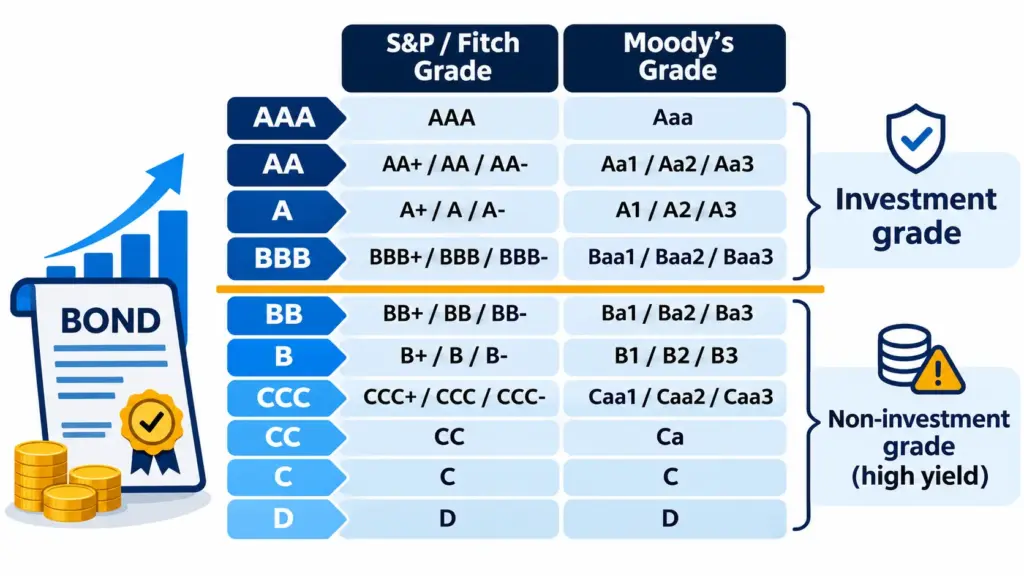
Ratings run from AAA at the top to D for default. Bonds rated BBB- or Baa3 and above are investment grade, while those below are non-investment grade, also called high yield. Plus and minus signs, or numbers on Moody’s scale, add finer steps within each letter band.
Credit Rating Scale at a Glance
| Band | S&P and Fitch | Moody’s | Broad meaning |
|---|---|---|---|
| Highest quality (investment grade) | AAA | Aaa | Strongest assessed capacity to meet financial obligations |
| High quality (investment grade) | AA | Aa | Very strong capacity, slightly below the top band |
| Upper medium (investment grade) | A | A | Strong capacity, more exposed to economic change |
| Lower medium (investment grade) | BBB | Baa | Adequate capacity, weaker in a downturn |
| Speculative (non-investment grade) | BB | Ba | Vulnerable to adverse conditions, the first band below the line |
| Highly speculative (non-investment grade) | B | B | Thin margin for error if conditions worsen |
| Substantial risk (non-investment grade) | CCC, CC, C | Caa, Ca, C | Default is a real possibility |
| Default | D | C is the lowest class | Obligations are in default or very close to it |
Each band is divided into finer steps called notches. S&P and Fitch add a plus or minus sign, so A+, A and A- are three notches within the A band. Moody’s uses the numbers 1, 2 and 3, so Baa1, Baa2 and Baa3 sit within the Baa band. The dividing line between investment grade and non-investment grade falls between BBB- and BB+ on the S&P and Fitch scales, and between Baa3 and Ba1 on Moody’s scale.
Why the investment grade line matters
A bond rated BBB- sits just one notch above that line. If it is downgraded to BB+, the issuer becomes a fallen angel, a term for an issuer that has dropped from investment grade into high yield. The reverse move, from high yield up into investment grade, creates a rising star. Because some investment mandates restrict holdings to investment grade securities, crossing the line can change who is allowed to hold the bond, which can affect trading and prices.
What Do Outlooks and Watches Signal About a Rating?
An outlook shows the likely direction of a rating over the medium term, while a watch flags a possible near-term change after a specific event. Neither guarantees a move, and rating changes can occur without warning. Investors may treat them as early signals worth investigating, not as predictions.
- A positive outlook indicates that the rating may be raised over time.
- A negative outlook indicates that the rating may be lowered over time.
- A stable outlook indicates that no change is currently expected.
- A developing or evolving outlook indicates that the rating could move in either direction depending on events.
- A rating watch, sometimes called a review, signals that a rating may change soon after an event such as an acquisition, a regulatory ruling or a financing announcement.
These alerts are formal, yet they are not promises. The SEC points out that rating changes can happen at any time and at any rating level, and that alerts may not come before every rating action. When an outlook changes, the useful question is what drove the change. How a downgrade can feed into price is covered under How Do Ratings Connect to Yield and Price?.
What Is Inside a Bond Rating Report?
A rating report explains the reasons behind the letter grade. It typically covers the issuer’s business profile, financial strength, debt structure, key credit strengths and risks, and the outlook. Reading the rationale matters more than reading the grade alone, because the reasons reveal what could change the rating.
Start with the rationale, not the grade
The rationale usually separates credit strengths from credit risks. A strong market position may support a rating, for example, while heavy borrowing may hold it back. Reports often outline what developments could lead the agency to raise or lower the rating, and those triggers are a practical guide to what an investor may want to monitor.
Financial ratios commonly cited for corporate issuers
Corporate rating reports tend to lean on a handful of measures. These formulas apply to companies and are not used the same way for governments.
Leverage: Total debt divided by EBITDA (earnings before interest, taxes, depreciation and amortisation). A lower figure generally means debt is smaller relative to earnings.
Interest coverage: EBIT (earnings before interest and taxes) divided by interest expense. It shows how many times operating earnings cover the interest owed.
Free cash flow to debt: Cash left after operating costs and capital spending, measured against total debt. It indicates how quickly debt could be repaid from internal cash generation.
Liquidity: Cash and available credit lines compared with debts falling due in the next twelve months. It shows whether near-term obligations can be met without new borrowing.
Here is a simple illustration with hypothetical figures. A company reports EBIT of 400 million and interest expense of 100 million, so interest coverage is 4.0 times (400 divided by 100). If EBIT falls to 250 million while interest stays at 100 million, coverage drops to 2.5 times. A report that highlights this kind of sensitivity helps explain why an agency might attach a negative outlook.
Reading reports on governments
For sovereign bonds, agencies weigh different factors, such as the government’s fiscal position, debt burden, economic strength and institutional quality, rather than corporate profit measures. The leverage and coverage ratios above therefore should not be applied to a government issuer.
Structure, covenants and call terms
The terms of a bond can matter as much as the headline grade. Covenants are promises that restrict an issuer from actions that could weaken its ability to pay. Payment terms may allow an issuer to skip certain interest payments or pay in additional bonds instead of cash. Call provisions let an issuer repay early, in which case investors receive principal back but may be unable to reinvest at a similar rate, as the SEC bulletin on high-yield corporate bonds explains. Readers who want to go further into issuer financials can review our guide to fundamental analysis for bonds.
Which Other Documents Should Investors Read Alongside a Rating?
A rating should be read together with the bond’s prospectus or offering document, the issuer’s latest financial statements and the agency’s published methodology. Together these show the bond’s terms, the issuer’s current financial position and how the agency reached its view.
- Prospectus or offering document: describes the offering, the issuer’s financial condition, how proceeds will be used, the bond’s terms and its significant risks.
- Annual and interim financial statements: show debt levels, earnings and cash flow, which can be compared with the ratios quoted in the rating report.
- Rating scale definitions and methodology: registered agencies must publish these on their websites, so investors can see exactly what each grade is meant to convey.
- Agency performance statistics: registered agencies must post transition and default statistics each year, which help show how stable ratings have been within each category.
- Issuer announcements and news: events such as acquisitions, refinancing or profit warnings may have occurred since the last rating action.
Access varies. Many agencies make ratings available publicly, while detailed narrative reports may require a subscription, although some are free. Investors may also ask their broker or adviser which ratings are available for a specific bond.
How Do Ratings Connect to Yield and Price?
Lower-rated bonds generally offer higher yields to compensate investors for greater default risk, and the extra yield over a safer benchmark is called the credit spread. When a rating is cut, spreads often widen and the bond’s price tends to fall. Ratings and prices do not always move in step.
The credit spread equals a bond’s yield minus the yield on a government bond of similar maturity. As a hypothetical example, if a corporate bond yields 6.0% and a comparable government bond yields 4.5%, the spread is 1.5 percentage points. A wider spread signals that the market is demanding more compensation for credit risk, and bond prices can reflect worsening credit before an agency acts.
Ratings cover credit risk only, so interest rate risk sits on top of the picture. Prices and yields move in opposite directions, and longer-maturity bonds generally react more to rate changes. Our guide to bond duration and interest rate risk explains how to measure that sensitivity, and the Bond Pricing and Valuation hub covers yield calculations in detail.
Investment Grade and Non-Investment Grade Bonds Compared
| Feature | Investment grade | Non-investment grade (high yield) |
|---|---|---|
| Rating range | BBB- or Baa3 and above | Below BBB- or Baa3 |
| Typical yield | Generally lower | Generally higher, to compensate for added risk |
| Default risk | Lower assessed likelihood of default | Higher assessed likelihood of default |
| Typical issuers | Governments and companies with stronger credit profiles | Often highly leveraged, smaller or emerging companies |
| Liquidity | Generally easier to trade | May carry more liquidity risk |
| Behaviour in a downturn | Often seen as the safer holding | Prices can fall as investors move toward safer bonds |
What Are the Limits of Bond Ratings, and What Mistakes Should Investors Avoid?
Ratings are useful opinions, not guarantees. They can lag market events, differ between agencies and address credit risk only. Even AAA-rated instruments have defaulted. Investors may consider using ratings alongside their own research, never as a substitute for it.
Built-in limitations
Ratings are subjective: There is no standard, agreed way to measure how accurate they are.
Prediction based on assumptions: A rating is a prediction of the likelihood of repayment based on an agency’s models and assumptions, which may differ from other analysts’ views.
Different outcomes across sectors: Default and rating-change patterns are not consistent across sectors, so the same grade can imply different outcomes for corporate and municipal bonds.
Potential conflicts of interest: Issuer-paid rating models create potential conflicts of interest that investors should keep in mind.
Common mistakes
Treating AAA as risk-free: This ignores interest rate, liquidity and price risk, and the fact that top-rated instruments have occasionally defaulted.
Chasing a high yield: Doing so without reading about the issuer confuses compensation for risk with a free bonus.
Relying on one agency: This misses differences in methodology and time horizon that other agencies may reveal.
Ignoring outlooks and watches: This overlooks the early signals that often come before a rating change.
Confusing an issuer rating with a bond rating: This overlooks the effect of seniority, security and bond terms.
How Does PhillipCapital DIFC Support Investors Researching Bonds?
PhillipCapital DIFC offers access to government, corporate and sovereign bonds through its Bonds and Debentures product line. Bonds are settled in cash, held in custody and traded without leverage. Minimum funding depends on the bond, so investors should review current terms and risks with the firm before any decision.
The Bonds and Debentures product page describes settlement as cash only, with custody available, and states that leverage is not applicable because the investments are fully funded. Execution is offline. Indicative minimum funding is USD 50,000 for government bonds and for some corporate bonds, particularly in the US, while sovereign bonds and most non-US corporate bonds carry a higher minimum of USD 200,000. These terms can change, so confirming current details directly is advisable.
Because each bond has its own rating and terms, investors may consider asking for the rating from each agency, the date of the most recent rating action and the current outlook before evaluating a specific bond. The checklist in the next section turns that into a repeatable routine.
Explore Government, Corporate and Sovereign Bonds
Review product details for fixed income trading with a DFSA-regulated broker.
How Can Investors Review a Bond Rating Step by Step?
Start with what is being rated, then work through the grade, the outlook, the rationale, the ratios and the bond terms in that order. Finish by checking the risks that ratings leave out. This sequence keeps attention on the reasons behind a grade instead of the letters alone.
Confirm what is rated: The issuer or the specific bond, and where the bond sits in the repayment order.
Collect every available rating: Note any notch differences between agencies.
Check the investment grade position: See where the rating sits relative to the investment grade line and how many notches away it is.
Check the outlook or watch status: Read the stated reasons behind it.
Read the rationale: Summarise the main strengths and risks in a short note.
Compare the quoted ratios: Check them against the issuer’s latest financial statements, ideally across several years.
Review the prospectus: Look for covenants, call dates, payment terms, currency and maturity.
Assess the risks ratings leave out: Consider interest rate sensitivity, liquidity and the price paid.
Worked scenario: two hypothetical bonds
Consider two hypothetical bonds with similar maturities. Bond A is issued by an established utility rated A- with a stable outlook. Bond B is issued by a highly leveraged retailer rated BB+ with a negative outlook.
For Bond A, the rating points to a strong capacity to pay, so the more relevant questions concern price sensitivity, since a long maturity makes it more responsive to interest rate changes, and whether the yield reflects its credit quality.
For Bond B, the rating sits just below the investment grade line and the negative outlook suggests a further downgrade is possible. An investor evaluating it would examine interest coverage, liquidity, upcoming debt maturities and covenant protections, then weigh whether the higher yield compensates for the added default and liquidity risk.
Neither bond is better in the abstract. The answer depends on each investor’s objectives, risk tolerance and time horizon.
What Should Investors Take Away From Bond Ratings?
Bond ratings are best understood as a starting point for research. The letter grade summarises an agency’s view of credit risk, the outlook hints at direction, and the report explains the reasoning. Reading all three, alongside the bond’s own documents, gives a far fuller picture than the grade alone.
Investors may consider comparing agencies, tracking outlooks, checking the financial ratios behind each rating and remembering the risks a rating does not cover. Used this way, ratings support a disciplined review of credit quality without replacing independent judgment.
Frequently Asked Questions (FAQs)
What does a bond rating of BBB- mean?
BBB- is the lowest rating that still counts as investment grade on the S&P and Fitch scales. The equivalent on Moody’s scale is Baa3. A bond at this level sits one notch above the high yield category, so a downgrade would move it across the line.
Can a AAA-rated bond still lose money?
Yes. A top rating lowers the assessed chance of default but does not remove it, and instruments rated AAA have defaulted in the past. Even without a default, the price of a AAA bond can fall when interest rates rise or when it becomes harder to sell.
What happens to a bond’s price when it is downgraded?
A downgrade often pushes the price down, because investors typically demand a higher yield for the higher perceived risk. The effect can be larger when a bond falls out of investment grade. Prices sometimes move before the downgrade, since markets can anticipate credit problems.
Where can investors find a bond’s rating report?
Ratings are usually available on the rating agencies’ websites and through market data providers. Some agencies charge a subscription for detailed reports, while others publish them free. Investors can also ask their broker or adviser which ratings apply to a specific bond.
Have Questions About a Specific Bond?
Speak with the PhillipCapital DIFC team about eligibility, requirements and available bonds.
Disclaimer:
Trading foreign exchange and/or contracts for difference on margin carries a high level of risk, and may not be suitable for all investors as you could sustain losses in excess of deposits. The products are intended for retail, professional and eligible counterparty clients. Before deciding to trade any products offered by PhillipCapital (DIFC) Private Limited you should carefully consider your objectives, financial situation, needs and level of experience. You should be aware of all the risks associated with trading on margin. The content of the Website must not be construed as personal advice. For retail, professional and eligible counterparty clients. Before deciding to trade any products offered by PhillipCapital (DIFC) Private Limited you should carefully consider your objectives, financial situation, needs and level of experience. You should be aware of all the risks associated with trading on margin.
Rolling Spot Contracts and CFDs are complex instruments and come with a high risk of losing money rapidly due to leverage. 78% of our retail client accounts lose money while trading with us. You should consider whether you understand how Rolling Spot Contracts and CFDs work, and whether you can afford to take the high risk of losing your money.

Basket Products
Basket Products in Structured Notes November 16, 2026 PhillipCapital DIFC...
Read More
Leveraged Structures
Leveraged Structures in Structured Products November 11, 2026 PhillipCapital DIFC...
Read More
Inverse Floaters
Inverse Floaters Explained November 9, 2026 PhillipCapital DIFC Research Team...
Read More
Non-Linear Payoff Structures
Non-Linear Payoff Structures October 29, 2026 PhillipCapital DIFC Research Team...
Read More
Linear Payoff Structures
Linear Payoff Structures October 28, 2026 PhillipCapital DIFC Research Team...
Read More
One-Touch and No-Touch Features
One-Touch and No-Touch Features Table of Contents Introduction What Are...
Read More
Barrier Levels and Payoff Impact
Barrier Levels and Payoff Impact Introduction Structured products often look...
Read More
Continuous vs Discrete Observation
Continuous vs Discrete Observation Table of Contents Introduction What Does...
Read More


Barrier Levels and Types
Barrier Levels and Types Introduction Structured products are built around...
Read More
Contingent Conversion Features
Contingent Conversion Features Introduction Structured products have evolved considerably over...
Read More
Early Redemption Features
Early Redemption Features Table of Contents Introduction What Is an...
Read More
Coupon Payments in Autocalls
Coupon Payments in Autocalls Table of Contents Introduction What Is...
Read More
Observation Dates
Observation Dates Introduction If you have ever explored structured products...
Read More
Autocall Mechanics
Autocall Mechanics Introduction If you’ve come across the term “autocallable...
Read More
Autocallable Structures
Autocallable Structure Table of Contents Introduction What Is an Autocallable...
Read More
Knock-In and Knock-Out Features
Knock-In and Knock-Out Features Table of Contents Introduction What Are...
Read More

Participation Structures in Structured Products
Participation Structures Maximizing Market Opportunities: A Guide to Participation Structures...
Read More
Zero Capital Protection
Zero Capital Protection Understanding Zero Capital Protection: Risks, Rewards, and...
Read More
Full Capital Protection
Full Capital Protection Understanding Full Capital Protection in Structured Products:...
Read More
Partial Capital Protection
Partial Capital Protection Partial Capital Protection: The Strategic Bridge Between...
Read More
Capital Protection Structures
Capital Protection Structures Strategic Wealth Preservation: A Comprehensive Guide to...
Read More

How Structured Products Work
How Structured Products Work A Complete Guide for Investors Table...
Read More

Components of Structured Products
Components of Structured Products A Detailed Guide for UAE Investors...
Read More
Introduction to Structured Products
Introduction to Structured Products In today’s dynamic financial landscape, traditional...
Read More