

Credit Analysis of Bond Issuers November 26, 2026 PhillipCapital DIFC...
Read MoreCredit Analysis of Bond Issuers
Credit Analysis of Bond Issuers: How Investors Judge Whether a Borrower Can Repay
When you buy a bond, you are lending money, and your return depends on one thing above all: whether the borrower keeps its promise to pay. Credit analysis is the discipline that tests that promise before money is committed. It asks how likely the issuer is to pay on time, and how much could be lost if it does not.
This guide walks through the process step by step. You will learn what credit risk is, how credit ratings work and where they fall short, which financial ratios matter, how the legal structure of a bond changes the risk, and how to read credit spreads. A worked example with hypothetical figures shows how the pieces fit together.
The guide is written for first-time bond investors and for readers who want a more structured way to assess issuers. It is educational only and does not recommend any security.
Table of Contents
- What is credit analysis of a bond issuer and why does it matter?
- How is credit risk different from interest rate risk?
- How do credit ratings work, and can investors rely on them?
- Which factors do analysts examine when assessing an issuer?
- Which financial ratios matter most in credit analysis?
- How does bond structure affect repayment?
- How does credit analysis differ for corporate, bank and government issuers?
- What do credit spreads reveal about an issuer?
- How can an investor compare two issuers in practice?
- How can investors access bonds after completing their credit review?
- What mistakes should investors avoid in credit analysis?
- Conclusion
- Frequently asked questions
What is credit analysis of a bond issuer and why does it matter?
Credit analysis of a bond issuer is the process of judging whether a government, company or financial institution can pay its coupons on time and repay the principal at maturity. Analysts study cash flow, debt levels, business strength and bond terms to estimate the likelihood of default and the loss an investor could face.
A coupon is the regular interest payment a bond makes, and default means the issuer fails to make a payment it legally owes. A bondholder is a lender, not an owner. The best outcome is usually to collect every coupon and receive the face value back, so there is no share in the upside if the issuer does well. The downside, however, can be large if the issuer fails. That imbalance is why bond investors spend most of their effort studying what could go wrong.
Credit analysis matters for everyone who holds bonds, whether directly or through a portfolio. Two bonds can offer similar coupons and maturities yet carry very different chances of repayment. Readers new to the topic may find it helpful to start with the bond basics section of the PhillipCapital DIFC Learn centre before returning here.
How is credit risk different from interest rate risk?
Credit risk is the chance that an issuer fails to pay interest or principal as promised. Interest rate risk is the chance that a bond’s market price falls because yields rise. A bond can lose value from either cause, and the two often interact, so investors assess them separately.
Interest rate risk affects even the safest borrowers. A government bond with no realistic default risk can still fall in price when market yields climb. The sensitivity of a bond’s price to rate changes is measured by duration, which is covered in the bond duration and interest rate risk guide. Credit risk, by contrast, is specific to the borrower and is the focus of this article.
Credit risk shows up in several distinct ways:
- Default risk is the possibility that the issuer misses a coupon or principal payment and cannot cure the failure.
- Downgrade risk is the possibility that a rating agency lowers the issuer’s rating, which usually pushes the bond’s price down even if no payment is missed.
- Credit spread risk is the possibility that the extra yield investors demand over government bonds widens, which reduces the bond’s market value.
- Recovery risk is the possibility that, after a default, bondholders recover only a portion of what they are owed.
See how a regulated broker approaches fixed income
Speak with the PhillipCapital DIFC team about bonds and debentures for Retail, Professional and Institutional clients.
How do credit ratings work, and can investors rely on them?
A credit rating is an independent agency’s opinion of an issuer’s ability to meet its debt obligations, shown on a scale from AAA down to D. Ratings give investors a fast starting point, but they are opinions, they can lag events, and they should not replace the investor’s own review.
Rating agencies analyse an issuer’s finances, business and debt terms, then assign a letter grade. On the commonly used scale, the grades run from AAA, AA, A and BBB through BB, B, CCC, CC and C, with D meaning default. The SEC’s Investor Bulletin on credit ratings explains that, on some agencies’ scales, a rating of BBB- or higher is investment grade, while anything lower is non-investment grade, also called speculative or high yield. Moody’s uses a different lettering style, where the equivalent dividing line is Baa3.
Ratings are useful, but investors should understand their limits:
- Ratings are opinions, not guarantees, so a highly rated issuer can still default and a lower-rated issuer can still pay in full.
- Ratings can lag the market, because agencies review issuers periodically and bond prices often move before a rating action is announced.
- Agencies can disagree, since each uses its own methodology, so the same issuer may carry different grades from different agencies.
- Outlooks and watch lists carry information, because a stable, positive or negative outlook signals the likely direction of the next rating change.
For a practical walkthrough of how to interpret rating scales and agency reports, see the PhillipCapital DIFC article on reading bond ratings and reports.
Which factors do analysts examine when assessing an issuer?
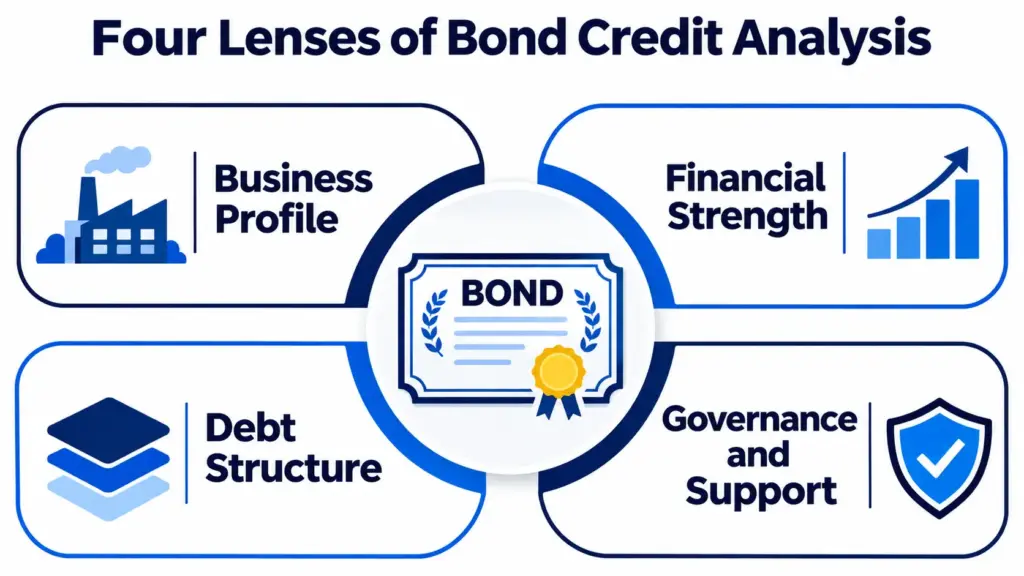
Analysts usually examine four areas: the issuer’s business profile, its financial strength, the structure of its debt, and the quality of its governance or outside support. No single area decides the outcome. A strong balance sheet can be undermined by weak management, and a weak business can sometimes be supported by a strong parent.
The four areas work as a checklist that keeps the analysis balanced:
- Business profile: the issuer’s industry, market position, revenue stability and exposure to economic cycles determine how reliable its cash flow is likely to be.
- Financial strength: profitability, leverage, cash generation and liquidity show whether the issuer can service its debt from its own resources.
- Debt structure: the mix of maturities, the ranking of each bond and the protections written into the contract determine how repayment is shared if trouble arises.
- Governance and support: management’s track record, ownership, financial policy and the likelihood of help from a parent or government influence how the issuer behaves under stress.
Qualitative judgement matters as much as arithmetic. An issuer with acceptable ratios but a record of aggressive acquisitions, frequent changes in financial policy or opaque reporting deserves a closer look. Analysts also compare the issuer with peers in the same sector, because what counts as healthy leverage in a stable utility would be risky in a cyclical industry.
Which financial ratios matter most in credit analysis?
Credit ratios turn financial statements into comparable measures of repayment capacity. The most widely used cover interest burden, leverage, cash generation and liquidity. Each ratio has a specific formula and works best when compared across several years and against similar issuers in the same sector, rather than read in isolation.
Two terms appear repeatedly. EBIT means earnings before interest and tax, a measure of operating profit. EBITDA adds back depreciation and amortisation, which are non-cash accounting charges, to approximate operating cash earnings. Free cash flow is the cash left after the business has paid for the investment it needs to keep operating.
Key credit ratios and how to read them
| Ratio | Formula | What it tells investors | What to watch for |
|---|---|---|---|
| Interest coverage | EBIT divided by interest expense | How many times operating profit covers the interest bill | Earnings can swing, so one strong year may flatter the result |
| Net debt to EBITDA | (Total debt minus cash) divided by EBITDA | Roughly how many years of earnings it would take to repay net debt | EBITDA ignores capital spending, and treatment of leases varies between issuers |
| Free cash flow to debt | (Operating cash flow minus capital expenditure) divided by total debt | How much cash is left after reinvestment relative to the debt load | Capital spending can be lumpy, and dividends or buybacks reduce the real cushion |
| Short-term liquidity | (Cash plus undrawn committed credit lines) divided by debt maturing within 12 months | Whether near-term obligations can be met without new borrowing | Credit lines may carry conditions, and market access can disappear under stress |
These formulas suit operating companies. Banks and insurers are analysed with different measures, as explained later in this guide, and no ratio has a universal pass mark. A level that is comfortable in one sector may be stretched in another. The PhillipCapital DIFC article on fundamental analysis for bonds shows how these statements connect to the wider economy and to issuer performance.
How does bond structure affect repayment?
Bond structure decides who gets paid first if an issuer struggles. Senior secured bonds rank ahead of senior unsecured bonds, which rank ahead of subordinated bonds. Two bonds from the same issuer can therefore carry different risk, which is why investors read the bond’s legal terms and not only the issuer’s rating.
In a default or restructuring, claims are generally settled in order of priority, with shareholders last. The actual recovery depends on the legal system, the assets available and the circumstances of each case, so it can never be assumed in advance. These features are worth checking in every bond:
- Seniority: a senior bond has a higher claim on the issuer’s assets than a subordinated bond, which generally compensates for its lower rank with a higher coupon.
- Security: a secured bond is backed by specific assets, which can improve recovery, while an unsecured bond relies on the issuer’s general ability to pay.
- Covenants: these are promises written into the bond contract, such as limits on additional borrowing, that give lenders an early warning or a remedy if the issuer’s finances weaken.
- Maturity profile: if a large share of an issuer’s debt falls due in the same period, it faces a refinancing deadline that can become a problem when markets are tight.
- Call features: a callable bond lets the issuer repay early, which can change both the expected return and the investor’s reinvestment position
How does credit analysis differ for corporate, bank and government issuers?
Credit analysis changes with the type of borrower. A corporate is judged mainly on operating cash flow, a bank on capital and funding, and a sovereign on its fiscal position and economic strength. Using one set of ratios for every issuer produces misleading conclusions.
How credit analysis differs by issuer type
| Issuer type | Main source of repayment | Metrics analysts emphasise | Distinctive risk |
|---|---|---|---|
| Corporate | Operating cash flow and access to refinancing | Interest coverage, leverage, free cash flow, liquidity | Business cycles, acquisitions and rising leverage |
| Bank or financial institution | Earnings, capital buffers and stable funding | Capital adequacy, asset quality, liquidity and funding mix | Loss of confidence or funding stress can develop quickly |
| Government-related entity | Own revenues plus the likelihood of state support | Standalone finances and the strength of the link to the government | Support is expected but is not always legally guaranteed |
| Sovereign | Tax revenue and the government’s capacity to borrow | Debt relative to the size of the economy, budget balance, external position, political stability | Debt in a foreign currency is riskier than debt in the government’s own currency |
The last point deserves a note. A government that borrows in its own currency can, in principle, create the money to repay, although doing so may cause inflation. A government that borrows in a foreign currency cannot, which is why analysts separate the two when assessing sovereign credit.
What do credit spreads reveal about an issuer?
A credit spread is the extra yield a bond pays over a comparable government bond to compensate investors for credit risk. A wider spread signals that the market sees more risk or demands more compensation. It is a useful market signal, but it is not a pure measure of default probability.
The formula is simple: credit spread = issuer bond yield minus the yield on a government bond of similar maturity. Spreads are quoted in basis points, where one basis point is one hundredth of a percentage point. As a hypothetical example, if a five-year corporate bond yields 6.0% and a comparable government bond yields 4.0%, the spread is 2.0 percentage points, or 200 basis points.
Spreads move for several reasons. They can widen because the issuer’s finances weaken, because investors become more cautious across the whole market, or because the bond is harder to trade. They also include compensation for features such as call options, so a wide spread does not automatically mean a high chance of default. To understand how yield and price relate, see the bond pricing and valuation section of the Learn centre.
Higher yield should be read as a price for risk rather than a bonus. The SEC notes in its bulletin on high-yield corporate bonds that these bonds generally offer higher yields than investment-grade bonds but carry a higher risk of default.
How can an investor compare two issuers in practice?
To compare two issuers, an investor can calculate the same set of ratios for each and then weigh them alongside business quality and bond terms. The following figures are hypothetical and exist only to show the method, not to represent any real company or market data.
Hypothetical comparison of two issuers (figures in millions of currency units)
| Measure | Company A | Company B |
|---|---|---|
| EBIT | 120 | 60 |
| Interest expense | 30 | 40 |
| Interest coverage (EBIT divided by interest) | 4.0 times | 1.5 times |
| Total debt | 600 | 900 |
| Cash | 100 | 50 |
| EBITDA | 250 | 150 |
| Net debt to EBITDA | 2.0 times | 5.7 times |
| Operating cash flow | 150 | 70 |
| Capital expenditure | 90 | 60 |
| Free cash flow | 60 | 10 |
| Hypothetical bond yield | 5.5% | 8.0% |
Company A covers its interest four times, carries modest net leverage and generates meaningful free cash flow. Company B covers interest only 1.5 times, would need nearly six years of EBITDA to repay its net debt, and keeps very little cash after investment. The higher yield on Company B’s bond reflects that thinner cushion.
The next steps would be to check when each issuer’s debt matures, how its bonds rank, whether covenants apply, and how each business performs in a downturn. An investor who stops at the yield comparison would miss most of the story. Investors should evaluate whether the extra yield adequately compensates for the added risk, in light of their own objectives and risk tolerance.
How can investors access bonds after completing their credit review?
Investors who complete their credit review may access bonds and debentures through a regulated broker. PhillipCapital DIFC is a DFSA-regulated brokerage in Dubai that offers a Bond and Debentures service. Product availability and eligibility may depend on the investor’s client classification and should be confirmed with the firm.
PhillipCapital DIFC serves Retail, Professional and Institutional clients, and the range of instruments open to each category can differ. Investors can review the Bond and Debentures service to understand how access works and what documentation is typically involved before they decide whether the product suits their circumstances.
Turn your credit research into an informed bond decision
Explore the Bond and Debentures service from a DFSA-regulated broker in Dubai.
What mistakes should investors avoid in credit analysis?
The most common mistakes are relying on a rating alone, choosing bonds mainly for yield, ignoring refinancing deadlines and overlooking bond terms. Avoiding these errors does not remove credit risk, but it helps investors make more informed decisions and size positions sensibly.
- Relying on the rating alone leaves investors exposed to changes that the agency has not yet reflected.
- Chasing the highest yield often means accepting a risk that the market has already priced in for a reason.
- Reading a single year of results can hide a deteriorating trend, so analysts prefer three to five years of data where available.
- Ignoring the maturity schedule can overlook a large repayment due when borrowing conditions are difficult.
- Skipping the bond’s legal terms means missing seniority, security and covenant details that determine recovery.
- Concentrating in one issuer or sector magnifies the damage if that credit fails, which is why diversification and position sizing remain central to risk management.
A few habits help investors avoid these errors. Review each issuer’s reports when they are published, watch for rating outlook changes and negative news, compare spreads with peers, and revisit the original reasoning for holding a bond whenever the facts change.
Conclusion
Credit analysis is the practice of asking whether a borrower can repay, how confident the answer is, and what happens if it cannot. Ratings, financial ratios, bond structure and spreads each add a piece of the picture, and none is sufficient alone. The strongest approach combines them with an understanding of the issuer’s business and a clear view of how the specific bond ranks.
Investors may consider building a repeatable routine: read the rating and outlook, calculate the core ratios, check the maturity profile and bond terms, and compare the spread with similar issuers. Over time, that routine makes it easier to separate genuine compensation for risk from yield that simply reflects trouble.
Frequently Asked Questions (FAQs)
What is the difference between a credit rating and credit analysis?
A credit rating is an agency’s summary opinion of an issuer, while credit analysis is the full process of examining the issuer’s finances, business and bond terms. The rating is one input into the analysis. Investors who do their own analysis can form a view that is more current and more specific to the bond they hold.
Does a higher-yielding bond always mean a riskier issuer?
Not always, but higher yield usually reflects higher perceived risk. A bond can also yield more because it is less liquid, has a longer maturity or contains features such as call options. Investors should examine the cause of the extra yield rather than assuming it is free compensation.
What usually happens to a bond's price when the issuer is downgraded?
The price usually falls, because investors demand a higher yield for the added risk. The size of the move depends on how much of the downgrade was already reflected in the market. Some downgrades cause little change, while others trigger sharp declines.
How often should investors review the credit quality of a bond issuer?
There is no fixed schedule, but a review at each reporting period and after any major event is a sensible habit. Rating actions, large acquisitions, changes in financial policy and unusual price moves are all reasons to look again. Investors in lower-rated bonds may need to monitor more closely.
Build a bond portfolio with a regulated partner
Talk to PhillipCapital DIFC about fixed income access, from Retail to Institutional.
Disclaimer:
Trading foreign exchange and/or contracts for difference on margin carries a high level of risk, and may not be suitable for all investors as you could sustain losses in excess of deposits. The products are intended for retail, professional and eligible counterparty clients. Before deciding to trade any products offered by PhillipCapital (DIFC) Private Limited you should carefully consider your objectives, financial situation, needs and level of experience. You should be aware of all the risks associated with trading on margin. The content of the Website must not be construed as personal advice. For retail, professional and eligible counterparty clients. Before deciding to trade any products offered by PhillipCapital (DIFC) Private Limited you should carefully consider your objectives, financial situation, needs and level of experience. You should be aware of all the risks associated with trading on margin.
Rolling Spot Contracts and CFDs are complex instruments and come with a high risk of losing money rapidly due to leverage. 78% of our retail client accounts lose money while trading with us. You should consider whether you understand how Rolling Spot Contracts and CFDs work, and whether you can afford to take the high risk of losing your money.

Read Bond Ratings and Reports
Read Bond Ratings and Reports November 24, 2026 PhillipCapital DIFC...
Read More
Fundamental Analysis for Bonds
Fundamental Analysis for Bonds November 20, 2026 PhillipCapital DIFC Research...
Read More

Repurchase Agreements (Repos)
Repurchase Agreement (Repo) Introduction Every day, banks, governments, and institutional...
Read More
Understanding the Money Market
Understanding the Money Market Introduction Every investor eventually asks the...
Read More

Bond Trading Mechanics
Bond Trading Mechanics Table of Contents Introduction What Does Bond...
Read More
Primary vs Secondary Bond Markets
Primary vs Secondary Bond Markets Table of Contents Introduction What...
Read More
Bond Market Structure and Participants
Bond Market Structure and Participants Table of Contents Introduction What...
Read More
Deferred Coupon Bonds
Perpetual Bonds Table of Contents Introduction What Are Deferred Coupon...
Read More

Inflation-Linked Bonds
Inflation-Linked Bonds Introduction Inflation is the silent tax that erodes...
Read More
Convertible Bonds Basics
Convertible Bonds Explained: Structure, Benefits, and Risks for Investors Table...
Read More
Callable and Putable Bonds
Callable and Putable Bonds Table of Contents Introduction What Is...
Read More


Municipal Bonds and Tax Implications
Municipal Bonds & Tax Implications Introduction When investors look for...
Read More
Corporate Bonds and Corporate Credit
Government Bonds & Treasury Securities Guide Table of Contents Introduction...
Read More
Government Bonds & Treasury Securities
Government Bonds & Treasury Securities Guide Introduction When markets get...
Read More

Prepayment Risk and Extension Risk
Prepayment Risk & Extension Risk in Bonds Understanding Prepayment Risk...
Read More
Liquidity Risk in Fixed Income
Liquidity Risk in Fixed Income Understanding Liquidity Risk in Fixed...
Read More

Interest Rate Risk Management
Interest Rate Risk Management Master Interest Rate Risk Management in...
Read More

Bond Duration & Interest Rate Risk Explained
Bond Duration & Interest Rate Risk Table of Contents Introduction:...
Read More
Macaulay Duration Explained
Macaulay Duration Explained Macaulay Duration Explained: A Comprehensive Guide for...
Read More
Modified Duration and Its Impact on Price
Modified Duration and Its Impact on Bond Prices Introduction Navigating...
Read More
Understanding Bond Duration
Understanding Bond Duration Introduction When stepping into the fixed-income market,...
Read More